

Forest and Grassland Resources Research ›› 2025›› Issue (2): 117-125.doi: 10.13466/j.cnki.lczyyj.2025.02.012
• Research paper • Previous Articles Next Articles
ZHU Yu1,2,3( ), LI Yanhong1,2,3(), YIN Shujing1,2,3, MIAO Guanghua1,2,3
Received:2024-12-11
Revised:2025-03-10
Online:2025-04-28
Published:2025-12-04
CLC Number:
ZHU Yu, LI Yanhong, YIN Shujing, MIAO Guanghua. Characteristics and influencing factors of soil carbon and nitrogen changes under different vegetation communities in the headwaters of the Irtysh River[J]. Forest and Grassland Resources Research, 2025, (2): 117-125.
Add to citation manager EndNote|Ris|BibTeX
URL: https://www.lyzygl.com.cn/EN/10.13466/j.cnki.lczyyj.2025.02.012
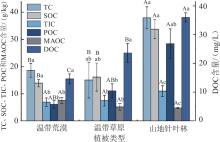
Fig.1
Soil carbon content under different vegetation types in river source district
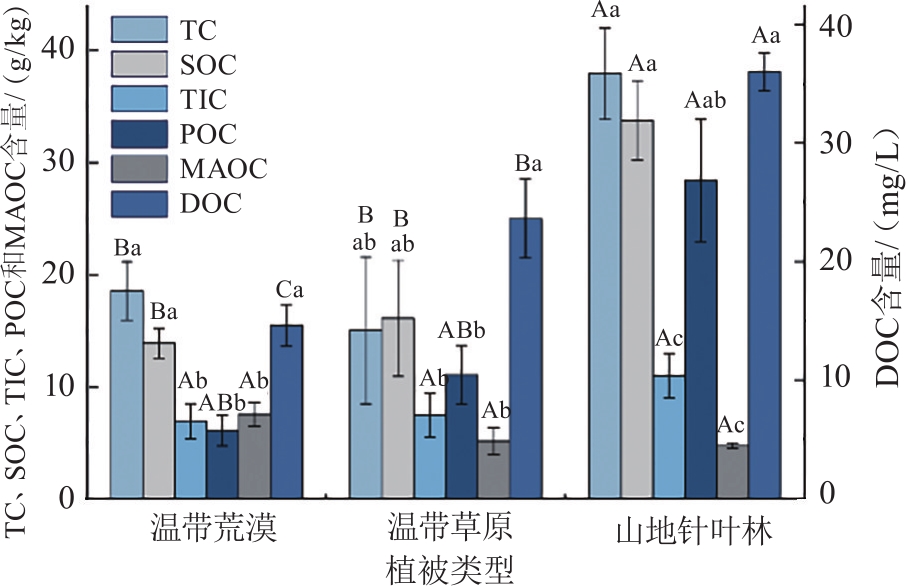
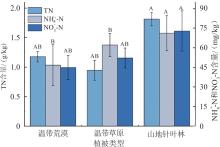
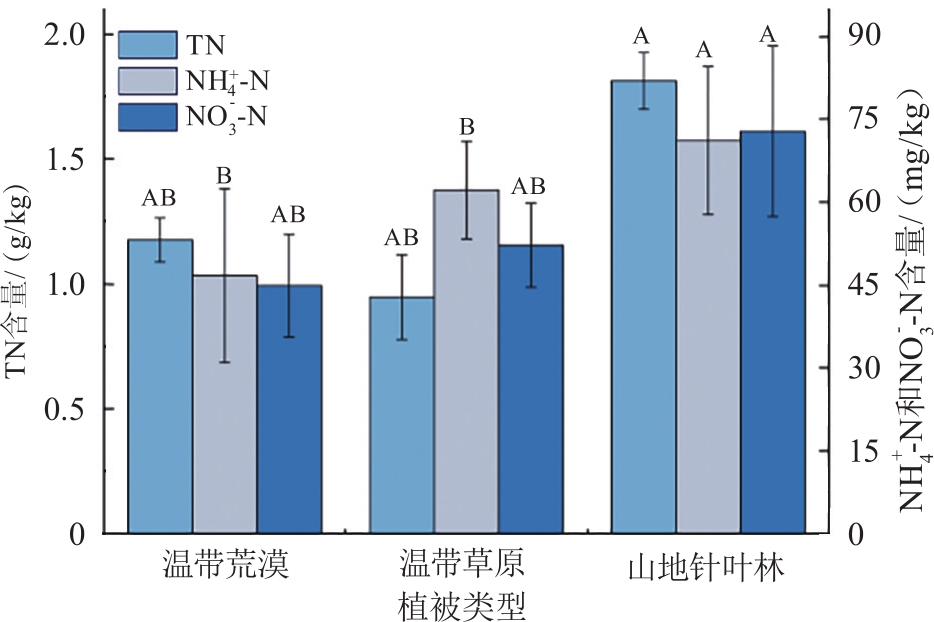
Fig.2
Soil nitrogen content under different vegetation types in river source district
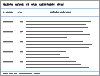
Tab.1
Differences in environmental factors in the source area of the Irtysh river
| 环境因子 | 温带荒漠 | 温带草原 | 山地针叶林 |
|---|---|---|---|
| 土壤温度(ST)/℃ | 30.39± 0.75* | 26.49± 1.06* | 16.67± 3.45* |
| 土壤含水率(SMC)/% | 5.04± 1.3* | 13.08± 2.4* | 11.27± 2.79* |
| 土壤pH | 6.96± 0.13 | 7.02± 0.84 | 6.71± 0.21 |
| 土壤盐分(SS)/(g/kg) | 2.18± 0.96* | 0.35± 0.06 | 0.38± 0.17 |
| 海拔高度(ALT)/h | 875.95±74.18* | 1 211.11±35.29* | 1 479.22±34.37* |
| 植被覆盖度(FVC)/% | 0.40± 0.04 | 0.47± 0.07 | 0.66± 0.03* |
| 叶面积指数(LAI) | 1.01± 0.18 | 1.29± 0.26 | 2.17± 0.2* |
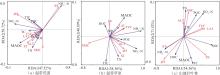
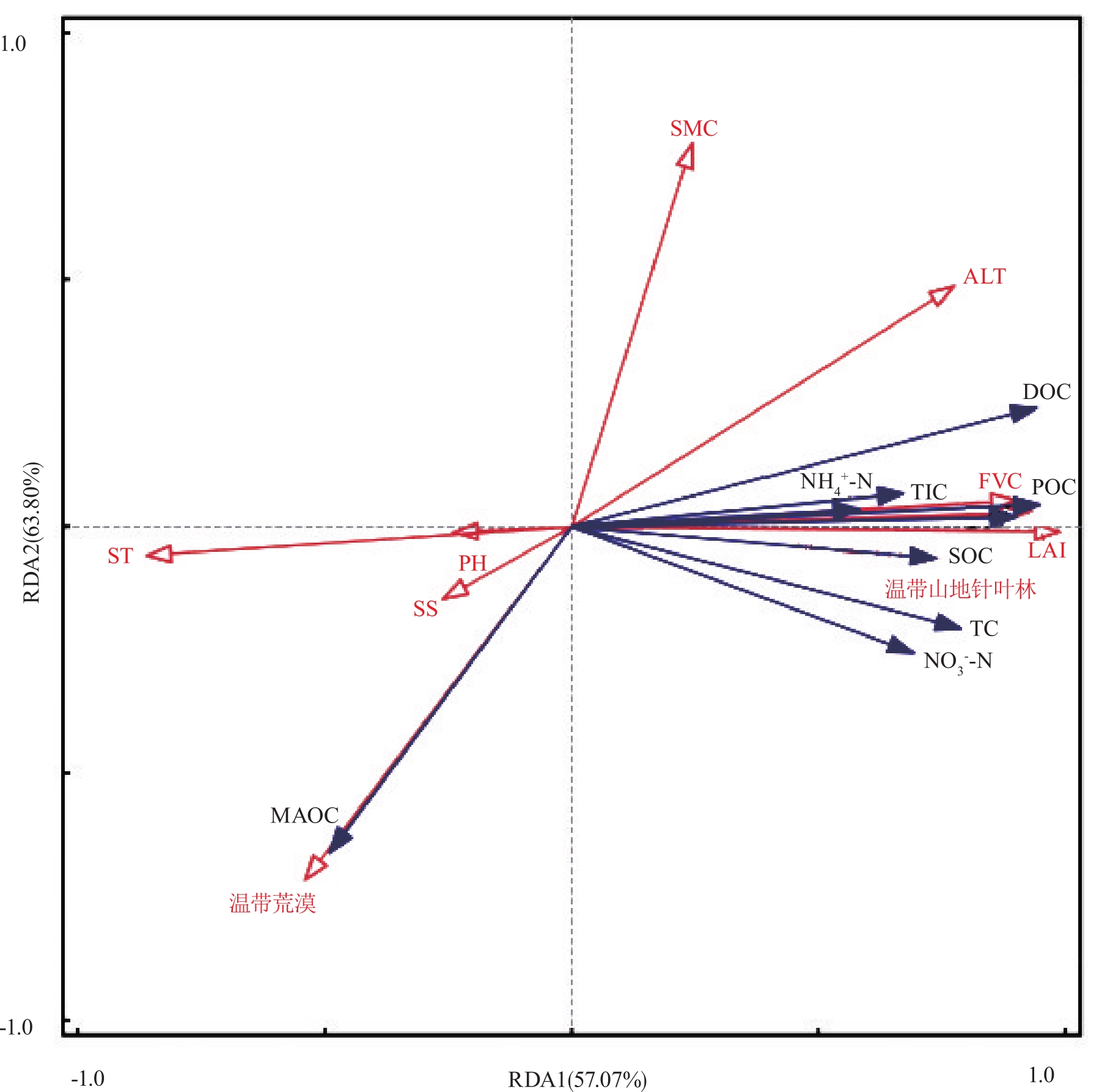
Fig.3
Analysis of soil carbon and nitrogen influencing factors under different vegetation types in river source district
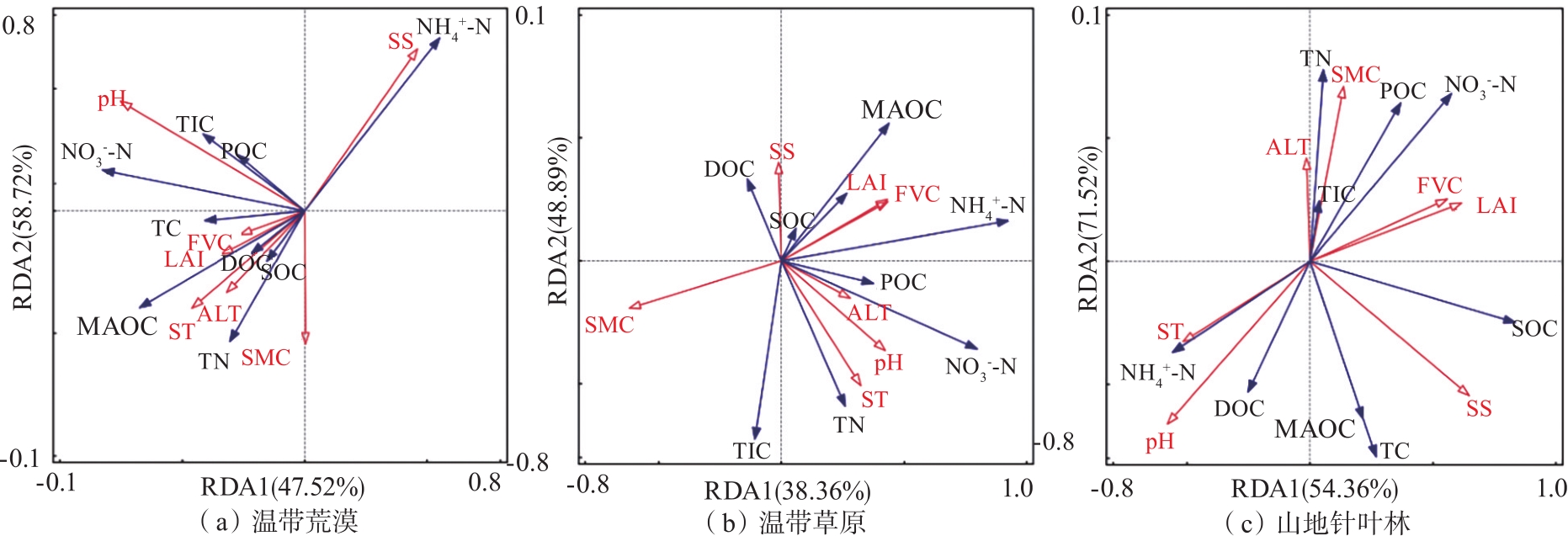
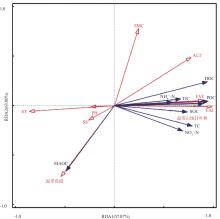
Fig.4
Analysis of soil carbon and nitrogen influencing factors in river source district
| [1] | 于贵瑞, 高扬, 王秋凤, 等. 陆地生态系统碳-氮-水循环的关键耦合过程及其生物调控机制探讨[J]. 中国生态农业学报(中英文), 2013, 21(1):1-13. |
| [2] | 刘长媛, 韩文昊, 田永任, 等. 鲁中南低山丘陵区土壤理化性质的空间分异及其遥感评估[J]. 山地学报, 2024, 42(4):442-455. |
| [3] | 成艺, 郭蓉, 支泽民, 等. 黄河流域河源区土地利用变化及其影响研究综述[J]. 资源科学, 2020, 42(3):446-459. |
| [4] |
刁二龙, 曹广超, 曹生奎, 等. 祁连山南坡不同土地利用方式下土壤碳氮含量及通径分析[J]. 干旱区研究, 2021, 38(5):1346-1354.
doi: 10.13866/j.azr.2021.05.16 |
| [5] | GALLOWAY J N, DENTENER F J, CAPONE D G, et al. Nitrogen cycles:Past,ppresent,and future[J]. Biogeochemistry, 2004,70:153-226. |
| [6] | 张晗, 欧阳真程, 赵小敏. 不同利用方式对江西省农田土壤碳氮磷生态化学计量特征的影响[J]. 环境科学学报, 2019, 39(3):939-951. |
| [7] |
潘红丽, 李迈和, 蔡小虎, 等. 海拔梯度上的植物生长与生理生态特性[J]. 生态环境学报, 2009, 18(2):722-730.
doi: 10.16258/j.cnki.1674-5906(2009)02-0722-09 |
| [8] | GUO Na, DEGEN A A, DENG Bin, et al. Changes in vegetation parameters and soil nutrients along degradation and recovery successions on alpine grasslands of the Tibetan plateau[J]. Agriculture,Ecosystems & Environment, 2019,284:106593. |
| [9] | TAN Qiqi, HAN Wenxuan, LI Xiran, et al. Clarifying the response of soil organic carbon storage to increasing temperature through minimizing the precipitation effect[J]. Geoderma, 2020,374:114398. |
| [10] | KLAMERUS-IWAN A, LINK T E, KEIM R F, et al. Storage and routing of precipitation through canopies[J]. Precipitation partitioning by vegetation:A global synthesis,2020:17-34. |
| [11] |
LIU Yuan, WANG Changhui, HE Nianpeng, et al. A global synthesis of the rate and temperature sensitivity of soil nitrogen mineralization:latitudinal patterns and mechanisms[J]. Global change biology, 2017, 23(1):455-464.
doi: 10.1111/gcb.13372 pmid: 27234363 |
| [12] |
沈贝贝, 张景, 李明, 等. 内蒙古草原叶面积指数时空格局与水热影响[J]. 遥感技术与应用, 2022, 37(1):253-261.
doi: 10.11873/j.issn.1004-0323.2022.1.0253 |
| [13] | 钱琦, 钱壮壮, 葛晓敏, 等. 武夷山不同海拔森林土壤碳氮特征[J]. 森林与环境学报, 2022, 42(3):225-234. |
| [14] |
庞丹波, 吴梦瑶, 赵娅茹, 等. 贺兰山东坡不同海拔土壤微生物群落特征及其影响因素[J]. 应用生态学报, 2023, 34(7):1957-1967.
doi: 10.13287/j.1001-9332.202307.031 |
| [15] |
张伟, 沈永平, 贺建桥, 等. 额尔齐斯河源区森林对春季融雪过程的影响评估[J]. 冰川冻土, 2014, 36(5):1260-1270.
doi: 10.7522/j.issn.1000-0240.2014.0151 |
| [16] | ZHANG Yongqiang, AI Juanjuan, SUN Qiwu, et al. Soil organic carbon and total nitrogen stocks as affected by vegetation types and altitude across the mountainous regions in the Yunnan Province,south-western China[J]. Catena, 2021,196:104872. |
| [17] | 李常准, 陈立新, 段文标, 等. 凋落物处理对不同林型土壤有机碳全氮全磷的影响[J]. 中国水土保持科学, 2020, 18(1):100-109. |
| [18] | 吴征镒. 中国植被[M]. 北京: 科学出版社,1980. |
| [19] | 姜凌, 李佩成, 胡安焱, 等. 干旱区绿洲土壤盐渍化分析评价[J]. 干旱区地理, 2009, 32(2):234-239. |
| [20] |
吕自立, 刘彬, 常凤, 等. 巴音布鲁克高寒草甸植物功能多样性与生态系统多功能性关系沿海拔梯度的变化[J]. 植物生态学报, 2023, 47(6):822-832.
doi: 10.17521/cjpe.2022.0195 |
| [21] | ZHANG Yanlin, HEAL K V, SHI Mengjie, et al. Decreasing molecular diversity of soil dissolved organic matter related to microbial community along an alpine elevation gradient[J]. Science of the Total Environment, 2022,818:151823. |
| [22] |
郭璐璐, 李安迪, 商宏莉, 等. 川西贡嘎山不同森林生态系统土壤有机碳垂直分布与组成特征[J]. 中国农业气象, 2018, 39(10):636-643.
doi: 10.3969/j.issn.1000-6362.2018.10.002 |
| [23] | 王超, 卢杰, 姚慧芳, 等. 急尖长苞冷杉叶功能性状特征及其环境响应[J]. 森林与环境学报, 2022, 42(2):123-130. |
| [24] | 吴小刚, 王文平, 李斌, 等. 中亚热带森林土壤有机碳的海拔梯度变化[J]. 土壤学报, 2020, 57(6):1539-1547. |
| [25] |
徐晨, 阮宏华, 吴小巧, 等. 干旱影响森林土壤有机碳周转及积累的研究进展[J]. 南京林业大学学报(自然科学版), 2022, 46(6):195-206.
doi: 10.12302/j.issn.1000-2006.202209015 |
| [26] | 梁钰镁, 高永, 蒙仲举, 等. 沙柳沙障腐烂过程对土壤碳氮磷化学计量特征的影响[J]. 农业工程学报, 2022, 38(21):76-82. |
| [27] | 史晓亮, 杨志勇, 王馨爽, 等. 黄土高原植被净初级生产力的时空变化及其与气候因子的关系[J]. 中国农业气象, 2016, 37(4):445-453. |
| [28] | ZHANG Shihang, ZHOU Xiaobing, CHEN Yusen, et al. Soil organic carbon fractions in China:Spatial distribution,drivers,and future changes[J]. Science of the Total Environment, 2024,919:170890. |
| [29] | ZHU Na, YAN Yuchun, BAI Keyu, et al. Conversion of croplands to shrublands does not improve soil organic carbon and nitrogen but reduces soil phosphorus in a temperate grassland of northern China[J]. Geoderma, 2023,432:116407. |
| [30] | LIANG Meng, WU Yang, ZHAO Qifan, et al. Secondary vegetation succession on the Loess Plateau altered the interaction between arbuscular mycorrhizal fungi and nitrogen-fixing bacteria[J]. Forest Ecology and Management, 2023,530:120744. |
| [31] | KOOCH Y, GHORBANZADEH N, HAJIMIRZAAGHAEE S, et al. Soil biological quality as affected by vegetation types in shrublands of a semi-arid montane environment[J]. Applied Soil Ecology, 2023,189:104980. |
| [32] | 徐丽, 何念鹏. 中国森林生态系统氮储量分配特征及其影响因素[J]. 中国科学:地球科学, 2020, 50(10):1374-1385. |
| [33] | 李婷, 邓强, 袁志友, 等. 黄土高原纬度梯度上的植物与土壤碳,氮,磷化学计量学特征[J]. 环境科学, 2015(8):2988-2996. |
| [1] | CHEN Haoquan, WANG Hongrong, ZHANG Wen, DONG Chen, MIN Zhiqiang. Construction of Fuel Load Models for Different Tree Vegetation Types in Sichuan Province [J]. Forest and Grassland Resources Research, 2024, 0(6): 117-128. |
| [2] | ZHOU Xuanying, ZHANG Mengwan, MA Ning. Evaluation and Analysis of Influencing Factors of Sustainable Development of Forest Based Health and Wellness Industry in Beijing-Tianjin-Hebei Region [J]. Forest and Grassland Resources Research, 2024, 0(5): 157-165. |
| [3] | ZHANG Shulan, ZHANG Haijun, ZHANG Yihao, WU Xiaoyu. Effects of Forest Types at Different Altitudes on Soil Hydrological Functions in Huoditang,Qinling Mountains [J]. Forest and Grassland Resources Research, 2024, 0(4): 39-47. |
| [4] | WANG Ziyi, LYU Shi, LI Shengfan, BAI Nini, YAN Huihui, LIN Hui, YU Shikui, LIU Fengshan. Analysis of Soil Heat Flux Characteristics and Influencing Factors in Cenchrus fungigraminus Grasslands in the Northwest Semi-arid Region [J]. Forest and Grassland Resources Research, 2024, 0(4): 48-59. |
| [5] | ZANG Xueqing, WANG Shishi, HUAI Zhiwen, SUN Miao, HUO Guangjie, WANG Jihua, LIN Qingwei, MA Jianmin. Surface Litter of the Plant Community in Jiaozuo Longxiang Mountain and Its Influencing Factors [J]. Forest and Grassland Resources Research, 2024, 0(3): 121-129. |
| [6] | WANG Xiaohui, ZHANG Huiru, PANG Yong, QIN Xianlin, LI Haikui, MENG Shili, YU Tao. Forest Vegetation Type Monitoring in the Natural Forest Protection Project Area [J]. FOREST RESOURCES WANAGEMENT, 2023, 0(2): 96-103. |
| [7] | ZHANG Min, WANG Jian, HAN Tianyi, OUYANG Xunzhi, PAN Ping, LIU Dongdong. Characteristics of Carbon Density and Its Influencing Factors of Pinus massoniana Forest Based on CBM-CFS3 Model [J]. FOREST RESOURCES WANAGEMENT, 2022, 0(6): 44-53. |
| [8] | REN Tianchen, CHEN Junfeng, LIU Nan. Dynamic Change and Influencing Factors of Vegetation Cover over the Past 30 years in the Wutai Mountain Area [J]. FOREST RESOURCES WANAGEMENT, 2022, 0(4): 89-99. |
| [9] | ZHOU Chenqin, YU Yongjun, FANG Luming, LIU Yuzhen, HU Jianjin. Effects of Flight Height and Canopy Density on Canopy Extraction of Metasequoia glyptostroboides [J]. FOREST RESOURCES WANAGEMENT, 2022, 0(1): 150-156. |
| [10] | ZHU Xiuwen, GUO Zihao, YANG Shuangna, GONG Hede. Study on the Characteristics and Relationship of Soil Moisture and Litter Fall of Three Vegetation Types in Ai-lao Mountain [J]. FOREST RESOURCES WANAGEMENT, 2022, 0(1): 43-51. |
| [11] | ZUO Xueman, YAN Guodong, CHEN Jin, WU Zhilong, HU Xisheng. Changes in Woodland Cover and its Altitude Gradient Analysis in Fujian Province [J]. FOREST RESOURCES WANAGEMENT, 2022, 0(1): 70-77. |
| [12] | CHAI Chunshan, WANG Ziting, ZHANG Yangdong, QI Jianli. Spatial Distribution Characteristics of Soil Nutrients in Semi-Arid Loess Hilly Area of Longzhong [J]. FOREST RESOURCES WANAGEMENT, 2021, 0(4): 114-120. |
| [13] | PU Ying, MU Yaojie, SHAO Jing'an. Analysis of Forest Ecological Service Function Change and its Influencing Factors of the Three Gorges Reservoir Area in the Past 20 Years:a Case Study of Shizhu County [J]. FOREST RESOURCES WANAGEMENT, 2020, 0(6): 31-39. |
| [14] | CHEN Yiqing, CHEN Zongzhu, CHEN Xiaohua, LEI Jinrui, WU Tingtian, LI Yuanling. A study on Ecological Stoichiometric Characteristics of C,N and P in three kinds of plant leaves and their community litters in Shimeiwan of Hainan island [J]. FOREST RESOURCES WANAGEMENT, 2020, 0(4): 66-73. |
| [15] | ZHOU Huiping, WANG Xiaobing, CAO Yinghui, WANG Aizhi, LIANG Wanyan. A Study on Vertical Distribution Characteristics of Soil Organic Carbon in Juniper Plantation [J]. FOREST RESOURCES WANAGEMENT, 2019, 0(6): 108-114. |
| Viewed | ||||||
|
Full text |
|
|||||
|
Abstract |
|
|||||
