

Forest and Grassland Resources Research ›› 2024›› Issue (6): 117-128.doi: 10.13466/j.cnki.lczyyj.2024.06.014
• Technical Application • Previous Articles Next Articles
CHEN Haoquan1( ), WANG Hongrong2, ZHANG Wen2, DONG Chen1,3(), MIN Zhiqiang1,3
Received:2024-10-21
Revised:2024-12-08
Online:2024-12-28
Published:2025-04-18
CLC Number:
CHEN Haoquan, WANG Hongrong, ZHANG Wen, DONG Chen, MIN Zhiqiang. Construction of Fuel Load Models for Different Tree Vegetation Types in Sichuan Province[J]. Forest and Grassland Resources Research, 2024, (6): 117-128.
Add to citation manager EndNote|Ris|BibTeX
URL: https://www.lyzygl.com.cn/EN/10.13466/j.cnki.lczyyj.2024.06.014

Tab.1
Information on sample plots for different arbor vegetation types
| 植被类型 | 样地数量/(个) | 主要优势树种 |
|---|---|---|
| 寒冷针叶林 | 308 | 云杉(Picea asperata)、柏木(Cupressus funebris)、冷杉(Abies fabri)、落叶松(Larix gmelinii) |
| 寒冷阔叶林 | 59 | 白桦(Betula platyphylla)、红桦(Betula albosinensis)、糙皮桦(Betula utilis) |
| 亚热带针叶林 | 4 043 | 云杉、柏木、冷杉、云南松(Pinus yunnanensis)、马尾松(Pinus massoniana)、华山松(Pinus armandii)、高山松(Pinus densata)、落叶松、柳杉(Cryptomeria japonica var.sinensis Miq.) |
| 亚热带阔叶林 | 2 231 | 栎(Quercus × leana)、桦木属(Betula)、其他硬阔、软阔类、桉(Eucalyptus robusta)、桤木(Alnus cremastogyn)、杨树(Populus spp.)、樟木(Cinnamomum spp.) |
| 亚热带混交林 | 207 | 栎、云南松、其他硬阔、软阔类 |
Tab.2
Fuel load and basic stand characteristics of sample plots
| 植被类型 | 单位面积可燃物 载量/(t/hm2) | 海拔/m | 郁闭度 | 林分密度/ (株/hm2) | 平均树高/ m | 平均胸径/ m |
|---|---|---|---|---|---|---|
| 寒冷针叶林 | 118.27±105.71 | 4 047.50± 61.52 | 0.51±0.19 | 731.35±485.06 | 12.49±7.69 | 0.23±0.14 |
| 寒冷阔叶林 | 129.09± 78.59 | 3 300.31± 280.90 | 0.57±0.19 | 1 370.93±866.71 | 8.84±2.82 | 0.13±0.05 |
| 亚热带针叶林 | 81.89± 41.81 | 2 249.80±1 210.87 | 0.6±0.19 | 1 432.58±963.50 | 12.56±5.72 | 0.19±0.12 |
| 亚热带阔叶林 | 96.16± 6.22 | 1 670.35±1 198.59 | 0.61±0.16 | 1 457.15±841.54 | 12.34±4.73 | 0.15±0.07 |
| 亚热带混交林 | 115.44± 66.60 | 1 703.57± 962.21 | 0.60±0.16 | 1 494.52±793.46 | 12.96±4.76 | 0.18±0.08 |
Tab.3
Model expressions
| 模型名称 | 模型表达式 |
|---|---|
| 线性模型 | y=b0+b1x |
| 对数模型 | y=b0+b1lnx |
| 逆模型 | y=b0+b1/x |
| 二项式 | y=b0+b1x+b2x2 |
| 三项式 | y=b0+b1x+b2x2+b3x3 |
| 复合函数 | y=b0b1x |
| 幂函数 | y=b0xb1 |
| S方程 | y=eb0+b1/x |
| 增长方程 | y=eb0+b1x |
| 指数方程 | y=b0eb1x |
| Logistic方程 | y= |
Tab.4
Quantification rules for discrete data on slope, aspect,position,and age group
| 类别 | 属性 | 值 |
|---|---|---|
| 坡度 | 平坡 | 1 |
| 缓坡 | 2 | |
| 斜坡 | 3 | |
| 陡坡 | 4 | |
| 急坡 | 5 | |
| 险坡 | 6 | |
| 坡向 | 北坡 | 1 |
| 东北坡 | 2 | |
| 东坡 | 3 | |
| 东南坡 | 4 | |
| 南坡 | 5 | |
| 西南坡 | 6 | |
| 西坡 | 7 | |
| 西北坡 | 8 | |
| 无坡向 | 9 | |
| 坡位 | 脊部 | 1 |
| 上坡位 | 2 | |
| 中坡位 | 3 | |
| 下坡位 | 4 | |
| 山谷 | 5 | |
| 平地 | 6 | |
| 龄组 | 幼龄林 | 1 |
| 中龄林 | 2 | |
| 近熟林 | 3 | |
| 成熟林、过熟林 | 4 |
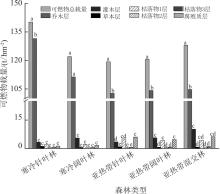
Fig.1
Fuel load across different forest types
Tab.5
Correlation coefficients of various factors with fuel load across different vegetation types
| 植被类型 | 海拔 | 坡度 | 坡向 | 坡位 | 郁闭度 | 林分密度 | 平均树高 | 平均胸径 | 龄组 |
|---|---|---|---|---|---|---|---|---|---|
| 寒冷针叶林 | -0.116 | -0.093 | 0.002 | -0.153 | 0.443 | 0.072 | 0.802 | 0.811 | 0.598 |
| 寒冷阔叶林 | -0.710 | -0.287 | 0.160 | -0.338 | 0.447 | 0.527 | 0.748 | 0.707 | 0.521 |
| 亚热带针叶林 | 0.285 | 0.099 | -0.020 | 0.018 | 0.225 | -0.049 | 0.655 | 0.699 | 0.480 |
| 亚热带阔叶林 | 0.284 | 0.088 | 0.016 | 0.044 | 0.280 | 0.170 | 0.405 | 0.588 | 0.405 |
| 亚热带混交林 | 0.312 | -0.012 | -0.063 | -0.068 | 0.223 | 0.166 | 0.278 | 0.467 | 0.321 |
Tab.6
Parameter estimates and evaluation Indices for single-factor fuel load modelswith different tree vegetation types
| 植被类型 | 自变量 | 模型名称 | 参数估计值 | 评价指标 | |||||
|---|---|---|---|---|---|---|---|---|---|
| b0 | b1 | b2 | b3 | R2 | F | P | |||
| 寒冷针叶林 | 郁闭度 | 幂函数 | 229.352 | 1.112 | 0.231 | 73.421 | <0.01 | ||
| 平均树高 | 幂函数 | 8.558 | 1.069 | 0.693 | 550.981 | <0.01 | |||
| 平均胸径 | 二项式 | -23.120 | 771.252 | -232.333 | 0.660 | 235.585 | <0.01 | ||
| 龄组 | 复合函数 | 23.816 | 1.661 | 0.449 | 198.514 | <0.01 | |||
| 寒冷阔叶林 | 海拔 | 线性 | 951.403 | -0.252 | 0.504 | 45.720 | <0.01 | ||
| 坡位 | 线性 | 329.498 | -49.430 | 0.114 | 5.802 | <0.05 | |||
| 郁闭度 | 幂函数 | 209.078 | 1.382 | 0.308 | 20.058 | <0.01 | |||
| 林分密度 | 幂函数 | 0.135 | 0.926 | 0.525 | 49.788 | <0.01 | |||
| 平均树高 | 幂函数 | 1.299 | 1.976 | 0.606 | 69.147 | <0.01 | |||
| 平均胸径 | S方程 | 6.744 | -0.253 | 0.504 | 45.720 | <0.01 | |||
| 龄组 | 幂函数 | 52.574 | 0.942 | 0.336 | 22.728 | <0.01 | |||
| 亚热带针叶林 | 平均树高 | 幂函数 | 13.697 | 0.824 | 0.485 | 3 049.034 | <0.01 | ||
| 平均胸径 | 幂函数 | 452.861 | 0.844 | 0.536 | 3 740.849 | <0.01 | |||
| 龄组 | 幂函数 | 56.215 | 0.689 | 0.310 | 1 454.155 | <0.01 | |||
| 亚热带阔叶林 | 平均树高 | 幂函数 | 11.452 | 0.885 | 0.303 | 775.677 | <0.01 | ||
| 平均胸径 | 幂函数 | 870.538 | 1.115 | 0.459 | 1510.078 | <0.01 | |||
| 龄组 | 幂函数 | 56.347 | 0.707 | 0.250 | 594.978 | <0.01 | |||
| 亚热带混交林 | 海拔 | 三项式 | 127.728 | -0.083 | 6.69×10⁻⁵ | -1.12×10⁻⁸ | 0.134 | 8.268 | <0.05 |
| 平均胸径 | 二项式 | -23.120 | 771.252 | -232.333 | 0.660 | 235.585 | <0.01 | ||
| 龄组 | 复合函数 | 23.816 | 1.661 | 0.449 | 198.514 | <0.01 | |||
Tab.7
Fuel load equation models based on multiple combined variables
| 植被类型 | 模型 | 拟合指标 | 评价指标 | |||
|---|---|---|---|---|---|---|
| R2 | TRE | MAE | MRE | RMSE | ||
| 寒冷针叶林 | Y=233.530 483.738 | 0.78 | 92.86 | 41.11 | 0.46 | 57.23 |
| 寒冷阔叶林 | Y=2.221-0.076X1+2.228 | 0.59 | 18.56 | 50.45 | 0.38 | 68.03 |
| 亚热带针叶林 | Y=1.162 | 0.53 | 1 120.57 | 35.70 | 0.37 | 55.44 |
| 亚热带阔叶林 | Y=1.194 | 0.35 | 914.67 | 37.92 | 0.64 | 53.11 |
| 亚热带混交林 | Y=357.498 | 0.24 | 70.25 | 46.78 | 0.48 | 60.07 |
Tab.8
Fuel load equation models derived from linear stepwise regression
| 植被类型 | 模型 | 拟合指标 | 评价指标 | |||
|---|---|---|---|---|---|---|
| R2 | TRE | MAE | MRE | RMSE | ||
| 寒冷针叶林 | Y=0.037X6+3.913X7+105.308X5+453.936X8-97.184 | 0.78 | 98.56 | 42.98 | 0.71 | 56.54 |
| 寒冷阔叶林 | Y=938.758X8+0.045X6-0.095X9+257.568 | 0.76 | 15.20 | 32.58 | 0.30 | 40.88 |
| 亚热带针叶林 | Y=2.217X2-2.428X3+0.009X6+3.062X7+0.014X1+ 103.058X5+340.814X8-89.373 | 0.63 | 925.42 | 29.82 | 0.28 | 49.28 |
| 亚热带阔叶林 | Y=1.284X3+5.131X9+1.399X7+72.755X5+0.014X1+ 0.028X6+662.531X8-125.746 | 0.52 | 633.36 | 30.83 | 0.61 | 50.49 |
| 亚热带混交林 | Y=74.586X5-12.988X2+0.021X1+0.023X6+443.972X8-29.023 | 0.34 | 56.60 | 44.43 | 0.38 | 59.71 |
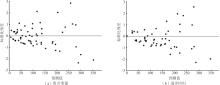
Fig.2
Distribution of standardized residuals for predicted values from combined equation models and stepwise regression models in cold coniferous forests
Fig.3
Distribution of standardized residuals for predicted values from combined equation models and stepwise regression models in cold broadleaf forests
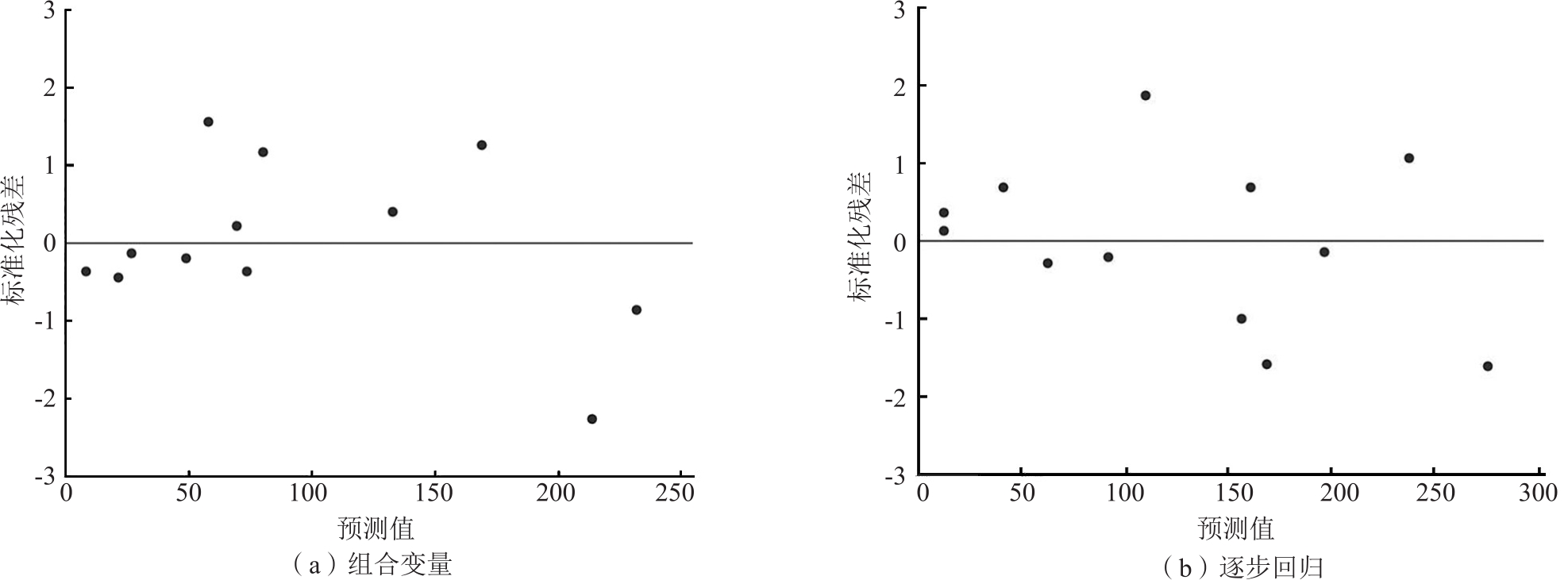
Fig.4
Distribution of standardized residuals for predicted values from combined equation models and stepwise regression models in subtropical coniferous forests
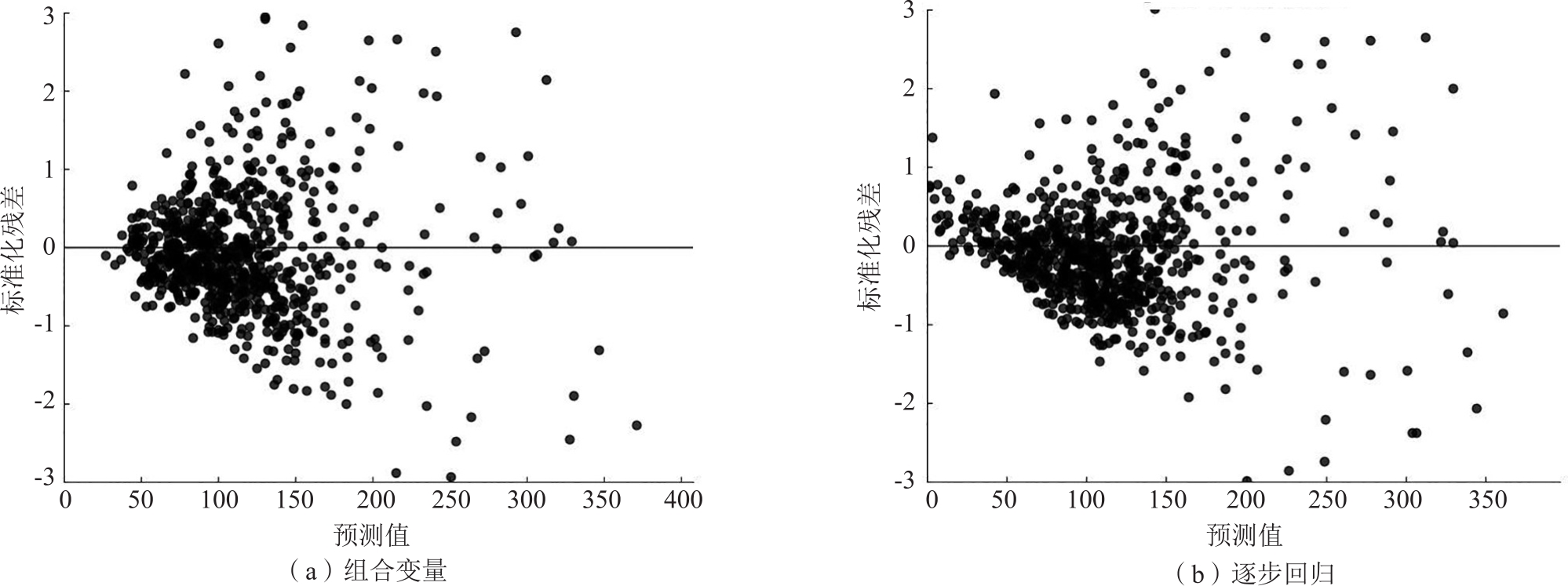
Fig.5
Distribution of standardized residuals for predicted values from combined equation models and stepwise regression models in subtropical broadleaf forests
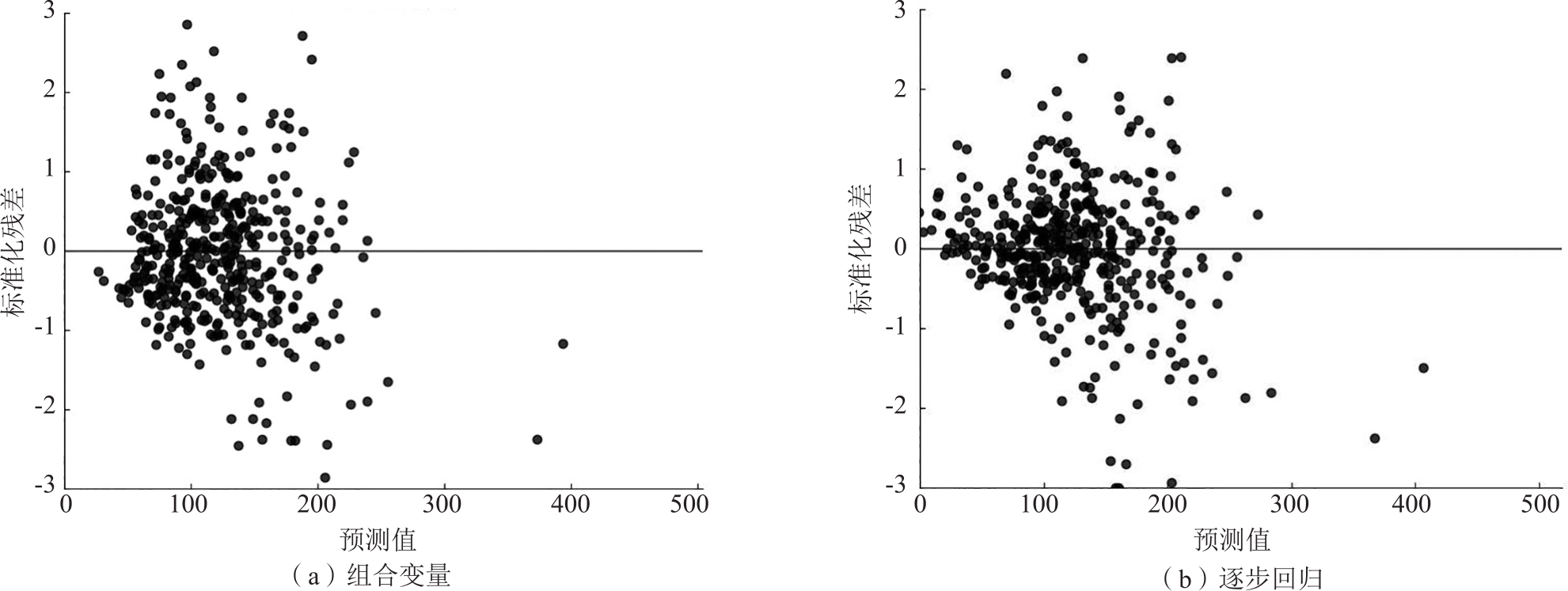
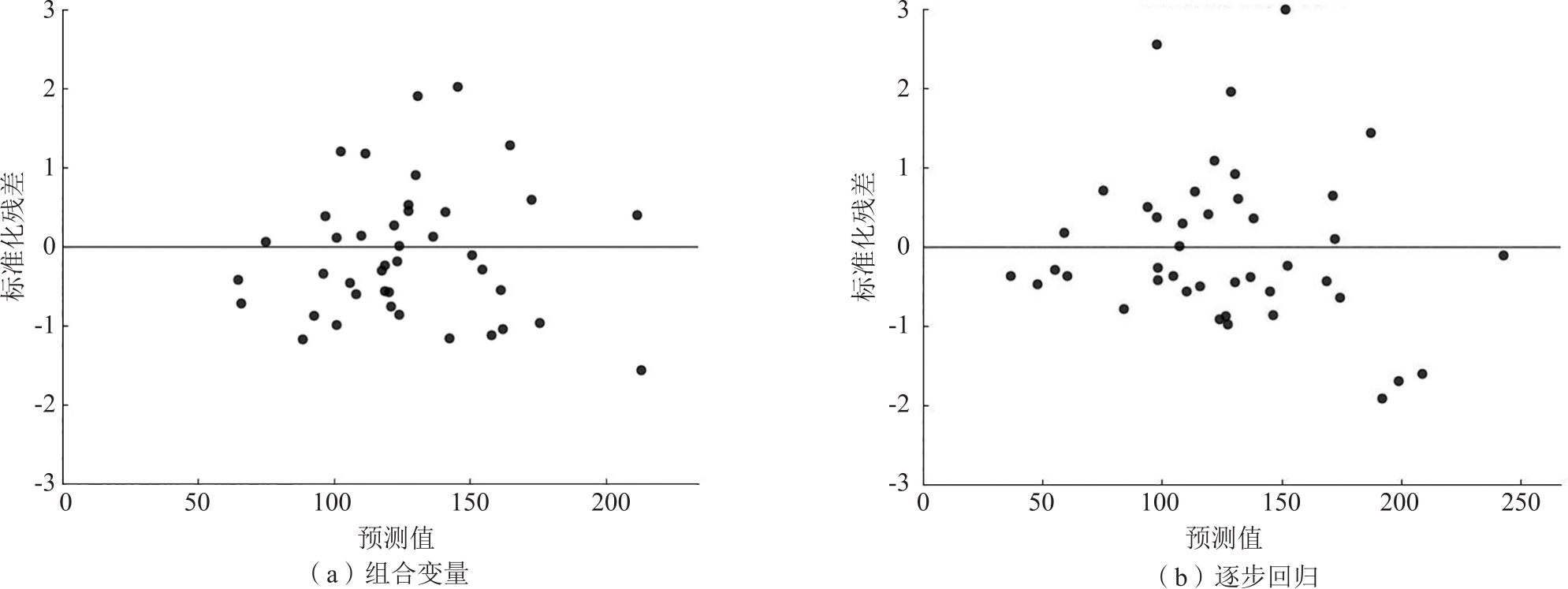
Fig.6
Distribution of standardized residuals for predicted values from combined equation models and stepwise regression models in subtropical mixed forests
| [1] | 龚亚东, 黎志彬, 汪炼峰, 等. 黄梅县森林防火阻隔带营建现状及对策[J]. 湖北林业科技, 2024, 53(2):79-82. |
| [2] | 黄跃飞, 黄庆军. 基于林业生态安全的森林防火管理措施探究[J]. 农村科学实验, 2024,(11):154-156. |
| [3] | 鲁雅楠, 黄海霞, 马立鹏, 等. 云杉和冷杉林可燃物载量特征及影响因素分析[J/OL]. 甘肃农业大学学报, 2024,1-11.(2024-04-29)[2024-10-10].http://kns.cnki.net/kcms/detail/62.1055.S.20240428.1458.056.html. |
| [4] | 李旭, 张延威, 张运林, 等. 云南顶瓶梗霉对森林地表凋落物的降解效果[J]. 中南林业科技大学学报, 2024, 44(6):120-127. |
| [5] | 宁吉彬, 瓮岳太, 邸雪颖, 等. 大兴安岭沟塘草甸地表可燃物载量快速测定方法[J]. 东北林业大学学报, 2018, 46(5):44-48. |
| [6] | 魏云敏, 鞠琳. 森林可燃物载量研究综述[J]. 森林防火, 2006(4):18-21. |
| [7] |
盛锋雷, 刁军, 王柏昌, 等. 上海市不同林分型乔木层可燃物载量模型研究[J]. 广西林业科学, 2023, 52(3):384-393.
doi: 10.19692/j.issn.1006-1126.20230317 |
| [8] | 王忆文, 索奥丽, 高钰, 等. 四川西昌云南松林地表可燃物载量及影响因素研究[J]. 北京林业大学学报, 2023, 45(10):100-108. |
| [9] | 肖君. 福建马尾松林可燃物载量估算模型构建[J]. 福建林业科技, 2023, 50(4):89-94. |
| [10] | 杨雪清, 孙志超, 柴. 全国森林可燃物载量样地调查与预估方法探讨[J]. 林业资源管理, 2022(6):1-6. |
| [11] | 董奎, 谭本会, 余斌. 联合Sentinel-1和Sentinel-2数据的森林可燃物载量反演研究[J]. 贵州工程应用技术学院学报, 2023, 41(3):58-66. |
| [12] | NGUYEN T H, JONES S, REINKE K J, et al. Estimating fine fuel loads in Eucalypt forests using forest inventory data and amodelling approach[J]. Forest Ecology and Management, 2024,561:121-851. |
| [13] | SYDORENKO S, GUMENIUK V, De Miguel-Díez F, et al. Assessment of the surface forest fuel load in the ukrainian polissia[J]. Fire Ecology, 2024, 20(1):35. |
| [14] | JI Cuicui, YANG Hengcong, LI Xiaosong, et al. Forest wildfire risk assessment of anning river valley in Sichuan Province based on driving factors with multi-source data[J]. Forests, 2024, 15(9):1523. |
| [15] |
王秋华, 王劲, 李晓娜, 等. 森林—城镇交界域火灾研究进展[J]. 南京林业大学学报(自然科学版), 2024, 48(5):1-10.
doi: 10.12302/j.issn.1000-2006.202303047 |
| [16] | WANG San, LI Hongli, NIU Shukui. Empirical research on climate warming risks for forest fires:A case study of grade I forest fire danger zone,Sichuan Province,China[J]. Sustainability, 2021, 13(14):7773. |
| [17] | 王明婷, 贾丹丹, 梁永佳, 等. 森林火灾危险性评估分级初探:以广西防城港市防城区为例[J]. 森林防火, 2024, 42(2):53-59. |
| [18] | 曹杨, 赵晓莉, 苏德斌, 等. 成都西部山地和平原过渡区边界层水平风场区域差异分析[J]. 气象科技, 2024, 52(5):743-752. |
| [19] | 四川省林业和草原局. 四川省第一次森林和草原火灾风险普查实施细则[EB/OL].(2021-04-12)[2024-09-30].https://lcj.sc.gov.cn/scslyt/gsgg/2021/4/12/62d5b22c2cd8419385ef0b460f027b7e.shtml. |
| [20] | 董利虎. 东北林区主要树种及林分类型生物量模型研究[D]. 哈尔滨: 东北林业大学, 2015. |
| [21] | 李兆国, 瓮岳太, 徐建楠, 等. 模拟地表火行为对燃烧剩余物水溶性碳氮的影响[J]. 生态学报, 2022, 42(4):1500-1511. |
| [22] | COHEN J. Statistical Power Analysis for the Behavioral Sciences[M].2nd ed.Hillsdale, NJ: Routledge, 1988. |
| [23] | ZOU H, HASTIE T. Regularization and variable selection via the elastic net[J]. Journal of the Royal Statistical Society:Series B(Statistical Methodology), 2005, 67(2):301-320. |
| [24] | 王秀, 张增江, 郑艳红, 等. 大三叶升麻种子与果实的相关性分析[J]. 特种经济动植物, 2024, 27(10):24-26. |
| [25] | 王雅萍, 徐喜飞, 李家国, 等. 中低分辨率卫星蓝藻水华监测面积校正研究:以GOCI-2为例[J]. 航天返回与遥感, 2024, 45(5):123-133. |
| [26] | 田野, 牛树奎, 陈锋, 等. 火干扰后的油松林地表死可燃物负荷及影响因子[J]. 福建农林大学学报(自然科学版), 2018, 47(6):691-697. |
| [27] | 胡庆, 刘福珍, 段信先. 乔木林可燃物载量空间分布研究:以吉安市为例[J]. 生物灾害科学, 2023, 46(4):529-537. |
| [28] | 张状, 宗树琴, 闫星蓉, 等. 林分和地形因子对崇礼冬奥核心区森林地表可燃物载量的影响[J]. 林业科学, 2022, 58(10):59-66. |
| [29] | 刘欣蓓. 基于高光谱的淮南地区典型农作物叶片叶绿素含量反演研究[D]. 安徽: 安徽理工大学, 2024. |
| [30] | 秦乃花, 陈瑞, 吕常笑, 等. 山东省不同林分地表可燃物载量及其燃烧性研究[J]. 西北林学院学报, 2023, 38(5):176-183. |
| [31] | 陈智卿, 陈柏华, 吕树德. 塞罕坝机械林场针叶林不同林分类型可燃物载量差异探讨[J]. 河北林果研究, 2014, 29(2):138-140. |
| [1] | HUANG Jincheng, LIU Hongsheng, NING Jinkui, OUYANG Xunzhi, ZANG Hao. Study of Adaptability of the Primary Afforestation Species in Chongyi County,Jiangxi Province Based on Random Forest [J]. FOREST RESOURCES WANAGEMENT, 2022, 0(2): 117-125. |
| [2] | XU Bingbing, BIAN Gengzhan, YI Xuan, ZHU Guangyu, QI Zhantao, LV Yong. Study on the Characteristics and Influencing Factors of the Single Tree Stem Form of Cunninghamia lanceolata Plantation in Hunan Province [J]. FOREST RESOURCES WANAGEMENT, 2020, 0(5): 82-88. |
| [3] | CHEN Yiqing, CHEN Zongzhu, CHEN Xiaohua, LEI Jinrui, WU Tingtian, LI Yuanling. A study on Ecological Stoichiometric Characteristics of C,N and P in three kinds of plant leaves and their community litters in Shimeiwan of Hainan island [J]. FOREST RESOURCES WANAGEMENT, 2020, 0(4): 66-73. |
| [4] | GUO Hong, YOU Lei, LEI Xiangdong, XIE Yangsheng, HONG Lingxia. Research on Logical Checking Methods for Plot Data of Multi-period Forest Investigation [J]. FOREST RESOURCES WANAGEMENT, 2019, 0(5): 84-88. |
| [5] | LI Mingjun, DU Mingfeng, YU Lifei. Study on the Relationship between the Stand Volume and Site Factors in Chinese Fir Forest of Middle Age in Guizhou Province [J]. FOREST RESOURCES WANAGEMENT, 2014, 0(5): 58-63. |
| [6] | YANG Zhongxing, HUA Chaolang, YU Changyuan, ZHANG Shaohui, ZHENG Jinxuan, YANG Guowei. Study on the Subalpine Marsh Wetland Vegetation in Yulong County of Yunnan Province [J]. FOREST RESOURCES WANAGEMENT, 2014, 0(1): 131-139. |
| [7] | GUO Tao, YANG Xiaobo, LI Donghai, WU Qingshu, CAO Shiwei, SUN Bo. Analysis of Natural Vegetation Types and Characteristics in Shenzhou Peninsula of Wanning,Hainan Province [J]. FOREST RESOURCES WANAGEMENT, 2008, 0(2): 78-84. |
| Viewed | ||||||
|
Full text |
|
|||||
|
Abstract |
|
|||||
