

林草资源研究 ›› 2026›› Issue (2): 80-92.doi: 10.13466/j.cnki.lczyyj.2026.02.008
陈振铭1( ), 李茂盛2, 郑洁敏3, 林海萍1, 戴惠明3()
收稿日期:2024-12-23
修回日期:2025-09-17
出版日期:2026-04-28
发布日期:2026-09-30
通讯作者:
戴惠明,高级工程师,主要从事林下经济研究。Email:dhm676818@163.com
作者简介:陈振铭,硕士研究生,主要从事森林保护研究。Email:214106605@qq.com
CHEN Zhenming1(), LI Maosheng2, ZHENG Jiemin3, LIN Haiping1, DAI Huiming3()
Received:2024-12-23
Revised:2025-09-17
Online:2026-04-28
Published:2026-09-30
摘要:
浙江省永嘉县古树名木资源丰富,分析其特征及分布格局对保护当地古树名木具有重要意义。基于浙江省永嘉县的2期古树名木资源调查数据,引入生长势指数作为量化标准,采用皮尔逊相关性分析和ArcGIS空间自相关分析方法进行相关性分析,并建立地理加权回归模型,分析古树名木在永嘉县范围内的资源特征、空间异质性和分布格局。结果表明:1)永嘉县目前存活古树名木1 381株,隶属于31科、51属、70种;2)皮尔逊相关系数分析,从8个环境因子中筛选出坡度、海拔、土层厚度、年平均气温、年蒸发量、年降水量等对古树名木的生长发育具有较大影响的环境因子,其中年平均气温的影响作用最为显著,与树龄、树高、胸径和冠幅均呈极显著相关(P<0.01),相关系数(r)分别为-0.089、0.072、0.116和0.347;3)永嘉县古树名木空间自相关分析莫兰指数为0.142,P值为0.077,处于边缘显著水平,表明空间分布存在微弱的空间自相关,具有一定的集聚特征,北部为高聚类、高密度区域;4)永嘉县古树名木生长势指数对环境因子的响应程度表现出明显的空间异质性,整体呈现由中部地区向四周逐渐增强的趋势,中部地区响应程度最低,西北部地区响应程度最高。研究结果可为未来永嘉县古树名木保护和管理提供理论依据。
中图分类号:
陈振铭, 李茂盛, 郑洁敏, 林海萍, 戴惠明. 基于地理加权回归模型的古树名木资源特征及分布格局分析——以浙江省永嘉县为例[J]. 林草资源研究, 2026,(2): 80-92.
CHEN Zhenming, LI Maosheng, ZHENG Jiemin, LIN Haiping, DAI Huiming. Analysis of characteristics and distribution patterns of ancient and famous tree resources by using geographically weighted regression: A case study of Yongjia County in Zhejiang Province[J]. Forest and Grassland Resources Research, 2026,(2): 80-92.
表1
古树名木数据采集标准
| 指标类别 | 采集内容 | 调查方法 |
|---|---|---|
| 空间信息 | GPS坐标(±3 m) | 手持佳明ETREX201X双星定位 |
| 生长指标 | 树高 | 激光测距仪(徕卡DISTO)[ |
| 胸径 | 胸径尺测量胸高1.3 m处[ | |
| 冠幅 | 数码设备拍摄后测量投影[ | |
| 环境因子 | 海拔(SRTM 30 m分辨率DEM提取) | ArcGIS空间插值法 |
| 坡度/坡向(ASTER GDEM计算) | ENVI 5.3地形分析 | |
| 土层厚度 | 洛阳铲井字布孔法取样[ |
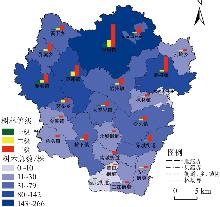
图1
永嘉县古树名木空间分布 注:审图号为浙温S(2026)7号。
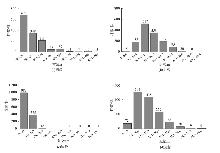
图2
永嘉县古树名木树龄、树高、胸径、冠幅分布
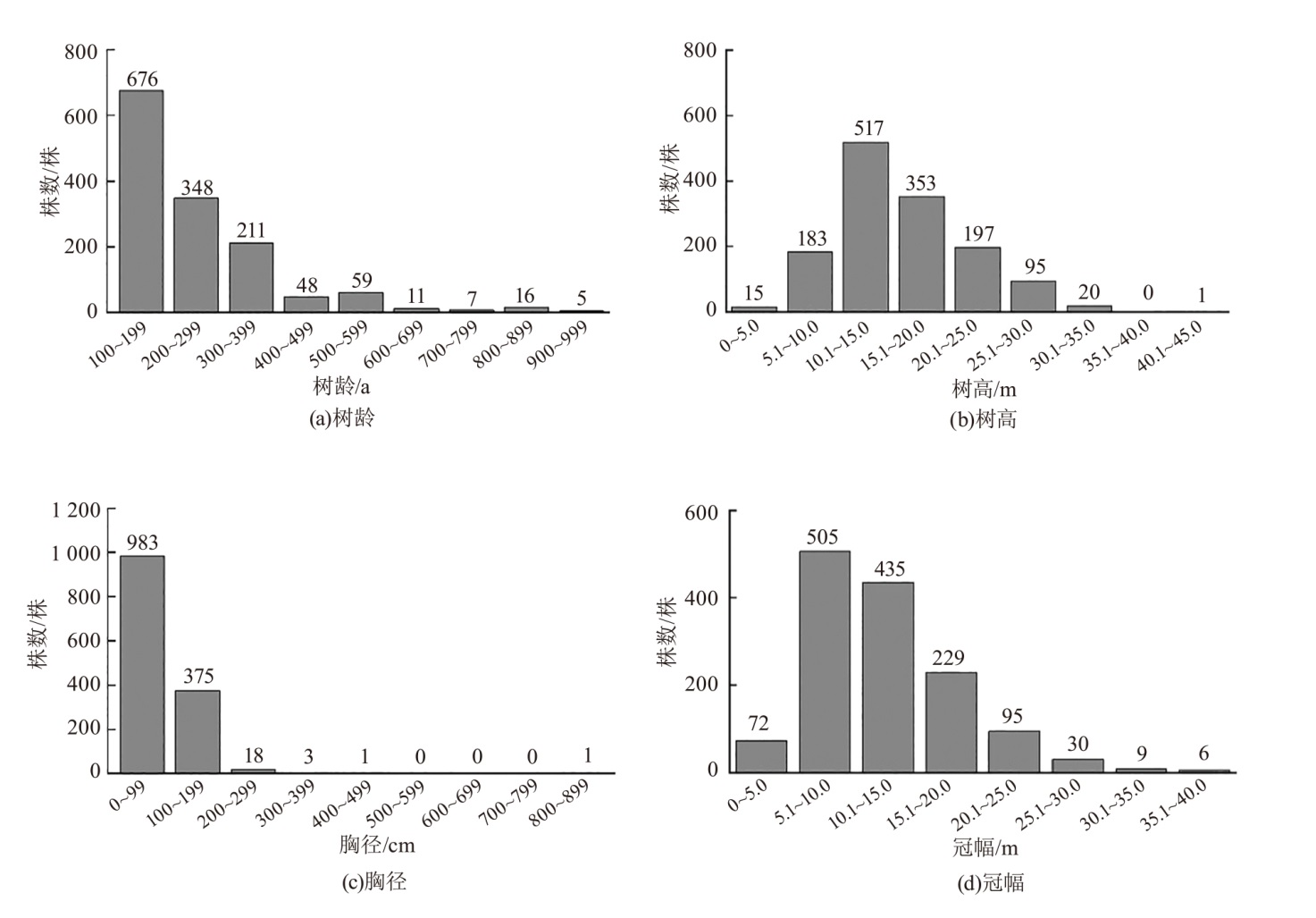
图3
永嘉县古树名木科—生长势级别 注:银杏科(Ginkgoaceae)、金缕梅科(Hamamelidaceae)、豆科(Fabaceae)、蓝果树科(Nyssaceae)、茜草科(Rubiaceae)、胡桃科(Juglandaceae)、罗汉松科(Podocarpaceae)、红豆杉科(Taxaceae)、樟科(Lauraceae)、海桐科(Pittosporaceae)、桦木科(Betulaceae)、桑科(Moraceae)、柿树科(Ebenaceae)、柏科(Cupressaceae)、松科(Pinaceae)、杜鹃花科(Ericaceae)、杉科(Taxodiaceae)、壳斗科(Fagaceae)、冬青科(Aquifoliaceae)。
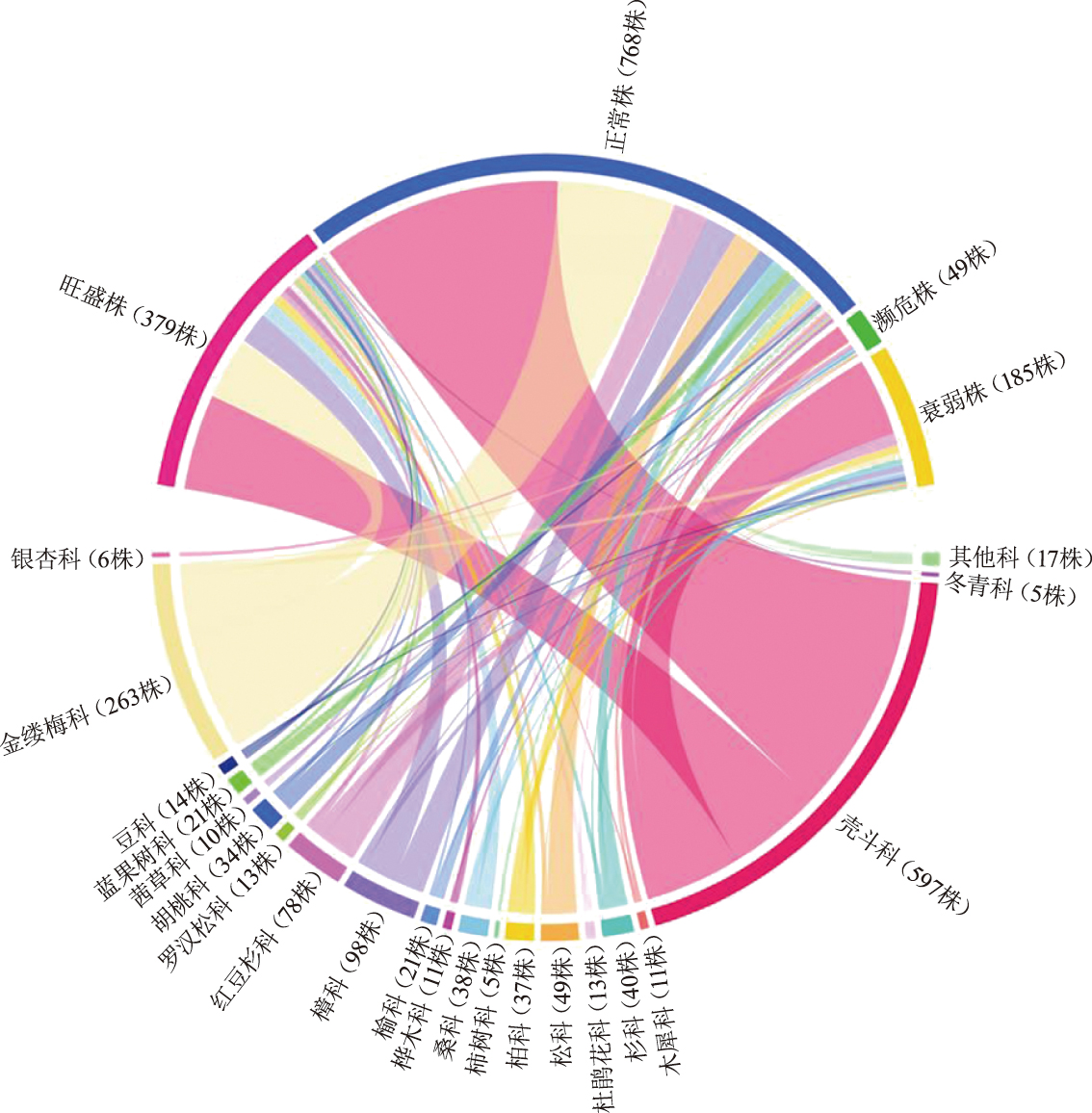
表2
古树名木皮尔逊相关系数
| 影响因子 | 树龄 | 树高 | 胸径 | 冠幅 |
|---|---|---|---|---|
| 坡度 | 0.001 | -0.056* | -0.050 | -0.205** |
| 海拔 | 0.076** | -0.080** | -0.114** | -0.323** |
| 土层厚度 | -0.082** | -0.015 | -0.049 | 0.057* |
| 年平均气温 | -0.089** | 0.072** | 0.116** | 0.347** |
| 年蒸发量 | -0.090** | 0.044 | 0.160** | 0.373** |
| 年降水量 | 0.099** | -0.048 | -0.107** | -0.312** |
表3
永嘉县古树名木生长势指数Moran's I值
| 莫兰指数 | 方差 | P值 | Z得分 | 分布模式 |
|---|---|---|---|---|
| 0.142 | 0.011 | 0.077 | 1.767 | 集聚 |
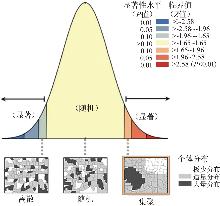
图4
永嘉县古树名木Moran's I值全局参数 注:橙色框为本研究区分布模式。
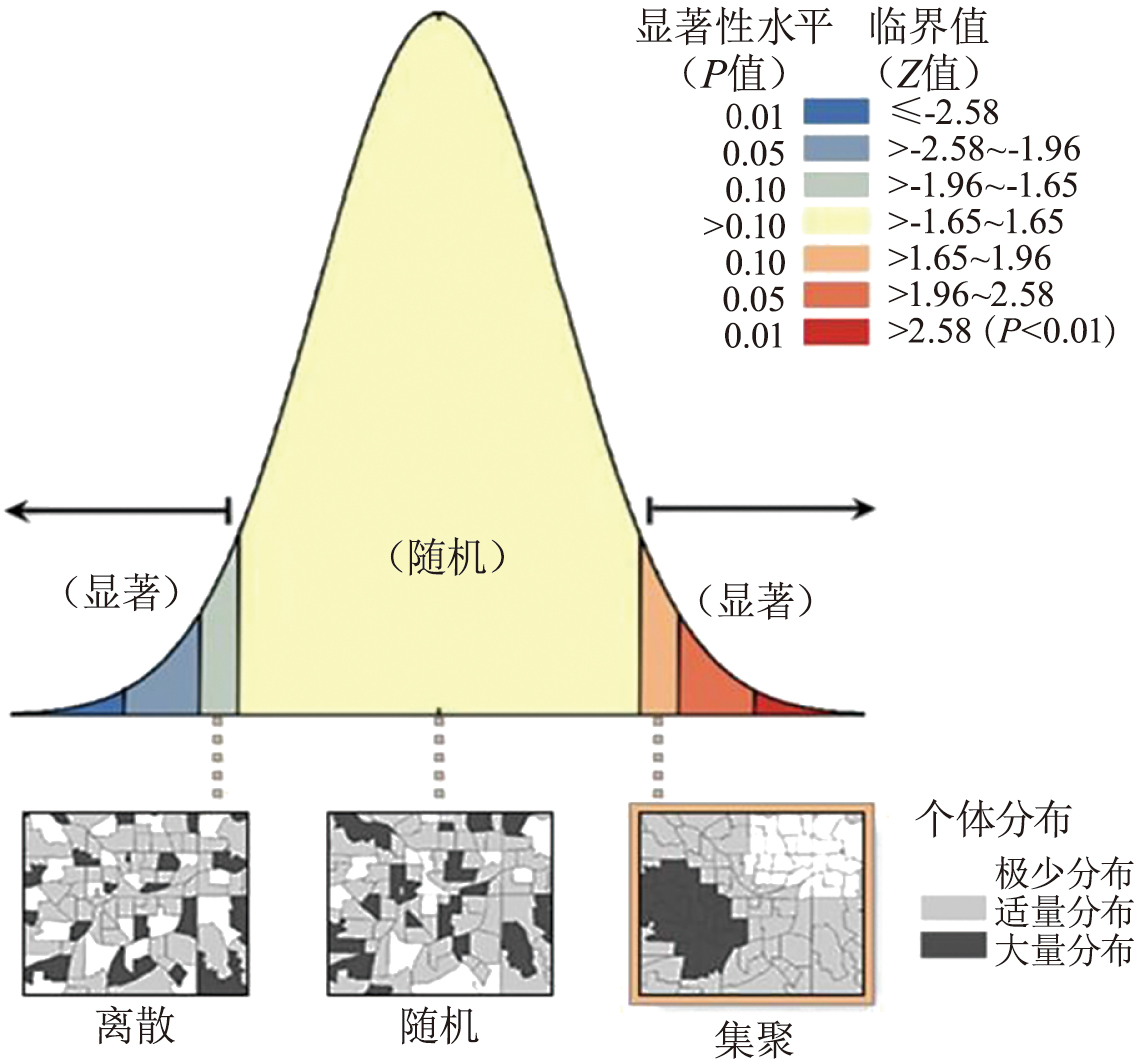
图5
永嘉县古树名木自相关聚类 注:审图号为浙杭S(2026)7号。
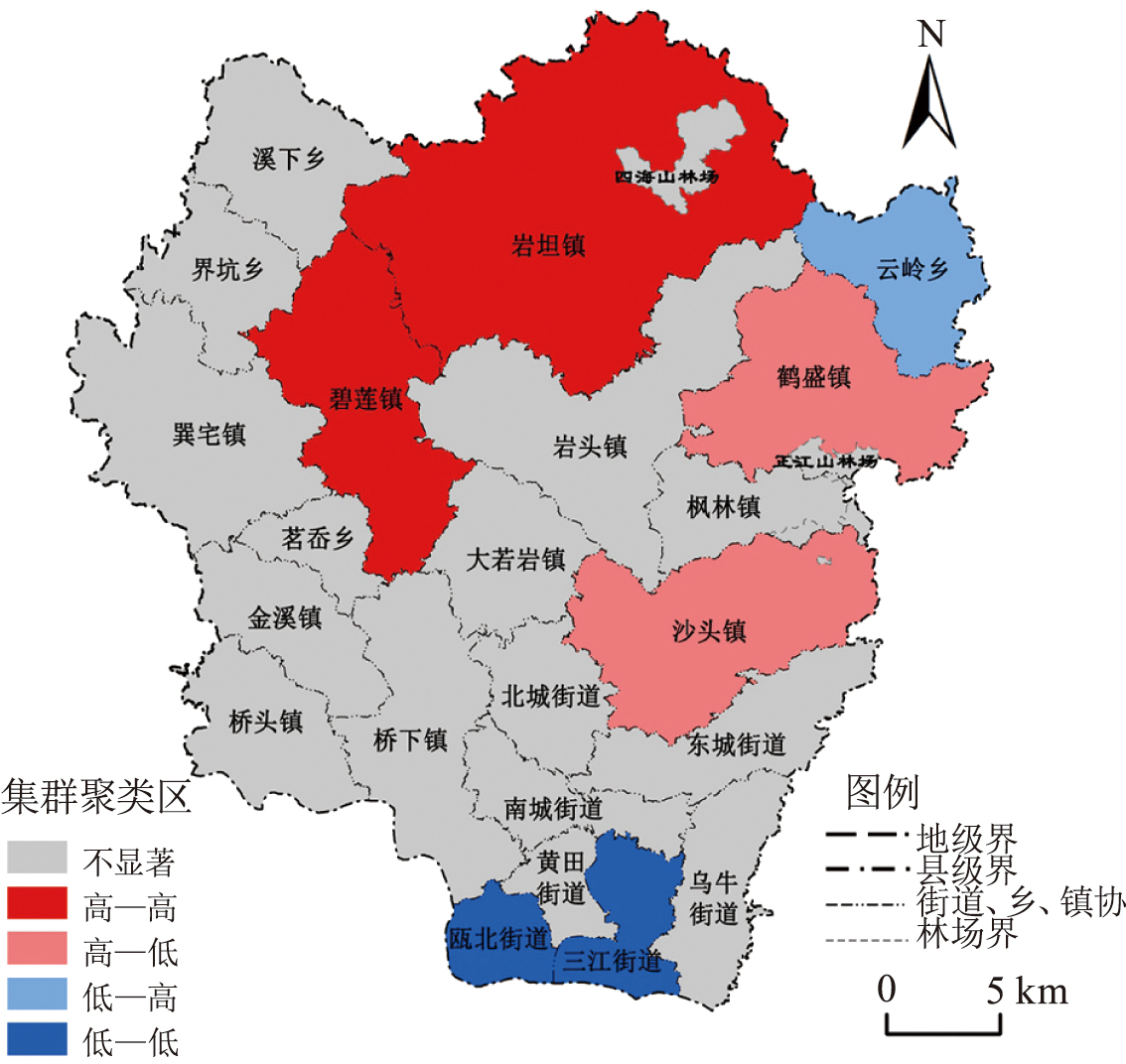
图6
永嘉县古树名木生长势指数对环境因子的响应程度分级 注:审图号为浙杭S(2026)7号。
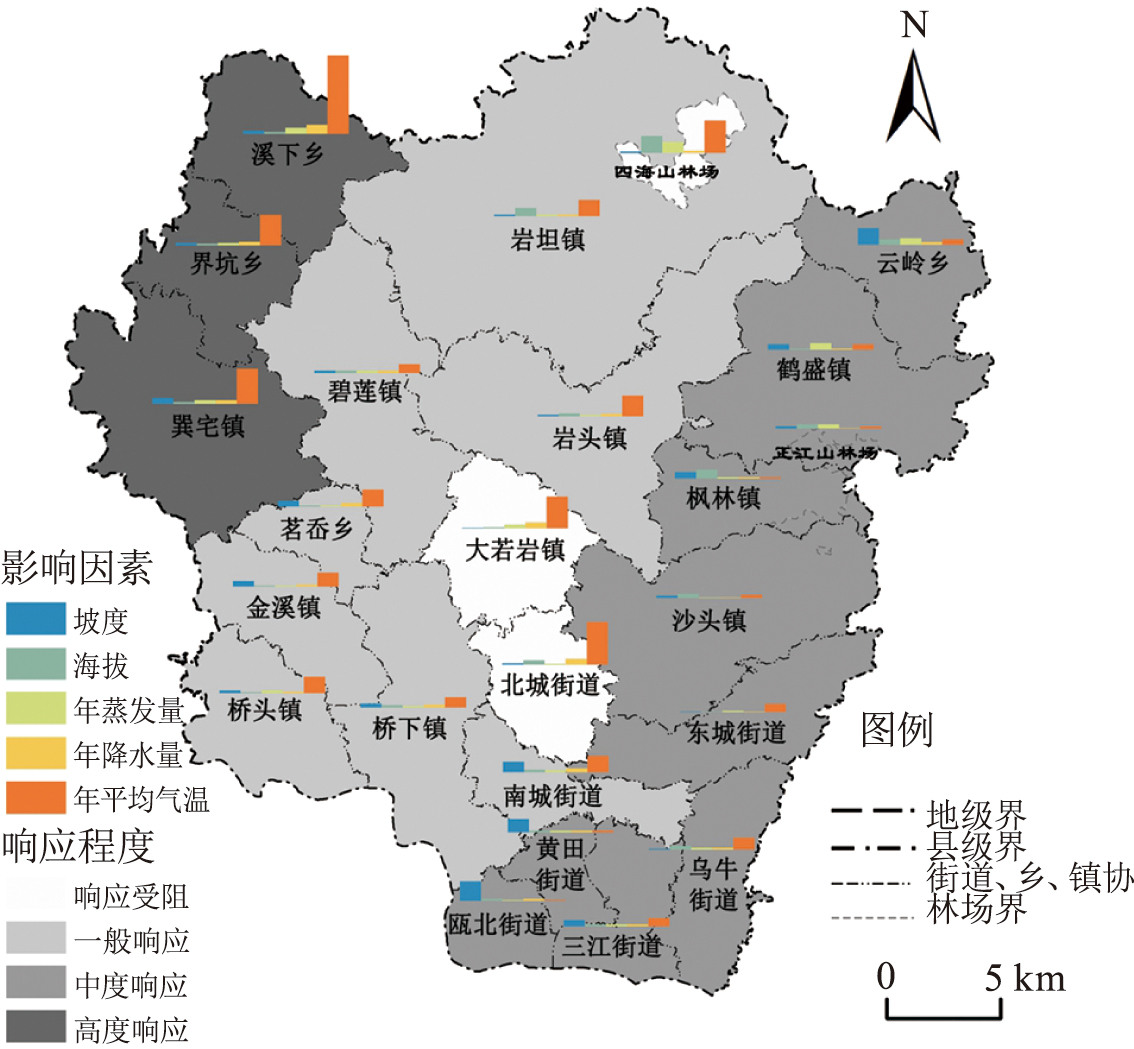
图7
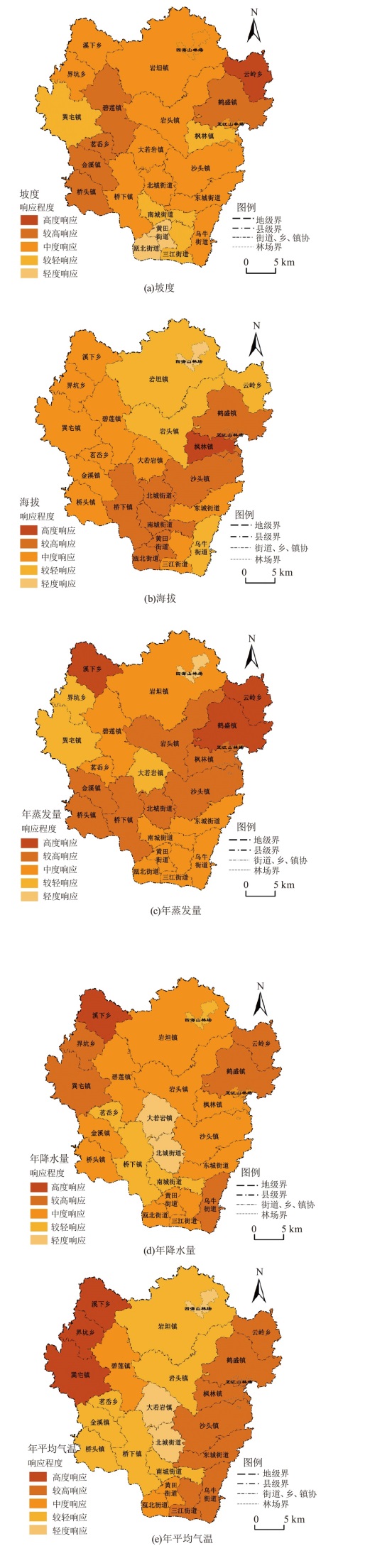
单一环境因子对永嘉县古树名木生长势指数的影响程度分级 注:审图号为浙杭S(2026)7号。
| [1] | 中华人民共和国国务院. 古树名木保护条例[EB/OL].(2025-01-27)[2025-02-02]. https://www.gov.cn/zhengce/content/202501/content_7001413.htm. |
| [2] | 戴边疆, 郭运勇, 宋希强, 等. 海口市古树名木资源特征及其空间分布[J]. 热带生物学报, 2020, 11(1):63-71. |
| [3] |
Liu Jiajia, Xia Shangwen, Zeng Di, et al. Age and spatial distribution of the world's oldest trees[J]. Conservation Biology:The Journal of the Society for Conservation Biology, 2022, 36(4):e13907.
doi: 10.1111/cobi.v36.4 |
| [4] | 陈芳, 罗广军, 杨佐兵. 榕属植物在广东省古树名木中的地位和价值研究[J]. 林草资源研究, 2023(5):148-154. |
| [5] | 廖高文, 龙冰雁. 金洞管理区古树名木资源现状调查与保护对策[J]. 湖南生态科学学报, 2020, 7(2):31-37. |
| [6] | 李艳龙, 陈帅, 贺晓慧, 等. 河西地区古树名木资源特征及空间分布格局分析[J]. 西部林业科学, 2023, 52(6):110-119. |
| [7] | 国家林业局. 古树名木普查技术规范:LY/T 2738-2016[S]. 北京: 中国标准出版社, 2017. |
| [8] | 中华人民共和国农业部. 土壤检测(第1部分:土壤样品的采集、处理和贮存):NY/T 1121.1—2006[S]. 北京: 中国标准出版社, 2006. |
| [9] | 张朝芳, 章绍尧. 浙江植物志[M]. 杭州: 浙江科学技术出版社, 1993. |
| [10] | 中华人民共和国农业部种植业管理司. 果树术语:NY/T 1839—2010[S]. 北京: 中国标准出版社, 2010. |
| [11] | 李中涛. 果树栽培中的几组名词术语辨析[J]. 果农之友, 2006(8):43. |
| [12] | 苏纯兰, 陈葵仙, 胡秋艳, 等. 基于层次分析法构建东莞市古树名木健康评价体系[J]. 林业与环境科学, 2016, 32(2):57-62. |
| [13] | 关追追, 赵江宁, 邱权, 等. 楸树人工林生长规律及其最优生长模型研究:以河南省洛宁县楸树为例[J]. 森林工程, 2021, 37(2):1-10. |
| [14] | 靳阿亮, 饶良懿, 李佳, 等. 华北落叶松人工林生物量实测分析[J]. 广东农业科学, 2012, 39(12):165-168. |
| [15] | 李德琼, 谢小良, 王仲梅. 判断向量组线性相关性的若干方法[J]. 湖南理工学院学报(自然科学版), 2021, 34(1):14-16. |
| [16] |
Han Yu, Hutson A D. Inferential procedures based on the weighted Pearson correlation coefficient test statistic[J]. Journal of Applied Statistics, 2024, 51(3):481-496.
doi: 10.1080/02664763.2022.2137477 pmid: 38370269 |
| [17] |
Dufera A G, Liu Tiantian, Xu Jin. Regression models of Pearson correlation coefficient[J]. Statistical Theory and Related Fields, 2023, 7(2):97-106.
doi: 10.1080/24754269.2023.2164970 |
| [18] | 赵鑫宇, 剧泽佳, 陈慧, 等. 石家庄市土壤中喹诺酮类抗生素空间分布特征及其与微生物群落相关性[J]. 环境科学, 2022, 43(9):4684-4696. |
| [19] |
Diawara N, Waller L, King R, et al. Simulations of local Moran’s index in a spatio-temporal setting[J]. Communications in Statistics-Simulation and Computation, 2019, 48(6):1849-1859.
doi: 10.1080/03610918.2018.1425441 |
| [20] | 卢宾宾, 葛咏, 秦昆, 等. 地理加权回归分析技术综述[J]. 武汉大学学报(信息科学版), 2020, 45(9):1356-1366. |
| [21] |
Song Meixuan, Huang Zihao, CHEN Chao, et al. Multi-scale geographically weighted regression estimation of carbon storage on coniferous forests considering residual distribution using remote sensing data[J]. Ecological Indicators, 2024, 166:112495.
doi: 10.1016/j.ecolind.2024.112495 |
| [22] |
Tesfamichael S G, Shiferaw Y A, Margaret P. Monthly geographically weighted regression between climate and vegetation in the Eastern Cape Province of South Africa:Clustering pattern shifts and biome-dependent accuracies[J]. Scientific African, 2022, 18:e01423.
doi: 10.1016/j.sciaf.2022.e01423 |
| [23] | LY/T 2737—2016古树名木鉴定规范[S]. 北京: 中国标准出版社, 2016. |
| [24] |
Liu Tianshu, Peng Xiangbin, Li Junjie. Evaluation of ecological sensitivity and spatial correlation analysis of landscape patterns in Sanjiangyuan National Park[J]. Sustainability, 2024, 16(13):5294-5294.
doi: 10.3390/su16135294 |
| [25] |
Santos D D, Lopes T R, Damaceno F M, et al. Evaluation of deforestation,climate change and CO2 emissions in the Amazon biome using the Moran Index[J]. Journal of South American Earth Sciences, 2024, 143:105010.
doi: 10.1016/j.jsames.2024.105010 |
| [26] |
Wang Tao, Zhao Mingsong, Gao Yingfeng, et al. Analyzing spatial-temporal change of vegetation ecological quality and its influencing factors in Anhui Province,Eastern China using multiscale geographically weighted regression[J]. Applied Sciences, 2023, 13(11):6359.
doi: 10.3390/app13116359 |
| [27] |
Zuleide F, Cristina C A, Pedro C. Analysing the spatial context of the altimetric error pattern of a digital elevation model using multiscale geographically weighted regression[J]. European Journal of Remote Sensing, 2023, 56(1):2260092.
doi: 10.1080/22797254.2023.2260092 |
| [28] | 张萌, 范秀华. 吉林蛟河针阔混交林红松和紫椴个体生长的影响因素[J]. 北京林业大学学报, 2024, 46(9):26-34. |
| [29] | 谢欢欢, 王玉婷, 万艳玲, 等. 西藏不同种源大果圆柏群落特征差异性研究[J]. 高原农业, 2024, 8(4):376-385. |
| [30] | 王柢渊, 杨帆, 张宽地, 等. 流量和坡度对植被水流水动力学特性的影响[J]. 人民黄河, 2017, 39(6):86-89. |
| [31] | 潘婵娟, 李鸿铭, 洪焕. 坡度对植被混凝土基材早期蒸散效应的影响[J]. 价值工程, 2018, 37(5):90-92. |
| [32] | 王云霓. 六盘山南坡典型森林的水文影响及其坡面尺度效应[D]. 北京: 中国林业科学研究院, 2015. |
| [33] | 程敏, 闫淑君, 吕蔚, 等. 海拔对植物花部性状影响的研究进展[J]. 世界林业研究, 2024, 37(5):16-21. |
| [34] |
黄业芸, 邱开阳, 朱亚超, 等. 贺兰山不同海拔植被生物量与土壤分形特征和土壤水分的相关关系[J]. 草业学报, 2023, 32(12):24-35.
doi: 10.11686/cyxb2023050 |
| [35] | 于晨一. 伏牛山南坡木本植物物种多样性的海拔分布格局及其驱动因素研究[D]. 郑州: 河南农业大学, 2024. |
| [36] |
武启骞, 王传宽. 季节性雪被变化对森林凋落物分解及土壤氮动态的影响[J]. 应用生态学报, 2018, 29(7):2422-2432.
doi: 10.13287/j.1001-9332.201807.004 |
| [37] |
雷自然, 王欣, 余新晓, 等. 庐山针阔混交林优势种水分利用来源季节变化及对降水的响应[J]. 应用生态学报, 2024, 35(4):886-896.
doi: 10.13287/j.1001-9332.202404.015 |
| [38] | Nola P, Bracco F, Assini S, et al. Xylem anatomy of Robinia pseudoacacia L.and Quercus robur L.is differently affected by climate in a temperate alluvial forest[J]. Annals of Forest Science:A Journal of the French National Institute for Agriculture,Food and Environment(INRAE), 2020, 77(3):1-15. |
| [39] |
Liu Jiajia, Lindenmayer B D, Yang Wenjing, et al. Diversity and density patterns of large old trees in China[J]. Science of the Total Environment, 2019, 655:255-262.
doi: 10.1016/j.scitotenv.2018.11.147 |
| [40] | 何晓雯. 黄浦区古树名木养护标准化管理初探[J]. 中国林业经济, 2018(5):75-78. |
| [41] |
Silva L C R, Sun Geng, Zhubarker X, et al. Tree growth acceleration and expansion of alpine forests:The synergistic effect of atmospheric and edaphic change[J]. Science Advances, 2016, 2:e1501302.
doi: 10.1126/sciadv.1501302 |
| [42] |
Sutinen R, Middleton M. Soil water drives distribution of northern boreal conifers Picea abies and Pinus sylvestris[J]. Journal of Hydrology, 2020, 588:125048.
doi: 10.1016/j.jhydrol.2020.125048 |
| [43] | 洪陈洁, 林晗, 洪伟, 等. 不同品系福建山樱花叶功能性状研究[J]. 热带亚热带植物学报, 2015, 23(2):191-196. |
| [44] | 张振文, 林立铭, 余厚美, 等. 温度对木薯叶片叶绿素荧光及Rubisco酶的影响[J]. 江西农业学报, 2017, 29(1):1-5. |
| [45] |
章健敏, 林国卫, 娄俊. 月均气温对三叶青林下容器栽培苗光合特性及其块根总黄酮含量的影响[J]. 浙江农业科学, 2024, 65(3):555-561.
doi: 10.16178/j.issn.0528-9017.20230043 |
| [46] | 魏靖轩, 许昆, 张远东, 等. 川西康定云冷杉径向生长对气候变化响应的差异[J]. 生态学报, 2024, 44(23):10906-10914. |
| [47] | 孙小珺, 孙杰, 尹若波, 等. 气温对树木生长影响的研究[J]. 防护林科技, 2019(10):23-25. |
| [48] | 胡乘风. 阔叶红松林冠层树种光合特性及光合生产潜力研究[D]. 北京: 北京林业大学, 2020. |
| [49] | 李天宇, 贾炜玮, 孙毓蔓, 等. 基于地理加权回归模型的凉水自然保护区红松空间分布分析[J]. 森林工程, 2024, 40(2):47-59. |
| [50] | 张铁. 贵州省马尾松林生物量分布驱动因子及GWR模型构建[D]. 贵阳: 贵州大学, 2023. |
| [51] | 翁翎燕, 濮励杰, 张超, 等. 基于格网的中国国家森林乡村空间分布特征及其影响因素[J]. 亚热带资源与环境学报, 2023, 18(3):1-10. |
| [52] |
Wang Wenzhi, Jia Min, Wang Genxv, et al. Rapid warming forces contrasting growth trends of subalpine fir(Abies fabri)at higher-and lower-elevations in the eastern Tibetan Plateau[J]. Forest Ecology and Management, 2017, 402:135-144.
doi: 10.1016/j.foreco.2017.07.043 |
| [53] |
Panthi S, Fan Zexin, Sleen P V D, et al. Long-term physiological and growth responses of Himalayan fir to environmental change are mediated by mean climate[J]. Global Change Biology, 2020, 26:1778-1794.
doi: 10.1111/gcb.14910 pmid: 31696994 |
| [54] | 彭钟通, 郭明明, 张远东, 等. 升温突变对川西道孚林线川西云杉和鳞皮冷杉生长的影响[J]. 生态学报, 2021, 41(20):8202-8211. |
| [55] |
Wang Xiaofeng, Yang Bao. Divergent tree radial growth at alpine coniferous forest ecotone and corresponding responses to climate change in northwestern China[J]. Ecological Indicators, 2021, 121:107052.
doi: 10.1016/j.ecolind.2020.107052 |
| [56] | 柴晓雷, 领梅, 陈美萍. 通辽市古树名木资源现状分析[J]. 内蒙古林业调查设计, 2024, 47(6):1-6. |
| [57] | 王筱迪. 浙江凤阳山不同海拔树木生长和水分利用效率对气候的响应研究[D]. 南京: 南京林业大学, 2024. |
| [58] | 田静, 王强, 周佳, 等. 2022—2023年基于物联网的小麦赤霉病自动监测预警系统应用效果评价[J]. 植物保护, 2024, 50(6):270-275. |
| [59] | 杨培松, 陈彩虹, 佘济云, 等. 靖州排牙山国有林场森林自然度评价[J]. 中南林业科技大学学报, 2022, 42(5):19-32. |
| [1] | 郭立明, 刘宝军, 田娜玲, 李庆波, 李宛盈. 宁夏沙化土地封禁保护区生态环境变化及驱动因素分析[J]. 林草资源研究, 2025, 0(3): 9-18. |
| [2] | 王枫, 曹先磊, 王金榜, 秦仲, 陈幸良. 古树名木保护补偿标准及价值评估研究[J]. 林草资源研究, 2025, 0(2): 1-10. |
| [3] | 杜磊, 田明华, 王晓翌, 靳晓曼, 徐靖文, 刘丹. 古树名木保护资金众筹中公众参与意愿与行为悖离研究——以北京市为例[J]. 林草资源研究, 2025, 0(2): 11-23. |
| [4] | 蒋春颖, 孙志超, 于世勇, 侯春彩, 杨雪清. 中国古树名木资源特征及保护管理策略[J]. 林草资源研究, 2025, 0(1): 6-16. |
| [5] | 张顺卫, 李婧涵, 杨小波, 李东海, 黄耀, 杜春雁, 商乃演. 海南热带雨林国家公园尖峰岭片区山铜材种群空间分布格局[J]. 林草资源研究, 2024, 0(2): 17-25. |
| [6] | 谭莹, 徐军, 林聪聪, 王柯, 王文武, 陈春雷. 基于层次分析法的浙江省古树名木资源综合价值评估研究[J]. 林业资源管理, 2023, 0(4): 169-178. |
| [7] | 鲜明睿, 党巍, 代斌, 刘波, 林国刘. 川西南云南松林可燃物载量模型及其影响因素研究[J]. 林业资源管理, 2023, 0(2): 64-69. |
| [8] | 宋雅贤, 顾光同. 中国碳市场试点区碳交易价格驱动因素及其时空异质性[J]. 林业资源管理, 2022, 0(5): 32-41. |
| [9] | 汤浩藩, 吴巧花, 王丽艳, 周晨, 王华, 狄岚, 罗坤水. 南昌市城郊针阔混交林负氧离子浓度及其影响因子研究[J]. 林业资源管理, 2022, 0(5): 84-90. |
| [10] | 郑坤, 罗婷文, 徐志搏. 城市古树名木分类保护的思考[J]. 林业资源管理, 2022, 0(3): 31-35. |
| [11] | 何斌, 李青, 李仰征, 李望军. 黔西北地区云南松种群数量动态及空间分布格局[J]. 林业资源管理, 2021, 0(2): 149-157. |
| [12] | 孙海宁, 孙艳丽. 北京市古树名木管理信息系统的开发与应用[J]. 林业资源管理, 2020, 0(2): 161-166. |
| [13] | 易善军, 姚晔, 崔健, 石美琳, 曾伟生. 玉屏侗族自治县古树名木资源特征分析及保护对策[J]. 林业资源管理, 2020, 0(2): 37-45. |
| [14] | 朱坤, 代继平, 庞婧, 韩旭, 左翔, 彭建松. 云南省芒市古树名木资源调查与特征分析[J]. 林业资源管理, 2020, 0(1): 22-29. |
| [15] | 郭子豪, 孙晶琦, 巩合德. 滇中地区主要灌丛生物量空间分布格局特征[J]. 林业资源管理, 2019, 0(6): 55-61. |
| 阅读次数 | ||||||
|
全文 |
|
|||||
|
摘要 |
|
|||||
