

林草资源研究 ›› 2026›› Issue (1): 34-45.doi: 10.13466/j.cnki.lczyyj.2026.01.004
李兴志( ), 朱洁, 柴宗政()
收稿日期:2025-11-24
修回日期:2026-01-15
出版日期:2026-02-28
发布日期:2026-08-07
通讯作者:
柴宗政,副教授,硕士研究生导师,博士,主要研究方向为森林可持续经营与智慧林业。Email:chaizz@126.com
作者简介:李兴志,硕士研究生,主要研究方向为森林可持续经营。Email:xzli01@126.com
基金资助:
LI Xingzhi(), ZHU Jie, CHAI Zongzheng()
Received:2025-11-24
Revised:2026-01-15
Online:2026-02-28
Published:2026-08-07
摘要:
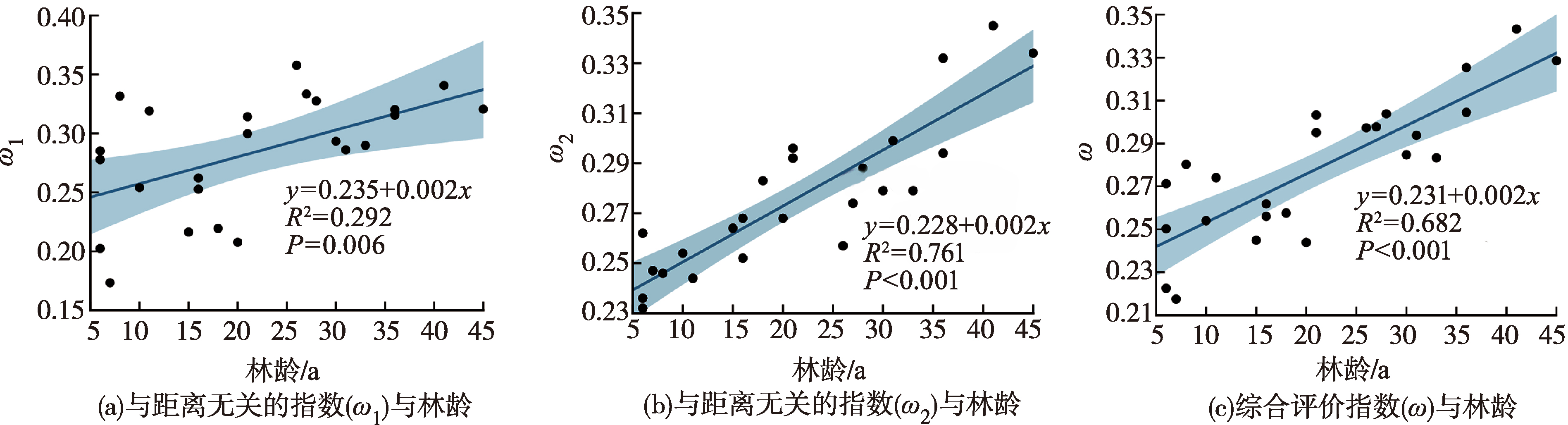
精准评估林分状态对优化森林结构、提升木材产量与生态功能具有重要意义。以马尾松人工林为研究对象,设置幼龄林、中龄林、近熟林和成熟林4个龄组共24个样地,结合单位圆法构建与距离无关的评价指数(ω1)、与距离有关的评价指数(ω2)及综合评价指数(ω),分别表征林分宏观属性、微观空间结构及整体状态,分析不同龄组林分状态差异及其动态变化规律。结果表明:1)不同龄组马尾松人工林林分状态存在显著差异,林木优势度、健康状况、树种组成、树种多样性及混交度均随林龄增加而显著提升,林分由幼龄林阶段的结构简单、树种单一状态,逐步向成熟林阶段的结构复杂、混交增强和状态优化方向演替。2)不同评价指数在龄组间表现出阶段性差异。近熟林的ω1和ω均显著高于幼龄林和中龄林(P<0.05),但与成熟林无显著差异;近熟林的ω2仅显著高于幼龄林,而成熟林的ω2显著高于其他3个龄组(P<0.05)。近熟林是林分整体状态发生显著转变的关键阶段。3)回归分析结果表明,ω1、ω2和ω与林龄之间均呈显著正相关,决定系数(R2)分别为0.292(P<0.05)、0.761(P<0.001)和0.682(P<0.001),林分状态随林龄增长逐步优化。其中,ω2在刻画林分状态变化方面具有更强的解释能力,而ω整合了宏观与微观信息,既能保持较高解释力,又能较全面反映林分整体状态。研究结果可为马尾松人工林林分状态评价、结构优化和分阶段经营提供参考。
中图分类号:
李兴志, 朱洁, 柴宗政. 基于多维度指标的马尾松人工林林分状态综合评价[J]. 林草资源研究, 2026,(1): 34-45.
LI Xingzhi, ZHU Jie, CHAI Zongzheng. Comprehensive evaluation of stand state in Pinus massoniana plantations based on multi-dimensional indicators[J]. Forest and Grassland Resources Research, 2026,(1): 34-45.
表1
样地基本情况
| 调查因子 | 幼龄林 | 中龄林 | 近熟林 | 成熟林 | ||||||||
|---|---|---|---|---|---|---|---|---|---|---|---|---|
| 主要树种组成 | 马尾松、柳杉、杉木、 枫香、光皮桦 | 马尾松、杉木、光皮桦、 山杨、枫香 | 马尾松、杉木、枫香、 麻栎、漆树 | 马尾松、杉木、枫香、 麻栎、桢楠 | ||||||||
| 样地数量/个 | 6 | 6 | 6 | 6 | ||||||||
| 林龄/a | 6 | ~ | 10 | 11 | ~ | 20 | 21 | ~ | 30 | 31 | ~ | 45 |
| 密度/(株/hm2) | 1 725 | ~ | 4 200 | 1 350 | ~ | 3 300 | 975 | ~ | 1 675 | 600 | ~ | 1 100 |
| 郁闭度 | 0.8 | ~ | 0.9 | 0.7 | ~ | 0.9 | 0.7 | ~ | 0.9 | 0.6 | ~ | 0.9 |
| 平均胸径/cm | 9.05 | ~ | 11.79 | 12.78 | ~ | 16.96 | 15.65 | ~ | 18.69 | 20.41 | ~ | 23.04 |
| 平均树高/m | 7.71 | ~ | 14.38 | 12.08 | ~ | 16.18 | 14.73 | ~ | 18.89 | 16.63 | ~ | 19.29 |
| 平均冠幅/m | 2.25 | ~ | 2.79 | 1.56 | ~ | 4.09 | 1.49 | ~ | 4.47 | 2.15 | ~ | 5.71 |
| 濒死木密度/(株/hm2) | 175 | ~ | 350 | 0 | ~ | 400 | 0 | ~ | 325 | 0 | ~ | 50 |
表2
与距离无关的林分状态评价指标及计算公式
| 维度 | 林分状态指标 | 公式及定义 |
|---|---|---|
| 结构 | 胸径分布(A) | 将林木胸径以2 cm为径阶距进行划分,按Meyer负指数分布模型表示胸径结构:N=ke-ad,式中:N为株数;e为自然对数的底;d为胸径;a为负指数分布结构常数,k为常数。A=eah,式中:h表示径阶距为2 cm。若A为1.2~1.7,则表示处在合理的异龄林径阶分布范围内[ |
| 树高分布(V) | 用基尼系数来表示树高分布。V=1- | |
| 林木拥挤度(K) | 用郁闭度表示,若郁闭度K值在0.6~0.8,则表示林分密度合理[ | |
| 活力 | 林木优势度(E) | E= |
| 林分长势(B) | B= | |
| 林木健康(Q) | 健康林木(无病虫害且非断梢、弯曲、空心等)株数占林分总株数的比例[ | |
| 多样性 | 树种组成(Z) | Z=- |
| 树种多样性(D) | D=1- | |
| 树种均匀度(J) | J=- |
表3
与距离有关的林分状态指标取值范围、最优值及类型
| 与距离有关的指标 | 取值范围 | 最优值 | 指标类型 |
|---|---|---|---|
| 混交度(M) | [0,1.0] | 1.0 | 戒上型 |
| 林层差异化(H) | [0,1.0] | 1.0 | 戒上型 |
| 密集度(C) | [0,1.0] | 0.5 | 中间型 |
| 角尺度(W) | [0,1.0] | 0.5 | 中间型 |
| 胸径大小比数(U) | [0,1.0] | 0.0 | 戒下型 |
表4
与距离有关的林分状态评价指标取值等级及意义
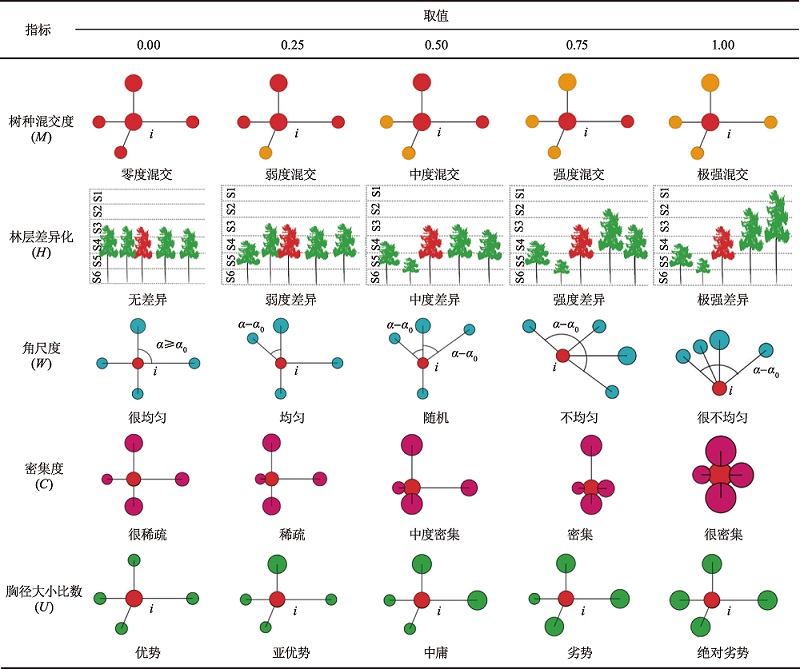 |
表5
与距离有关的林分状态评价指标及计算公式
| 指标 | 计算公式 | 变量说明 |
|---|---|---|
| 混交度(M) | M= | 当参照树i与第j株最近相邻木树种不同时,vij=1;否则vij=0 |
| 林层差异化(H) | H= | Ni为以参照树i为中心的空间结构单元内不同林层类型的数量。 |
| 密集度(C) | C= | 当参照树i与第j株最近相邻木树冠投影相互重叠时,yij=1;否则yij=0 |
| 角尺度(W) | W= | 当以参照树i为顶点,其周围相邻两株相邻木方向线形成的第j个夹角小于标准角α0时,zij=1;否则zij=0;其中α0=72° |
| 胸径大小比数(U) | U= | 当第j株最近相邻木胸径大于参照树i时,kij=1;否则kij=0 |
表6
不同龄组马尾松人工林林分指标对比
| 指标类型 | 指标 | 幼龄林 | 中龄林 | 近熟林 | 成熟林 |
|---|---|---|---|---|---|
| 与距离无关的指标 (ω1) | 胸径分布(A) | 0.284±0.05a | 0.199±0.017b | 0.178±0.015bc | 0.149±0.004c |
| 树高分布(V) | 0.109±0.025a | 0.13±0.033a | 0.169±0.06a | 0.128±0.072a | |
| 林木拥挤度(K) | 0.79±0.265ab | 0.61±0.239bc | 0.958±0.073a | 0.52±0.147c | |
| 林木优势度(A) | 0.384±0.219b | 0.502±0.224b | 0.605±0.195ab | 0.803±0.147a | |
| 林分长势(B) | 0.69±0.017a | 0.669±0.028ab | 0.636±0.036b | 0.664±0.033ab | |
| 林木健康(Q) | 0.901±0.022b | 0.925±0.054ab | 0.934±0.07ab | 0.959±0.035a | |
| 树种组成(Z) | 0.071±0.076c | 0.132±0.143bc | 0.225±0.114b | 0.364±0.088a | |
| 树种多样性(D) | 0.078±0.086c | 0.175±0.209bc | 0.286±0.164b | 0.469±0.106a | |
| 树种均匀度(J) | 0.084±0.073b | 0.142±0.14b | 0.206±0.139ab | 0.29±0.044a | |
| 与距离有关的指标 (ω2) | 混交度优度系数(Mpv) | 0.036±0.039c | 0.114±0.137bc | 0.226±0.147b | 0.41±0.094a |
| 林层差异化优度系数(Hpv) | 0.326±0.1a | 0.375±0.082a | 0.416±0.056a | 0.35±0.119a | |
| 角尺度优度系数(Wpv) | 0.802±0.024a | 0.788±0.029a | 0.806±0.032a | 0.81±0.021a | |
| 密集度优度系数(Cpv) | 0.557±0.018b | 0.6±0.059b | 0.586±0.056b | 0.672±0.022a | |
| 胸径大小比数优度系数(Upv) | 0.399±0.013ab | 0.398±0.015ab | 0.405±0.013a | 0.386±0.016b |
图1
基于单位圆方法的不同龄组马尾松林分状态综合评价 注:单位圆图中径向刻度表示各指标标准化得分,取值范围为0~1;扇形面积越大,表示相应指标评价值越高。柱状图中数值为评价指数均值,误差线表示标准误差;不同小写字母表示不同龄组间差异显著(P<0.05)。ω1为与距离无关的评价指数,ω2为与距离有关的评价指数,ω为林分状态综合评价指数。Mpv、Hpv、Wpv、Cpv和 Upv分别为混交度、林层差异化、角尺度、密集度和胸径大小比数的优度系数。A为胸径分布;V为树高分布;K为林木拥挤度;E为林木优势度;B为林分长势指数;Q为林木健康指数;Z为树种组成指数;D为树种多样性指数;J为树种均匀度指数。
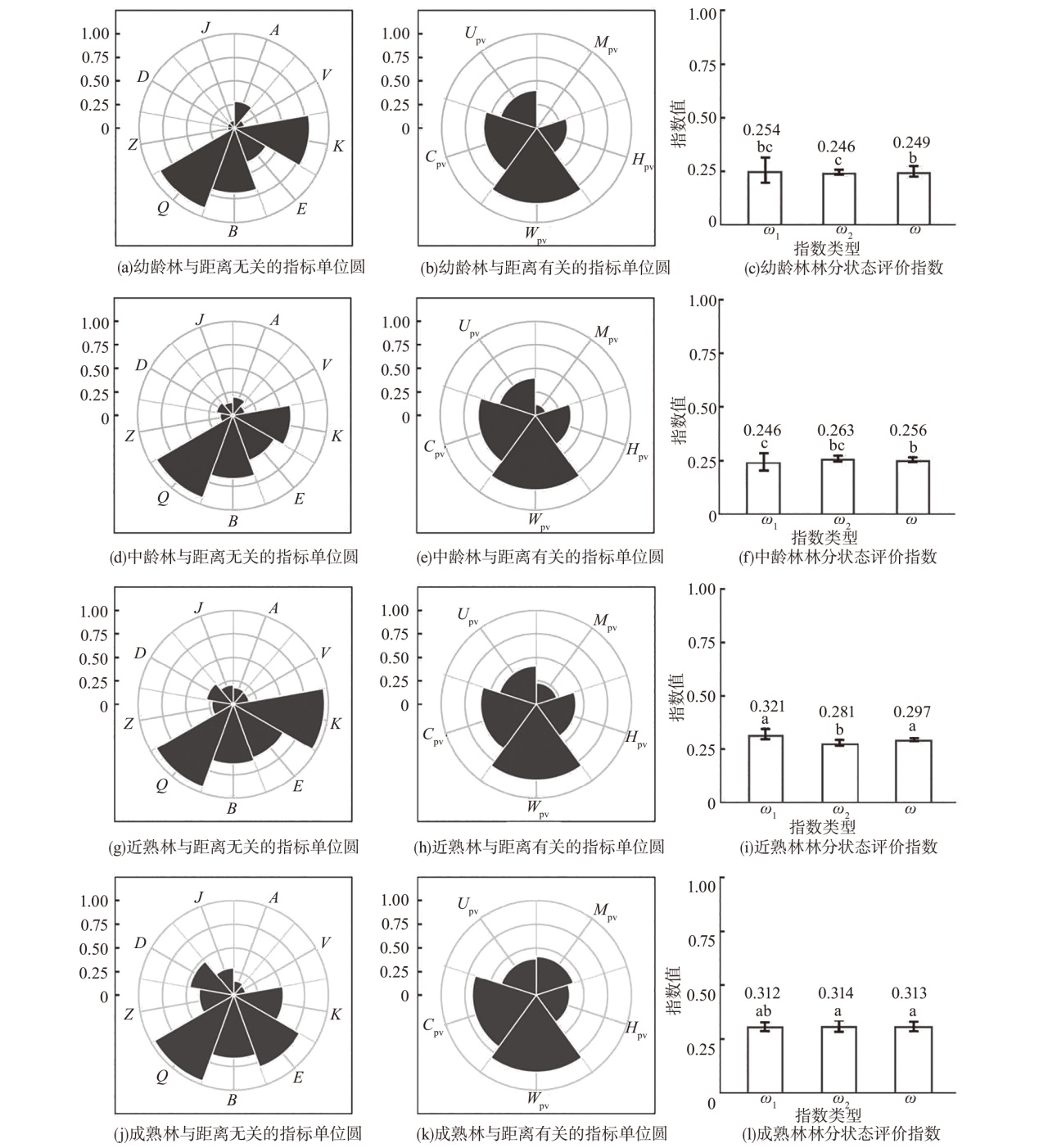
图2
马尾松人工林林分状态与林龄的动态变化分析
| [1] |
Liu Ziye, Feng Zhongke, Chang Chen. GEF Innovative forest management plan:taking grassland forest farm in Fengning county as an example[J]. Sustainability, 2022, 14(13):7795.
doi: 10.3390/su14137795 |
| [2] | Borecki T. Importance of the forest management in the sustainable forest economy[J]. Sylwan, 2008, 152(1):9-14. |
| [3] |
Başkent E Z, Keleş S, Kadloğulla A İ, et al. Quantifying the effects of forest management strategies on the production of forest values:timber,carbon,oxygen,water,and soil[J]. Environmental Modeling and Assessment, 2011, 16(2):145-152.
doi: 10.1007/s10666-010-9238-y |
| [4] |
Sheng Qi, Dong Lingbo, Chen Ying, et al. Selection of the optimal timber harvest based on optimizing stand spatial structure of broadleaf mixed forests[J]. Forests, 2023, 14(10):2046.
doi: 10.3390/f14102046 |
| [5] | Canton H. Food and agriculture organization of the United Nations:FAO[M]// Europa Publications.The Europa Directory of International Organizations 2021.23rd ed. London: Routledge, 2021. |
| [6] |
Luyssaert S, Schulze E D, Börner A, et al. Old-growth forests as global carbon sinks[J]. Nature, 2008, 455(7210):213-215.
doi: 10.1038/nature07276 |
| [7] |
Zhang Ganggang, Hui Gangying, Zhang Gongqiao, et al. A novel comprehensive evaluation method of forest state based on unit circle[J]. Forests, 2019, 10(1):5.
doi: 10.3390/f10010005 |
| [8] | 惠刚盈, 张弓乔, 赵中华, 等. 天然混交林最优林分状态的π值法则[J]. 林业科学, 2016, 52(5):1-8. |
| [9] |
Pommerening A. Approaches to quantifying forest structures[J]. Forestry, 2002, 75(3):305-324.
doi: 10.1093/forestry/75.3.305 |
| [10] |
Dong Lingbo, Wei Hongyang, Liu Zhaogang. Optimizing forest spatial structure with neighborhood-based indices:four case studies from northeast China[J]. Forests, 2020, 11(4):413.
doi: 10.3390/f11040413 |
| [11] |
Wan Pan, Zhang Gongqiao, Wang Hongxiang, et al. Impacts of different forest management methods on the stand spatial structure of a natural Quercus aliena var.acuteserrata forest in Xiaolongshan,China[J]. Ecological Informatics, 2019, 50:86-94.
doi: 10.1016/j.ecoinf.2019.01.007 |
| [12] |
Fu Liyong, Lei Xiangdong, Hu Zongda, et al. Integrating regional climate change into allometric equations for estimating tree aboveground biomass of Masson pine in China[J]. Annals of Forest Science, 2017, 74(2):42.
doi: 10.1007/s13595-017-0636-z |
| [13] |
Zhang Yan, Zhang Danju, Li Xun, et al. Contribution of soil fauna to the degradation of recalcitrant components in cinnamomum camphora foliar litter in different-sized gaps in Pinus massoniana plantations[J]. Journal of Forestry Research, 2019, 30(3):931-941.
doi: 10.1007/s11676-018-0609-6 |
| [14] | 申鹏, 周雯, 柴宗政. 近自然经营对马尾松种群结构及分布格局的影响[J]. 西南林业大学学报(自然科学), 2024, 44(3):35-42. |
| [15] |
Tu Jing, Zhao Zhongwen, Chai Zongzheng. The short-term impact of logging intensity on the stand state of middle-aged Masson pine(pinus massoniana Lamb.) Plantations[J]. Forests, 2025, 16(1):183.
doi: 10.3390/f16010183 |
| [16] | 赵中华, 惠刚盈. 基于林分状态特征的森林自然度评价:以甘肃小陇山林区为例[J]. 林业科学, 2011, 47(12):9-16. |
| [17] | Pukkala T, Lähde E, Laiho O. Continuous cover forestry in Finland-recent research results[M]. Dordrecht: Springer, 2012. |
| [18] | 惠刚盈, 张连金, 胡艳波, 等. 林分拥挤度及其应用[J]. 北京林业大学学报, 2016, 38(10):1-6. |
| [19] | 汤孟平, 唐守正, 李希菲, 等. 树种组成指数及其应用[J]. 林业资源管理, 2003(2):33-36. |
| [20] | Cabello-Solorzano K, Ortigosa De Araujo I, Peña M, et al. The impact of data normalization on the accuracy of machine learning algorithms:a comparative analysis[C]//García Bringas P,Pérez García H,Martínez De Pisón F J,et al. 18th International conference on soft computing models in industrial and environmental applications(SOCO 2023). Cham: Springer Nature Switzerland, 2023:344-353. |
| [21] | 惠刚盈, 胡艳波. 混交林树种空间隔离程度表达方式的研究[J]. 林业科学研究, 2001(1):23-27. |
| [22] |
Clark P J, Evans F C. Distance to nearest neighbor as a measure of spatial relationships in populations[J]. Ecology, 1954, 35(4):445-453.
doi: 10.2307/1931034 |
| [23] | 邹丰虎, 赵中文, 黄建平, 等. 基于模拟采伐马尾松人工林的空间结构优化决策[J]. 温带林业研究, 2021, 4(4):11-16. |
| [24] | 柴宗政. 基于相邻木关系的森林空间结构量化评价及R语言编程实现:以秦岭中山带典型次生林为例[D]. 杨凌: 西北农林科技大学, 2017. |
| [25] | 严兰, 谭伟, 柴宗政. 不同龄组柳杉人工林林分结构分析[J]. 福建农林大学学报(自然科学版), 2019, 48(3):316-324. |
| [26] | 惠刚盈, 赵中华, 胡艳波, 等. 基于结构参数均值的林分空间结构综合评价研究[J]. 林业科学研究, 2023, 36(2):12-21. |
| [27] |
Bāders E, Jõgiste K, Elferts D, et al. Storm legacies shaping post-windthrow forest regeneration:learnings from spatial indices in unmanaged Norway spruce stands[J]. European Journal of Forest Research, 2021, 140(4):819-833.
doi: 10.1007/s10342-021-01368-x |
| [28] |
Kassier H W. Forest dynamics,growth and yield:from measurement to model[J]. Southern Forests:A Journal of Forest Science, 2011, 73(1):63-65.
doi: 10.2989/20702620.2011.574816 |
| [29] | Messier C, Puettmann K J. Forests as complex adaptive systems:implications for forest management and modelling[J]. L’italia Forestale E Montana, 2011, 66(3):249-258. |
| [30] |
Kint V. Structural development in ageing temperate Scots pine stands[J]. Forest Ecology and Management, 2005, 214(1):237-250.
doi: 10.1016/j.foreco.2005.04.014 |
| [31] | O’hara K L. Multiaged silviculture:managing for complex forest stand structures[M]. Oxford: Oxford University Press, 2014. |
| [32] |
Zeller L, Prechzsch H. Effect of forest structure on stand productivity in central european forests depends on developmental stage and tree species diversity[J]. Forest Ecology and Management, 2019, 434:193-204.
doi: 10.1016/j.foreco.2018.12.024 |
| [33] | 朱洁, 李兴志, 刘云山, 等. 马尾松人工林空间结构评价及动态分析[J]. 西部林业科学, 2025, 54(3):9-17. |
| [34] | Prechzsch H. Forest dynamics,growth and yield:from measurement to model[M]. Berlin: Springer-Verlag, 2009. |
| [35] |
Wang Boheng, Zhou Chaofan, Liu Di, et al. Stability and spatial structure of Chinese pine(Pinus tabuliformis carr.) plantations in loess hilly region:a case study from Huanglong mountain[J]. Forests, 2023, 14(9):1921.
doi: 10.3390/f14091921 |
| [36] | 姜俊, 谢阳生, 陆元昌, 等. 不同林龄阶段马尾松人工林群落结构特征及经营策略[J]. 西北林学院学报, 2015, 30(6):1-7. |
| [37] | 陈超, 赵吟吟, 俞家聪, 等. 基于角尺度、混交度和胸径优势度的杉木混交林空间结构优化[J]. 林草资源研究, 2025(1):38. |
| [38] | 李佳妮, 胡杨, 杨君珑. 基于无人机激光雷达的贺兰山青海云杉林空间结构分析与促进更新模拟研究[J]. 林草资源研究, 2025(4):52-61. |
| [39] |
Zhao Zhonghua, Hui Gangying, Yang Aimin, et al. Assessing tree species diversity in forest ecosystems:a new approach[J]. Frontiers in Ecology and Evolution, 2022, 10:971585.
doi: 10.3389/fevo.2022.971585 |
| [40] |
Dong Lingbo, Bettinger Pete, Liu Zhaogang. Optimizing neighborhood-based stand spatial structure:four cases of boreal forests[J]. Forest Ecology and Management, 2022, 506:119965.
doi: 10.1016/j.foreco.2021.119965 |
| [41] |
Fang Xianfeng, Tan Wei, Chai Zongzheng. Close-to-nature management positively improves the spatial structure of Masson pine forest stands[J]. Web Ecology, 2021, 21:45-54.
doi: 10.5194/we-21-45-2021 |
| [42] |
Yang Senlin, Mao Kangshan, Yang Hao, et al. Stand characteristics and ecological benefits of Chinese fir,Chinese cedar,and mixed plantations in the mountainous areas of the Sichuan basin[J]. Forest Ecology and Management, 2023, 544:121168.
doi: 10.1016/j.foreco.2023.121168 |
| [1] | 蒋亚桂, 王瑞辉, 刘凯利, 张斌, 焦泽南, 刘雨倩, 邹涛. 抚育经营措施对杉木近熟林生长影响的研究[J]. 林草资源研究, 2025, 0(3): 75-82. |
| [2] | 国红, 雷相东, 王雪军. 我国森林经营技术标准现状与发展建议[J]. 林草资源研究, 2025, 0(1): 17-25. |
| [3] | 李郊, 王冰, 王晨, 高鹤, 吴辉龙, 郑鑫, 彭华福. 2005—2020年江西省森林碳储量时空变化趋势及影响因素[J]. 林草资源研究, 2024, 0(1): 17-24. |
| [4] | 王倩, 王红春, 王端. 森林经营方案施行检评方法研究[J]. 林业资源管理, 2023, 0(4): 179-184. |
| [5] | 王凯旋, 胡月, 胡磊, 张亚昊, 韩泽民, 李斌, 李晓辉, 张卓文, 佃袁勇. 基于FLR和SFM的新型森林经营方案编制与实施[J]. 林业资源管理, 2022, 0(zk1): 24-31. |
| [6] | 陈绍志, 邬可义, 韩东阳, 邹文涛. 国有林场新型森林经营方案编制的思考——以木兰围场国有林场为例[J]. 林业资源管理, 2022, 0(zk1): 32-38. |
| [7] | 唐小平, 欧阳君祥. 森林经营方案发展综述[J]. 林业资源管理, 2022, 0(zk1): 8-18. |
| [8] | 李洪, 涂宏涛, 姚兴博, 马国强, 张蓉, 杨书宇. 经营单位级森林资源动态监测评估系统构建研究[J]. 林业资源管理, 2022, 0(2): 54-60. |
| [9] | 秦家炜, 于宝勒. 我国内蒙古西部地区国有林场经营现状与发展问题探析[J]. 林业资源管理, 2021, 0(1): 17-22. |
| [10] | 徐军, 姚鸿文, 张国江, 谭莹. 县域森林经营增汇减排发展路径研究——以浙江省临安区为例[J]. 林业资源管理, 2020, 0(6): 66-71. |
| [11] | 刘静. 新型森林经营方案编制与实施[J]. 林业资源管理, 2020, 0(3): 6-10. |
| [12] | 胡中洋, 刘锐之, 刘萍. 建立森林经营规划与森林经营方案编制体系的思考[J]. 林业资源管理, 2020, 0(3): 11-14. |
| [13] | 王金池, 黄如楚, 黄清麟, 马志波, 郑群瑞, 严铭海. 马尾松人工林皆伐1年后新增天然阔叶幼树初报[J]. 林业资源管理, 2019, 0(6): 115-120. |
| [14] | 胡中洋, 刘锐之, 刘萍. 基于MATLAB的森林经营方案编制程序设计[J]. 林业资源管理, 2019, 0(4): 132-136. |
| [15] | 王云霖. 我国人工林发展研究[J]. 林业资源管理, 2019, 0(1): 6-11. |
| 阅读次数 | ||||||
|
全文 |
|
|||||
|
摘要 |
|
|||||
