

Forest and Grassland Resources Research ›› 2024›› Issue (5): 86-95.doi: 10.13466/j.cnki.lczyyj.2024.05.010
• Scientific Research • Previous Articles Next Articles
WU Jilai1( ), MAO Yangjun2,3,4, CHEN Yangen1, HU Ao2,3,4, WU Yanping2,3,4, SHI Yan5, WANG Yixiang2,3,4()
Received:2024-08-30
Revised:2024-09-30
Online:2024-10-28
Published:2025-04-18
CLC Number:
WU Jilai, MAO Yangjun, CHEN Yangen, HU Ao, WU Yanping, SHI Yan, WANG Yixiang. The Impact of Natural Recovery of Diseased and Pest-infected Treescutting on the Niche and Diversity of Secondary Pinus massoniana Forests[J]. Forest and Grassland Resources Research, 2024, (5): 86-95.
Add to citation manager EndNote|Ris|BibTeX
URL: https://www.lyzygl.com.cn/EN/10.13466/j.cnki.lczyyj.2024.05.010
Tab.1
Basic overview of Pinus massoniana stands under different cutting intensities and natural restoration years
| 处理 | 累积株数采伐强度 | 自然恢复年限/a | 郁闭度 | 主要乔木树种 | 平均胸径/cm |
|---|---|---|---|---|---|
| CK | 未采伐 | 0.7 | 马尾松、青冈、枫香树等 | 17.03±0.93 | |
| MT5 | 30%~40%,中度采伐 | 5 | 0.6 | 马尾松、木荷、青冈等 | 19.20±1.40 |
| HT5 | 60%~80%,重度采伐 | 5 | 0.5 | 木荷、马尾松、青冈等 | 17.68±0.70 |
| MT15 | 30%~40%,中度采伐 | 15 | 0.7 | 马尾松、青冈、苦槠等 | 12.05±1.59 |
| HT15 | 60%~80%,重度采伐 | 15 | 0.7 | 杉木、青冈、女贞等 | 9.87±0.67 |
Tab.2
Importance values of arbor species under different cutting intensities and natural restoration years %
| 树种 | 重要值 | |||||
|---|---|---|---|---|---|---|
| CK | MT5 | HT5 | MT15 | HT15 | ||
| 针叶树 | 马尾松(Pinus massoniana) | 40.02(1) | 60.74(1) | 26.95(2) | 29.50(1) | 1.31(13) |
| 杉木(Cunninghamia lanceolata) | 3.52(5) | 3.90(4) | 6.09(6) | 28.68(1) | ||
| 合计 | 40.02 | 64.26 | 30.85 | 35.59 | 29.99 | |
| 阔叶树 | 青冈(Quercus glauca) | 27.77(2) | 6.17(3) | 4.00(3) | 18.80(2) | 12.04(2) |
| 木荷(Schima superba) | 19.09(2) | 61.28(1) | 4.70(7) | 7.05(6) | ||
| 油茶(Camellia oleifera) | 3.19(5) | 3.21(6) | 8.55(5) | 7.59(5) | ||
| 檵木(Loropetalum chinense) | 3.01(7) | 3.87(5) | 2.71(10) | |||
| 枫香树(Liquidambar formosana) | 25.71(3) | 8.74(4) | ||||
| 苦槠(Castanopsis sclerophylla) | 15.47(3) | 6.48(7) | ||||
| 女贞(Ligustrum lucidum) | 13.18(4) | 9.79(3) | ||||
| 棕榈(Trachycarpus fortunei) | 3.31(4) | |||||
| 山矾(Symplocos sumuntia) | 4.26(4) | |||||
| 白栎(Quercus fabri) | 3.71(8) | |||||
| 豹皮樟(Litsea coreana var.sinensis) | 5.45(8) | |||||
| 黄檀(Dalbergia hupeana) | 2.89(9) | |||||
| 灯台树(Cornus controversa) | 2.54(11) | |||||
| 梾木(Cornus macrophylla) | 2.45(12) | |||||
| 盐麸木(Rhus chinensis) | 1.16(14) | |||||
| 三角槭(Acer buergerianum) | 1.12(15) | |||||
| 合计 | 59.98 | 35.74 | 69.15 | 64.41 | 70.01 | |
Tab.3
Niche breadth of arbor species under different cutting intensities and natural restoration years
| 树种 | 生态位宽度(BL) | |||||
|---|---|---|---|---|---|---|
| CK | MT5 | HT5 | MT15 | HT15 | ||
| 针叶树 | 马尾松(Pinus massoniana) | 3.816 | 2.999 | 1.936 | 2.990 | 1.000 |
| 杉木(Cunninghamia lanceolata) | 1.000 | 1.000 | 1.690 | 2.728 | ||
| 阔叶树 | 青冈(Quercus glauca) | 2.827 | 1.748 | 1.000 | 2.510 | 1.615 |
| 木荷(Schima superba) | 2.885 | 2.920 | 1.000 | 1.766 | ||
| 油茶(Camellia oleifera) | 1.000 | 1.000 | 2.179 | 2.837 | ||
| 檵木(Loropetalum chinense) | 1.000 | 1.000 | 1.732 | |||
| 枫香树(Liquidambar formosana) | 2.898 | 1.596 | ||||
| 苦槠(Castanopsis sclerophylla) | 2.918 | 2.472 | ||||
| 女贞(Ligustrum lucidum) | 1.855 | 2.184 | ||||
| 棕榈(Trachycarpus fortunei) | 1.000 | |||||
| 山矾(Symplocos sumuntia) | 1.000 | |||||
| 白栎(Quercus fabri) | 1.000 | |||||
| 豹皮樟(Litsea coreana var.sinensis) | 1.000 | |||||
| 黄檀(Dalbergia hupeana) | 1.000 | |||||
| 灯台树(Cornus controversa) | 1.000 | |||||
| 梾木(Cornus macrophylla) | 1.000 | |||||
| 盐麸木(Rhus chinensis) | 1.000 | |||||
| 三角槭(Acer buergerianum) | 1.000 | |||||
Tab.4
Niche overlap between Pinus massoniana and other tree species under different cutting intensities and natural restoration years
| 树种 | 与马尾松的生态位重叠 | |||||
|---|---|---|---|---|---|---|
| CK | MT5 | HT5 | MT15 | HT15 | ||
| 针叶树 | 杉木(Cunninghamia lanceolata) | 0.593 | 0.888 | 0.616 | 0.536 | |
| 阔叶树 | 青冈(Quercus glauca) | 0.896 | 0.828 | 0.937 | 0.879 | 0.000 |
| 木荷(Schima superba) | 0.983 | 0.671 | 0.476 | 0.926 | ||
| 油茶(Camellia oleifera) | 0.406 | 0.593 | 0.796 | 0.388 | ||
| 檵木(Loropetalum chinense) | 0.566 | 0.046 | 0.000 | |||
| 枫香树(Liquidambar formosana) | 0.995 | 0.314 | ||||
| 苦槠(Castanopsis sclerophylla) | 0.931 | 0.489 | ||||
| 女贞(Ligustrum lucidum) | 0.639 | 0.912 | ||||
| 棕榈(Trachycarpus fortunei) | 0.729 | |||||
| 山矾(Symplocos sumuntia) | 0.572 | |||||
| 白栎(Quercus fabri) | 0.476 | |||||
| 豹皮樟(Litsea coreana var.sinensis) | 0.000 | |||||
| 黄檀(Dalbergia hupeana) | 0.000 | |||||
| 灯台树(Cornus controversa) | 0.000 | |||||
| 梾木(Cornus macrophylla) | 1.000 | |||||
| 盐麸木(Rhus chinensis) | 1.000 | |||||
| 三角槭(Acer buergerianum) | 1.000 | |||||
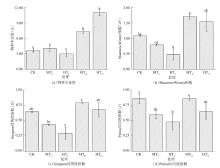
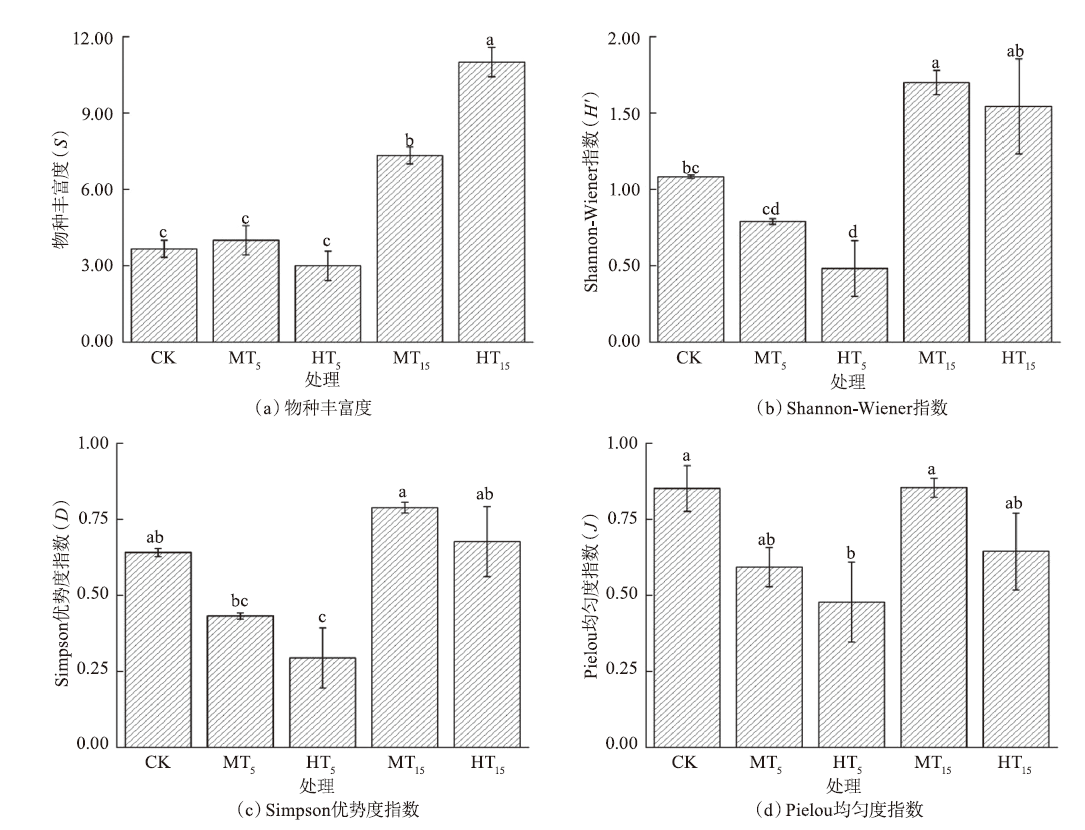
Fig.1
Species diversity index of Pinus massoniana stands under different cutting intensities and natural restoration years
Tab.5
Two-factor analysis of the effects of cutting intensity and natural restoration period on species diversity index
| 因素 | 物种丰富度(S) | Shannon-Wiener多样性指数(H') | Simpson优势度指数(D) | Pielou均匀度指数(J) |
|---|---|---|---|---|
| 采伐强度 | * | ns | ns | ns |
| 自然恢复年限 | ** | ** | ** | ns |
| 采伐强度×自然恢复年限 | ** | ns | ns | ns |
| [1] | 项文化, 田大伦. 不同年龄阶段马尾松人工林养分循环的研究[J]. 植物生态学报, 2002, 26(1):89-95. |
| [2] | 张华锋, 陈思宇, 刘刚, 等. 松材线虫病疫木卫生伐对马尾松纯林林分结构的影响[J]. 浙江农林大学学报, 2020, 37(4):745-751. |
| [3] | 洪利兴, 王泳, 杜国坚, 等. 我国南方马尾松林生态系统的退化特征和改造对策研究[J]. 浙江林业科技, 2000, 20(2):1-9. |
| [4] | 叶建仁, 吴小芹. 松材线虫病研究进展[J]. 中国森林病虫, 2022, 41(3):1-10. |
| [5] | 邓莉丽, 刘青华, 周志春, 等. 抗松材线虫病马尾松种质资源遗传多样性分析及核心种质构建[J]. 浙江农林大学学报, 2024, 41(1):67-78. |
| [6] | 果叮咚, 谢力. “数字森防”助力浙江高质量防控松材线虫病[N/OL].(2024-01-16)[2024-08-02]. http://lyj.zj.gov.cn/art/2024/1/16/art_1276365_59065117.html. |
| [7] | 万凌凡, 刘国华, 樊辉, 等. 青藏高原东南部森林群落生态位特征与物种多样性的影响因素[J]. 生态学报, 2024, 44(13):5658-5668. |
| [8] | 黄睿雪, 欧静, 王洪飞, 等. 百里杜鹃国家森林公园植物群落物种多样性及优势种生态位宽度对人为干扰的响应[J]. 生态学杂志, 2024, 43(5):1217-1226. |
| [9] | 沈琪, 张骏, 朱锦茹, 等. 浙江省生态公益林植被恢复过程中物种组成及多样性的变化[J]. 生态学报, 2005, 25(9):2131-2138. |
| [10] | 南国卫, 韩磊, 何馨雨, 等. 刺槐林草本层物种多样性的动态变化特征[J]. 森林与环境学报, 2022, 42(5):491-497. |
| [11] | 胡澳, 赵毅辉, 吴继来, 等. 采伐后植被自然恢复对马尾松次生林土壤有机碳及其活性组分的影响[J]. 浙江农林大学学报, 2024, 41(6):1189-1200. |
| [12] |
吴敏娟, 尤誉杰, 张晓红, 等. 不同干扰模式对受害马尾松人工纯林林分结构的影响[J]. 应用生态学报, 2019, 30(1):58-66.
doi: 10.13287/j.1001-9332.201901.007 |
| [13] | ERIC K, ALANA L B, MARGARET M M. Understory plant species and functional diversity in the degraded wet tropical forest of Kolombangara Island,Solomon Islands[J]. Bioligical Conservation, 2012,145:214-224. |
| [14] | 刘艳红, 赵惠勋. 干扰与物种多样性维持理论研究进展[J]. 北京林业大学学报, 2000, 22(4):101-105. |
| [15] | 赵勇强, 阎玺羽, 谢加琪, 等. 退化喀斯特森林自然恢复中不同生活史阶段木本植物物种多样性与群落构建[J]. 生物多样性, 2024, 32(5):72-83. |
| [16] | PARIONA W, FREDERICKSEN T S, LICONA J C. Natural regeneration and liberation of timber species in cutting gaps in two Bolivian tropical forests[J]. Forest Ecology and Management, 2003, 181(3):313-322. |
| [17] | 石娟, 骆有庆, 宋冀莹, 等. 松材线虫入侵后不同伐倒干扰强度对马尾松林植物多样性的影响[J]. 应用生态学报, 2006, 17(7):1157-1163. |
| [18] | 邹丰虎, 周雯, 柴宗政. 近自然经营对马尾松林优势树种生态位及种间关系的影响[J]. 西部林业科学, 2024, 53(1):55-65. |
| [19] | 罗应华, 孙冬婧, 林建勇, 等. 马尾松人工林近自然化改造对植物自然更新及物种多样性的影响[J]. 生态学报, 2013, 33(19):6154-6162. |
| [20] | 黎露, 王永琪, 马姜明, 等. 南亚热带马尾松人工林近自然恢复过程中林下木本植物生态位动态[J]. 广西科学, 2021, 28(5):499-510. |
| [21] | 姚珊, 郭其强, 盘金文, 等. 马尾松人工林发育过程中林下灌草群落优势种生态位动态分析[J]. 西北植物学报, 2021, 41(8):1417-1424. |
| [22] | 马克平. 生物群落多样性的测度方法Ⅰα多样性的测度方法(上)[J]. 生物多样性, 1994, 2(3):162-168. |
| [23] | 马克平, 刘玉明. 生物群落多样性的测度方法Ⅰα多样性的测度方法(下)[J]. 生物多样性, 1994, 2(4):231-239. |
| [24] | LEVINS R. Evolution in changing environments:Some theoretical explorations[M]. New Jersey: Princeton University Press,1968. |
| [25] | PIANKA E R. The structure of lizard communities[J]. Annual Review of Ecology and Systematics, 1973, 4(1):53-74. |
| [26] |
张慧, 周国模, 白尚斌, 等. 目标树抚育对亚热带天然次生灌丛群落结构和多样性的影响[J]. 应用生态学报. 2017, 28(5):1414-1420.
doi: 10.13287/j.1001-9332.201705.037 |
| [27] | GU Li, GONG Zhiwen, LI Weizhong. Niches and interspecific associations of dominant populations in three changed stages of natural secondary forests on Loess Plateau,P.R.China[J]. Scientific Reports, 2017, 7(1):1-12. |
| [28] | 史作民, 程瑞梅, 刘世荣. 宝天曼落叶阔叶林种群生态位特征[J]. 应用生态学报, 1999, 10(3):10-14. |
| [29] | SMITH M D, KNAPP A K. Dominant species maintain ecosystem function with non-random species loss[J]. Ecological Letters, 2003, 6(8):509-517. |
| [30] | 唐洪辉, 赵庆, 陈星澄, 等. 桉树不同采伐强度对新栽阔叶树种生态位及其生长量的影响[J]. 中南林业科技大学学报, 2021, 41(4):101-110. |
| [31] |
马万里, 罗菊春, 荆涛, 等. 采伐干扰对长白山核桃楸林生物多样性的影响研究[J]. 植物研究, 2007, 27(1):119-124.
doi: 10.7525/j.issn.1673-5102.2007.01.022 |
| [32] | 巫志龙, 陈金太, 周新年, 等. 择伐强度对天然次生林乔木层6种优势种群生态位的影响[J]. 热带亚热带植物学报, 2013, 21(2):161-167. |
| [33] | PETRAITIS P S. Algebraic and graphical relationships among niche breadth measures[J]. Ecology, 1981, 62(3):545-548. |
| [34] | 陆云峰, 杨安娜, 王豪, 等. 紫楠天然群落优势物种生态位与种间联结性[J]. 林业科学研究, 2024, 37(3):61-67. |
| [35] | 马姜明, 占婷婷, 莫祖英, 等. 漓江流域岩溶区檵木群落不同恢复阶段主要共有种生态位变化[J]. 西北植物学报, 2012, 32(12):2530-2536. |
| [36] | 张乐满, 兰波, 张东升, 等. 三峡水库涪陵—奉节段消落带优势草本植物生态位与种间联结性研究[J]. 生态学报, 2022, 42(8):3228-3240. |
| [37] | SPIES T A, FRANKLIN J F, KLOPSCH M. Canopy gaps in Douglas-fir forests of the Cascade Mountains[J]. Canadian Journal of Forest Research, 1990, 20(5):649-658. |
| [38] | 舒琪, 徐瑞晶, 胡璇, 等. 海南岛甘什岭青梅群落主要乔木树种生态位与种间联结[J]. 生态学杂志, 2021, 40(9):2689-2697. |
| [39] | 张明霞, 王得祥, 康冰, 等. 秦岭华山松天然次生林优势种群的种间联结性[J]. 林业科学, 2015, 51(1):12-21. |
| [40] | 董冬, 许小天, 周志翔, 等. 安徽九华山风景区古树群落主要种群生态位的动态变化[J]. 生态学杂志, 2019, 38(5):1292-1304. |
| [41] | 齐麟, 代力民, 于大炮, 等. 采伐对长白山阔叶红松林乔木群落的影响[J]. 湖南农业科学, 2009(8):129-132. |
| [42] | 陈旭, 刘宗悦, 徐钧杰, 等. 天目山毛竹林皆伐后群落的恢复特征[J]. 浙江农林大学学报, 2022, 39(4):705-716. |
| [1] | SONG Zhenjiang, LENG Mingni, WU Baoshu, KANG Xiaolan. Ecological security assessment of Poyang Lake by using ecological niche model and its key influencing factors [J]. Forest and Grassland Resources Research, 2025, 0(6): 48-59. |
| [2] | YANG Chen, LI Yichen, ZHANG Maobin, LI Xin, SHI Wenjie, ZE Sangzi, MA Yunqiang. Research progress on remote sensing of pine wilt disease based on phased prevention and control [J]. Forest and Grassland Resources Research, 2025, 0(5): 121-128. |
| [3] | PANG Lidong, WU Baolong, CHEN Li, WANG Qi, PANG Wanlong. The mechanism of photosynthetic water niche differentiation between invasive species of Xanthium strumanum subsp.italicum and X.spinosum in the same domain [J]. Forest and Grassland Resources Research, 2025, 0(3): 83-91. |
| [4] | WANG Yukang, HUANG Leijun, LI Yang. A detection method for pine wood nematode-infected trees using an improved YOLOv8n model [J]. Forest and Grassland Resources Research, 2025, 0(1): 114-125. |
| [5] | GUO Haotian, XIE Peizheng, CHEN Xiaowei, ZHOU Mengli, JIN Shanshan, YAN Dongfeng. Identification of Protection Gaps for Key Wild Tree Species in the Yellow River Basin of Henan Province [J]. Forest and Grassland Resources Research, 2024, 0(3): 96-105. |
| [6] | LUO Yaopei, LI Heping, YANG Guangbin, CEN Gang, LI Man, CAO Qianyang, WANG Renru, CHEN Panfang. Volume Estimation Method of High Canopy Density Pinus massoniana Forest Based on UAV Image [J]. Forest and Grassland Resources Research, 2024, 0(2): 68-79. |
| [7] | LI Wei, WANG Xiaohong. Individual Tree Segmentation Algorithm of Pinus MassonianaForest Based on Fusion Point Cloud Data [J]. Forest and Grassland Resources Research, 2024, 0(2): 92-100. |
| [8] | HU Xinting, YUAN Jun, CHENG Yonqquan, GUO Fengyi, YUAN Weiying, LI Gang, YANG Yongfeng. Biodiversity Conservation and Practice in National Wetland Park—A Case Study of Xixi National Wetland Park [J]. Forest and Grassland Resources Research, 2024, 0(2): 133-140. |
| [9] | DU Jun, CAO Jiashuo, LI Weidie. Survey and Evaluation of Wildlife Resources in Heilongjiang Huzhong National Nature Reserve [J]. Forest and Grassland Resources Research, 2023, 0(6): 82-90. |
| [10] | TANG Jiajun, WANG Gang, CHAI Zongzheng. Single-TreeVolume Estimation of Pinus massoniana based on Airborne LiDAR Point Cloud [J]. Forest and Grassland Resources Research, 2023, 0(6): 105-112. |
| [11] | JIAO Quanjun, ZHENG Yanfeng, HUANG Wenjiang, ZHANG Bing, ZHANG Heyi, SHI Yimeng, WU Fayun, FU Anmin. Detection of Discolored Trees Caused by Pine Wilt Disease Based on Vegetation Index Method Using Terrestrial Ecosystem Carbon Inventory Satellite Data [J]. FOREST RESOURCES WANAGEMENT, 2023, 0(4): 123-131. |
| [12] | LUO Wen, LI Yanpeng, XU Han, QIN Wenhao, LIU Daye, MO Shiqin. Characteristics of Suitable Communities of Hopea hainanensis, a Wild Plant with Extremely Small Populations in National Park of Hainan Tropical Rainforest [J]. FOREST RESOURCES WANAGEMENT, 2023, 0(4): 98-106. |
| [13] | YANG Shenjun, TAN Wei, CHEN Xinyu, TANG Jiajun, YANG Zejun, WU Yujie. Study on Stand Spatial Structure of Typical Pinus massoniana Mixed Forest in Liping County of Guizhou Province [J]. FOREST RESOURCES WANAGEMENT, 2023, 0(3): 105-114. |
| [14] | LI Cheng, TANG Daisheng, JIA Jianbo. Estimation of Pinus massoniana Index Based on Geostatistical Spatial Analysis [J]. FOREST RESOURCES WANAGEMENT, 2023, 0(3): 128-133. |
| [15] | ZHANG Min, WANG Jian, HAN Tianyi, OUYANG Xunzhi, PAN Ping, LIU Dongdong. Characteristics of Carbon Density and Its Influencing Factors of Pinus massoniana Forest Based on CBM-CFS3 Model [J]. FOREST RESOURCES WANAGEMENT, 2022, 0(6): 44-53. |
| Viewed | ||||||
|
Full text |
|
|||||
|
Abstract |
|
|||||
