

Forest and Grassland Resources Research ›› 2024›› Issue (5): 148-156.doi: 10.13466/j.cnki.lczyyj.2024.05.016
• Technical Application • Previous Articles Next Articles
ZHANG Zhaoxiang1,2( ), LUO Qinghong2, HE Miao2, NING Husen2, ZHANG Zhijun3, BAO Qiang4, SUN Qian1()
Received:2024-08-02
Revised:2024-10-08
Online:2024-10-28
Published:2025-04-18
CLC Number:
ZHANG Zhaoxiang, LUO Qinghong, HE Miao, NING Husen, ZHANG Zhijun, BAO Qiang, SUN Qian. Assessment and Analysis of Carbon Storage in Aksu Kekeya Ecosystem Based on the InVEST Model[J]. Forest and Grassland Resources Research, 2024, (5): 148-156.
Add to citation manager EndNote|Ris|BibTeX
URL: https://www.lyzygl.com.cn/EN/10.13466/j.cnki.lczyyj.2024.05.016
Tab.1
Carbon intensity of different land use types in Kekeya t/hm2
| 土地利用类型 | Cabove | Cbelow | Csoil | Cdead | ||
|---|---|---|---|---|---|---|
| 0~<20 cm | 20~<40 cm | 40~60 cm | ||||
| 耕地 | 10.58 | 11.34 | 25.12 | 20.68 | 19.38 | 0.24 |
| 林地 | 13.35 | 10.24 | 22.16 | 18.42 | 17.23 | 0.66 |
| 草地 | 0.71 | 6.24 | 12.14 | 9.68 | 6.87 | 0.22 |
| 水域 | 0.93 | 0.66 | 0 | 0 | 0 | 0 |
| 建设用地 | 3.29 | 2.11 | 0 | 0 | 0 | 0 |
| 未利用土地 | 0.66 | 1.26 | 0.76 | 0.41 | 0.27 | 0 |
Tab.2
Carbon storage in different land use types in Kekeya in 2020 t
| 土地利用类型 | 地上生物碳储量 | 地下生物碳储量 | 土壤碳储量 | 死亡有机质碳储量 | 总碳储量 |
|---|---|---|---|---|---|
| 耕地 | 1.24×10⁵ | 1.26×10⁵ | 7.28×10⁵ | 4.21×10³ | 9.82×10⁵ |
| 林地 | 5.84×10⁵ | 6.47×10⁵ | 4.96×10⁶ | 2.05×10⁴ | 6.21×10⁶ |
| 草地 | 7.21×10⁴ | 8.56×10⁴ | 3.97×10⁵ | 1.21×10³ | 5.56×10⁵ |
| 水域 | 2.81×10⁴ | 1.51×10⁴ | 0 | 0 | 4.32×10⁴ |
| 建设用地 | 1.41×10⁵ | 2.28×10⁵ | 0 | 0 | 3.69×10⁵ |
| 未利用土地 | 1.52×10⁴ | 1.72×10⁴ | 7.41×10⁴ | 0 | 1.07×10⁵ |
| 合计 | 9.64×10⁵ | 1.12×10⁶ | 6.16×10⁶ | 2.59×10⁴ | 8.27×10⁶ |

Fig.1
Spatial distribution map of carbon storage in Kekeya engineering area


Fig.2
The soil carbon density and carbon storage of various land use types in the Kekeya engineering area
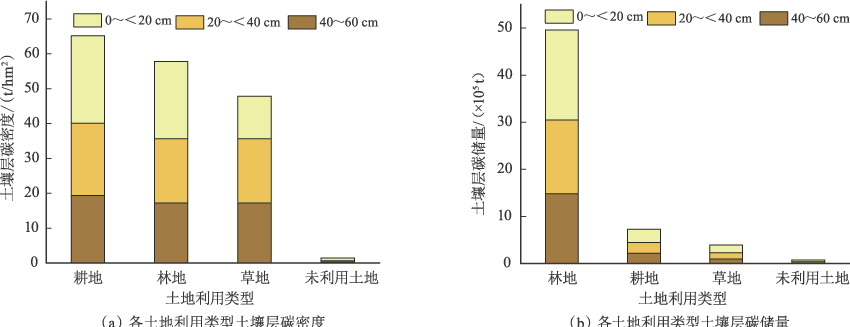

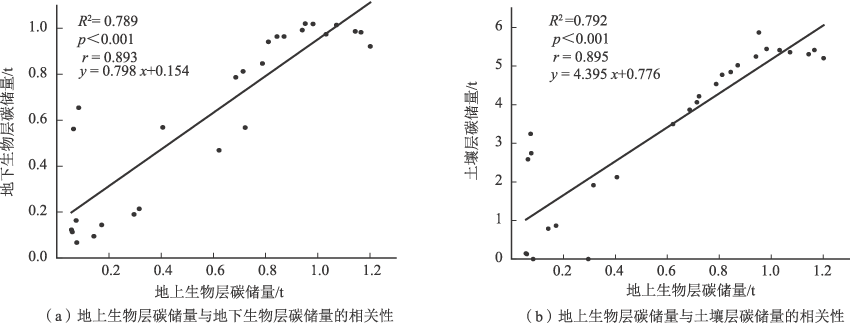
Fig.3
The correlation between the carbon storage in the aboveground biomass layer and the carbon storage in the underground biomass layer and the soil layer
| [1] | COSTANZA R, DE GROOT R, SUTTON P, et al. Changes in the global value of ecosystem services[J]. Global Environmental Change, 2014, 26(5):152-158. |
| [2] | 秦大河, STOCKER T. IPCC第五次评估报告第一工作组报告的亮点结论[J]. 气候变化研究进展, 2014, 10(1):1-6. |
| [3] | 杨元合, 石岳, 孙文娟, 等. 中国及全球陆地生态系统碳源汇特征及其对碳中和的贡献[J]. 中国科学:生命科学, 2022, 52(4):534-574. |
| [4] | 丁一汇, 任国玉, 石广玉, 等. 气候变化国家评估报告(I):中国气候变化的历史和未来趋势[J]. 气候变化研究进展, 2006, 2(1):1-5. |
| [5] | WOODWELL G M, WHITAKE RR H, REINERS W A, et al. Biota and world carbon budget[J]. Science, 1978, 199(4325):141-146. |
| [6] | 刘国华, 傅伯杰, 方精云. 中国森林碳动态及其对全球碳平衡的贡献[J]. 生态学报, 2000, 20(5):733-740. |
| [7] | WOODALL C W, HEATH L S, SMITH J E. National inventories of down and dead woody material forest carbon stocks in the United States:Challenges and opportunities[J]. Forest Ecology and Management, 2008, 256(3):221-228. |
| [8] |
谢高地, 李士美, 肖玉, 等. 碳汇价值的形成和评价[J]. 自然资源学报, 2011, 26(1):1-10.
doi: 10.11849/zrzyxb.2011.01.001 |
| [9] | LIU Shuangna, ZHOU Tao, WEI Linyan, et al. The spatial distribution of forest carbon sinks and sources in China[J]. Chinese Science Bulletin, 2012, 57(14):1699-1707. |
| [10] | 李海奎, 雷渊才, 曾伟生. 基于森林清查资料的中国森林植被碳储量[J]. 林业科学, 2011, 47(7):7-12. |
| [11] | 周玉荣, 于振良, 赵士洞. 我国主要森林生态系统碳贮量和碳平衡[J]. 植物生态学报, 2000(5):518-522. |
| [12] | PAN Yude, LUO Tianxiang, BIRDSEY R, et al. New estimates of carbon storage and sequestration in China' s forests:Effects of age-class and method on inventory-based carbon estimation[J]. Clima-tic Change, 2004, 67(2/3):211-236. |
| [13] | 肖复明, 张群, 范少辉. 中国森林生态系统碳平衡研究[J]. 世界林业研究, 2006, 19(1):53-57. |
| [14] | 葛立雯, 潘刚, 任德智, 等. 西藏林芝地区森林碳储量、碳密度及其分布[J]. 应用生态学报, 2013, 24(2):319-325. |
| [15] | 李奇, 朱建华, 冯源, 等. 中国主要人工林碳储量与固碳能力[J]. 西北林学院学报, 2016, 31(4):1-6. |
| [16] | DIXON R K, BROWN S, HOUGHTON R A, et al. Carbon pools and flux of global forest ecosystem[J]. Science, 1994,262:185-190. |
| [17] | 费本华, 江泽慧, 虞华强, 等. 人工经济林木材性质研究[J]. 林业科学, 2005, 41(1):116-122. |
| [18] |
张旭琛, 朱华忠, 钟华平, 等. 新疆伊犁地区草地植被地上生物量遥感反演[J]. 草业学报, 2015, 24(6):25-34.
doi: 10.11686/cyxb2014478 |
| [19] | HOUGHTON A R, NASSIKAS A A. Global and regional fluxes of carbon from land use and land cover change 1850-2015[J]. Global Biogeochemical Cycles, 2017, 31(3):456-472. |
| [20] | 蒋九华, 齐实, 胡俊, 等. 基于InVEST模型的北京山区森林生态系统碳储量评估分析[J]. 地球与环境, 2019, 47(3):326-335. |
| [21] | 李军, 邓云思, 黄泳杰, 等. 基于FLUS-InVEST模型的川西山地区土地利用变化和碳储量时空演变及预测:以雅安市为例[J]. 西南农业学报, 2024, 37(8):1797-1808. |
| [22] | 郑吉林, 蔡艳龙, 郭晓宇, 等. 基于InVEST模型的晋北土地利用变化与碳储量研究[J]. 地质通报, 2024, 43(1):173-180. |
| [23] | 朱丽亚, 胡克, 孙爽, 等. 基于InVEST模型的辽宁省海岸带碳储量时空变化研究[J]. 现代地质, 2022, 36(1):96-104. |
| [24] | RAFAEL H G, ARTURO R L, CLEMENTINA G. Assessing and modeling the impact of land use and changes in land cover related to carbon storage in a western basin in Mexico[J]. Remote Sensing Applications-Society and Environment, 2019,13:318-327. |
| [25] |
卢雅焱, 徐晓亮, 李基才, 等. 基于InVEST模型的新疆天山碳储量时空演变研究[J]. 干旱区研究, 2022, 39(6):1896-1906.
doi: 10.13866/j.azr.2022.06.20 |
| [26] | 张宇飞, 王子昊, 王冰, 等. 基于InVEST模型的大兴安岭天保工程区碳储量时空变化研究[J]. 西部林业科学, 2024, 53(1):108-118. |
| [27] | 阿克苏市志编委会. 阿克苏市志[M]. 北京: 新华出版社,1991. |
| [28] | 阿克苏柯柯牙绿化工程志编委会. 柯柯牙绿化工程志[M]. 乌鲁木齐: 新疆人民出版社, 2006. |
| [29] | 宋薇, 程平. 新疆现代林业发展的内在逻辑与实践创新:柯柯牙造林工程模式[J]. 林业建设, 2022(4):35-40. |
| [30] | 张利霞. 阿克苏市柯柯牙人工防护林体系生态效益研究[D]. 乌鲁木齐: 新疆大学, 2012. |
| [31] | 蔡亚林, 张嘉良. 阿克苏,沙漠绿洲的绿色路线图[J]. 经济, 2008(11):111-115. |
| [32] | 周德成, 罗格平, 许文强, 等. 1960—2008年阿克苏河流域生态系统服务价值动态[J]. 应用生态学报, 2010, 21(2):399-408. |
| [33] | 方精云, 陈安平. 中国森林植被碳库的动态变化及其意义[J]. 植物学报, 2001, 43(9):967-973. |
| [34] |
陈科屹, 林田苗, 王建军, 等. 天保工程20年对黑龙江大兴安岭国有林区森林碳库的影响[J]. 生态环境学报, 2023, 32(6):1016-1025.
doi: 10.16258/j.cnki.1674-5906.2023.06.002 |
| [35] | YU Guirui, LI Xuanran, WANG Qiufeng, et al. Carbon storage and its spatial pattern of terrestrial ecosystem in China[J]. Journal of Re-sources and Ecology, 2010(2):97-109. |
| [36] | 刘纪远. 国家资源环境遥感宏观调查与动态监测研究[J]. 遥感学报, 1997, 1(3):225-230. |
| [37] | 方精云, 刘国华, 徐蒿龄. 我国森林植被的生物量和净生产量[J]. 生态学报, 1996, 16(5):497-508. |
| [38] | 国家林业局造林绿化管理司.造林项目碳汇计量监测指南:LY/T 2253—2014[S]. 北京: 国家林业局, 2014. |
| [39] | 涂宏涛, 周红斌, 马国强, 等. 基于第九次森林资源清查的云南森林碳储量特征研究[J]. 西北林学院学报, 2023, 38(3):185-193. |
| [40] | 宁晨, 闫文德, 宁晓波, 等. 贵阳市区灌木林生态系统生物量及碳储量[J]. 生态学报, 2015, 35(8):2555-2563. |
| [41] | 宋蒙亚, 李忠佩, 刘明, 等. 不同林地凋落物组合对土壤速效养分和微生物群落功能多样性的影响[J]. 生态学杂志, 2014, 33(9):2454-2461. |
| [42] | 熊巧利, 何云玲, 李同艳, 等. 西南地区生长季植被覆盖时空变化特征及其对气候与地形因子的响应[J]. 水土保持研究, 2019, 26(6):259-266. |
| [1] | CUI Xiaoling, GAO Hanbo, HU Zhenhua, ZHANG Hanyu, YANG Bin, LIU Bingjie. Prediction of carbon storage and carbon sink potential of ecological public welfare forests in Taiyuan city [J]. Forest and Grassland Resources Research, 2025, 0(5): 44-52. |
| [2] | ZHANG Miao, WANG Bing, MENG Xiangyuan, WANG Zihao, ZHANG Qiuliang, SA Rula. Spatiotemporal patterns of ecosystem services and their trade-off and synergy relationship in western Inner Mongolia [J]. Forest and Grassland Resources Research, 2025, 0(4): 30-41. |
| [3] | ZHU Yu, LI Yanhong, YIN Shujing, MIAO Guanghua. Characteristics and influencing factors of soil carbon and nitrogen changes under different vegetation communities in the headwaters of the Irtysh River [J]. Forest and Grassland Resources Research, 2025, 0(2): 117-125. |
| [4] | DANG Kaihan, MA Jing, FANG Jiajia. Carbon stock estimation across forest ecosystem components in the qinling mountain of Shaanxi Province [J]. Forest and Grassland Resources Research, 2025, 0(2): 126-132. |
| [5] | WU Jianguo, WANG Siyu, LIU Weiwei, DUAN Min, HE kai, GERONG Duoji, DANZEN Zhuoga. Characteristics of grassland biomass carbon density and carbon storage in nature reserve in Xizang [J]. Forest and Grassland Resources Research, 2025, 0(2): 56-67. |
| [6] | LI Moqin, XU Wei, ZHANG Qinying, XUN Yaxin, YANG Jialin. Vegetation characteristics and carbon density of river ecological revetment projects in Tianjin [J]. Forest and Grassland Resources Research, 2025, 0(2): 89-99. |
| [7] | GAO Yonglong, LAI Guanghui, WANG Yuerong, WANG Huan, ZHANG Yiming, SHI Shaowei, ZHANG Lianjin. Growth Model of Carbon Storage in Pinus tabuliformis Plantation Based on National Forest Inventory Data [J]. Forest and Grassland Resources Research, 2024, 0(3): 79-87. |
| [8] | JIANG Shengxiu, ZHAO Peng, ZHANG Junnian, LI Delu, LIU Zixi. Characteristics and Influencing Factors of Soil Organic Carbon in Typical Vegetation in the Qilian Mountains [J]. Forest and Grassland Resources Research, 2024, 0(2): 1-7. |
| [9] | ZHU Zan, WANG Yongjun, WANG Jianqi, XU Yulan, QIU Xinqi, WAN Xi. Construction of a Carbon Storage Measurement Model for Eucalyptus Canopy in Guangxi Based on Drone Oblique Photography [J]. Forest and Grassland Resources Research, 2024, 0(1): 88-94. |
| [10] | LIU Yan, NIU Xiang, WANG Bing. Spatial-Temporal Evolution of Habitat Quality and Its Prediction in Luoxiao Mountain Area in the Past 25 Years [J]. Forest and Grassland Resources Research, 2023, 0(6): 39-51. |
| [11] | YUAN Yuan, SHENG Yan, LIU Linfu, WANG Shuo, LI Juan, AN Li. Spatial-Temporal Evolution Characteristics and Driving Influence Mechanism of Habitat Quality in Kuye River Basin [J]. Forest and Grassland Resources Research, 2023, 0(6): 67-74. |
| [12] | CAO Cong, GUO Zexin, GUO Yanqing, MO Yanqing, LIU Ping. Spatial Distribution of Forest Carbon Storage in the Pearl River Delta Based on Geographically Weighted Regression Model [J]. Forest and Grassland Resources Research, 2023, 0(6): 98-104. |
| [13] | ZOU Weimin, CHEN Chao, HUANG Lei, SONG Meixuan, LI Xuejian, DU Huaqiang. Geographic Weighted Regression Model Combined with Remote Sensing for Estimating Forest Aboveground Carbon Storage of Songyang County [J]. FOREST RESOURCES WANAGEMENT, 2023, 0(4): 132-140. |
| [14] | YAN Baoyin, JIANG Wenlong, FAN Junjun, XIANG Zheng, HUANG Jun. Research on Carbon Storage Estimation of Cunninghamia lanceolata Plantation Based on LiDAR Technology [J]. FOREST RESOURCES WANAGEMENT, 2023, 0(3): 134-139. |
| [15] | JIANG Jingjian, LI Zirui, NIU Mingyue, HU Weijiang, ZHANG Yong. Service Function Value Assessment of Carbon Sequestration and Oxygen Release of Forest Vegetation in the State-Owned Forest Farms of Zhejiang Province [J]. FOREST RESOURCES WANAGEMENT, 2022, 0(zk1): 66-71. |
| Viewed | ||||||
|
Full text |
|
|||||
|
Abstract |
|
|||||
