

Forest and Grassland Resources Research ›› 2024›› Issue (6): 54-63.doi: 10.13466/j.cnki.lczyyj.2024.06.007
• Scientific Research • Previous Articles Next Articles
WANG Shangxiao( ), NIU Xiaonan, ZHANG Ming, ZHANG Jie, ZONG Leli, ZHOU Mo, TANG Zhimin
Received:2024-06-24
Revised:2024-11-02
Online:2024-12-28
Published:2025-04-18
CLC Number:
WANG Shangxiao, NIU Xiaonan, ZHANG Ming, ZHANG Jie, ZONG Leli, ZHOU Mo, TANG Zhimin. Remote Sensing Monitoring and Spatiotemporal Characteristics Analysis of Forest Loss in East China from 2001 to 2023[J]. Forest and Grassland Resources Research, 2024, (6): 54-63.
Add to citation manager EndNote|Ris|BibTeX
URL: https://www.lyzygl.com.cn/EN/10.13466/j.cnki.lczyyj.2024.06.007
Tab.1
The five hotspot types and definitions ofanalysis of emerging spatiotemporal hotspots
| 热点类别 | 定义 |
|---|---|
| 新增热点 | 最后1个时间步长统计上出现显著性的热点,且在其他时间步长从未出现过显著热点的位置 |
| 加强热点 | 在90%时间步长(包括最后的时间步长)上观察到显著的热点现象。各时间步长内的聚集强度显著增加。 |
| 连续热点 | 在最后一个连续时间步内,观察到2个具有统计显著性的热点,并且在此之前的所有热点运行均未达到统计显著性。 |
| 持续热点 | 在90%以上的时间步长中,具有统计显著性的热点,且在分析期间聚集强度没有明显增减 |
| 振荡热点 | 在最后1个时间步长统计显著的热点,同时在前1个时间步长中存在的显著冷点 |
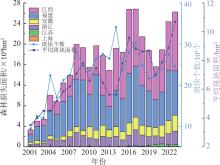
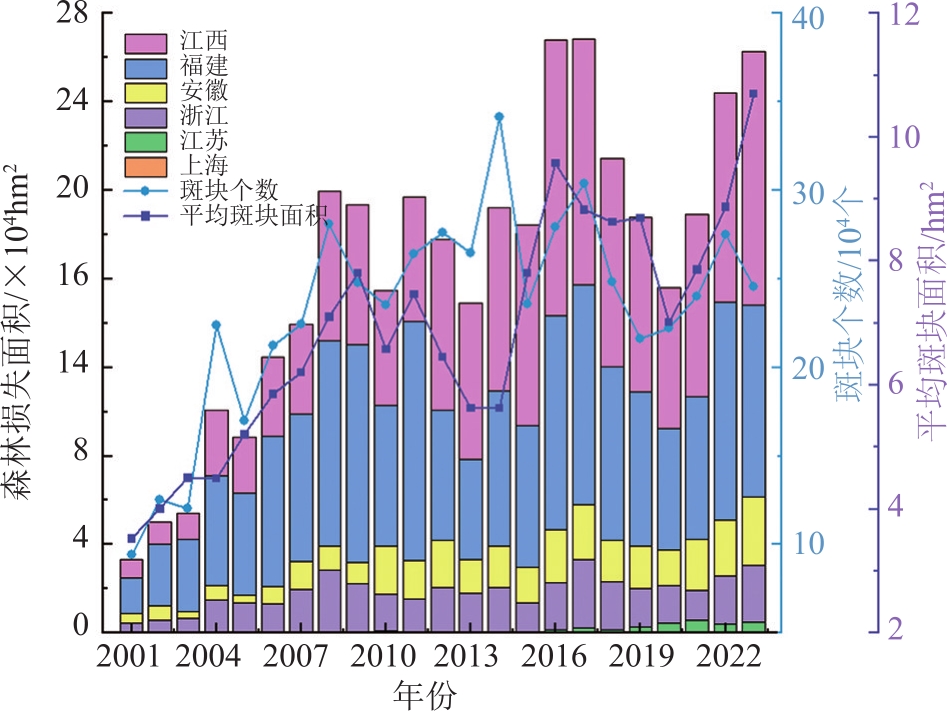
Fig.1
Distribution and trend of forest loss in East China
Tab.2
Forest loss area in East China
| 区域 | 减少面积/ hm2 | 减少面积 占比/% | 平均减少 面积/hm2 | 最小年份及面积/hm2 | 最大年份及面积/hm2 | ||
|---|---|---|---|---|---|---|---|
| 年份 | 面积/hm2 | 年份 | 面积/hm2 | ||||
| 上海 | 873.81 | 0.02 | 37.99 | 2002 | 1.71 | 2021 | 154.26 |
| 江苏 | 32 793.21 | 0.86 | 1 425.79 | 2003 | 124.20 | 2021 | 5 672.16 |
| 浙江 | 397 877.04 | 10.39 | 17 299.00 | 2001 | 4 349.70 | 2017 | 31 046.31 |
| 安徽 | 356 839.29 | 9.32 | 15 514.75 | 2003 | 3 236.04 | 2023 | 30 732.03 |
| 福建 | 1 556 672.13 | 40.33 | 67 681.40 | 2001 | 16 125.84 | 2011 | 108 245.16 |
| 江西 | 1 483 149.96 | 38.74 | 64 484.78 | 2001 | 8 243.37 | 2023 | 114 488.01 |
| 华东地区 | 3 828 205.44 | 100.00 | 166 443.71 | 2001 | 33 245.10 | 2017 | 268 153.29 |
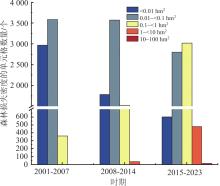
Fig.2
Forest loss density and statistical results of three periods in East China
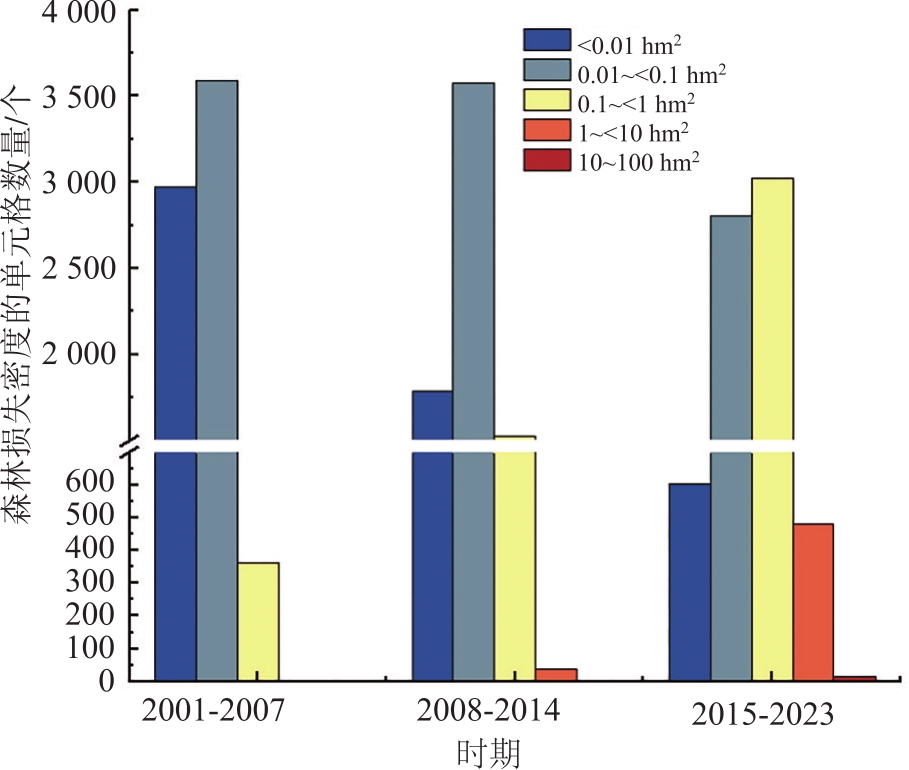
Fig.3
Forest loss patch area at different levels in East China from 2001 to 2023
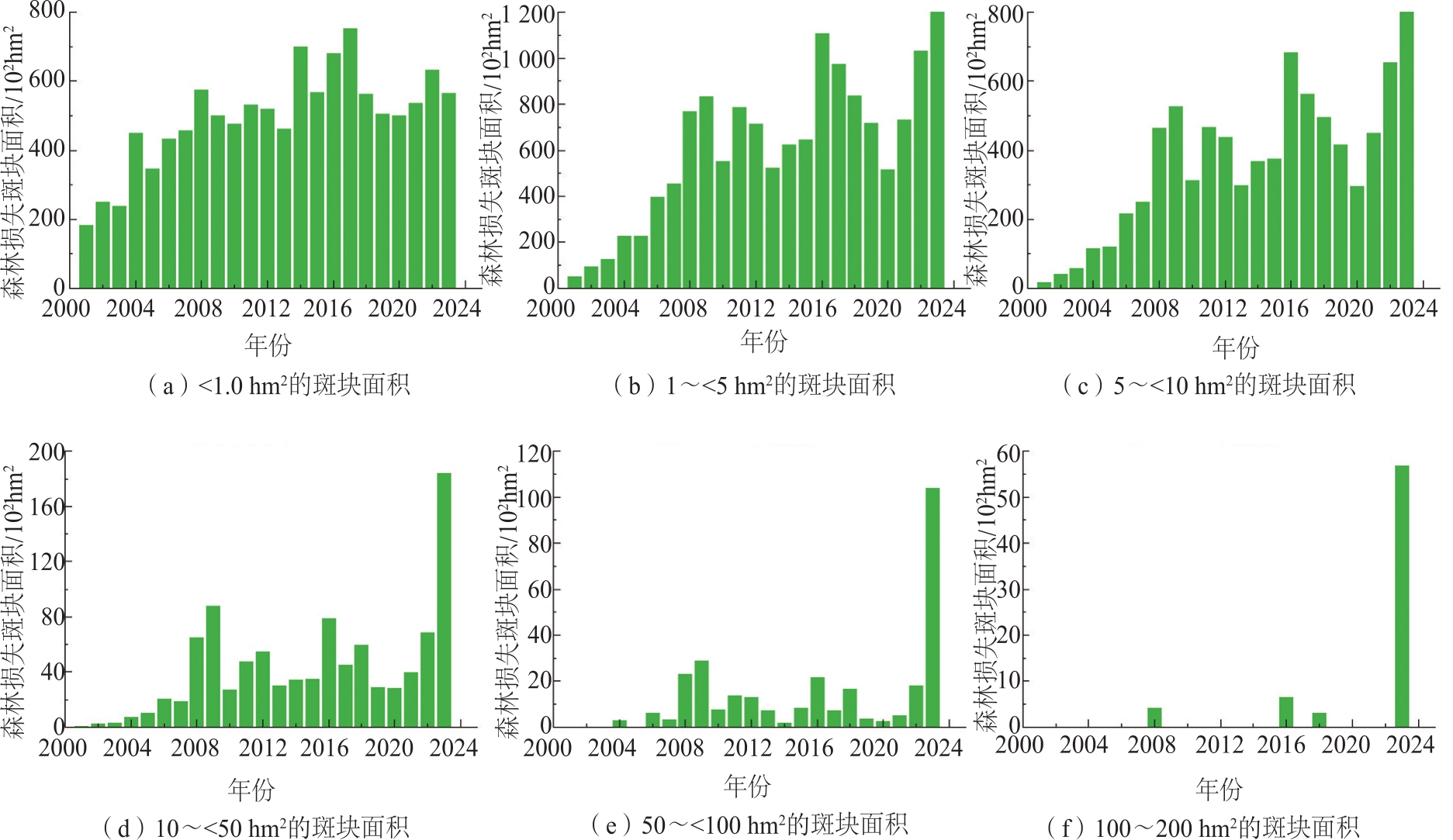
Fig.4
Trends in forest loss in East China from 2001 to 2023
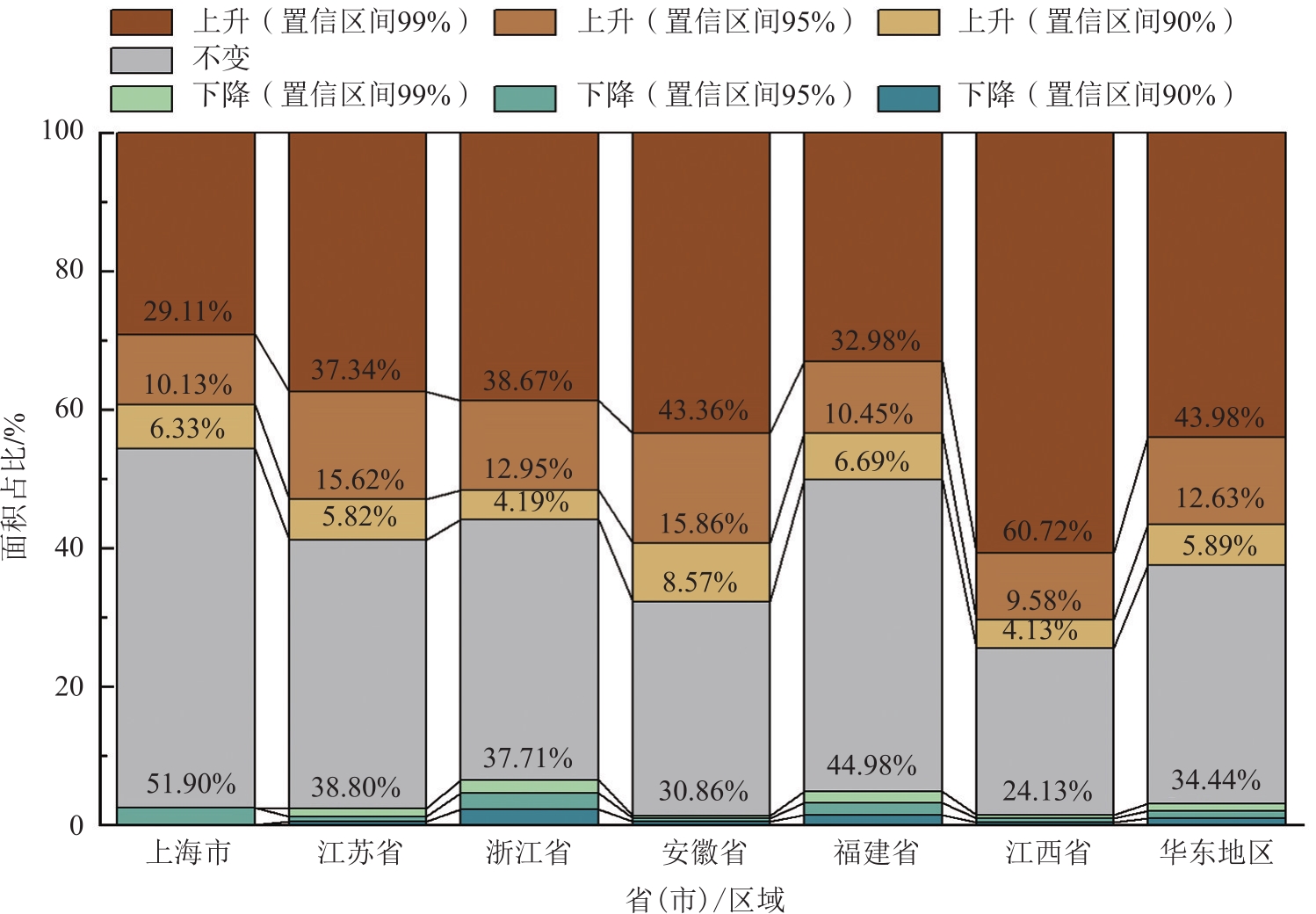
Tab.3
Area statistics of forest loss hotspot types in East China from 2001 to 2023
| 区域 | 新增热点 | 震荡热点 | 持续热点 | 连续热点 | 加强热点 | |||||||
|---|---|---|---|---|---|---|---|---|---|---|---|---|
| 面积/104hm2 | 占比/% | 面积/104hm2 | 占比/% | 面积/104hm2 | 占比/% | 面积/104hm2 | 占比/% | 面积/104hm2 | 占比/% | |||
| 上海 | 0 | 0 | 0 | 0 | 0 | 0 | 0 | 0 | ||||
| 江苏 | 2 | 10 | 18 | 90.00 | 0 | 0 | 0 | 0 | 0 | |||
| 浙江 | 13 | 5.33 | 231 | 94.67 | 0 | 0 | 0 | 0 | 0 | |||
| 安徽 | 91 | 28 | 234 | 72.00 | 0 | 0 | 0 | 0 | 0 | |||
| 福建 | 0 | 0 | 788 | 65.07 | 184 | 15.19 | 28 | 2.31 | 211 | 17.42 | ||
| 江西 | 19 | 1.28 | 1 466 | 98.72 | 0 | 0 | 0 | 0 | 0 | |||
| 华东地区 | 125 | 3.81 | 2 737 | 83.32 | 184 | 5.60 | 28 | 0.85 | 211 | 6.42 | ||
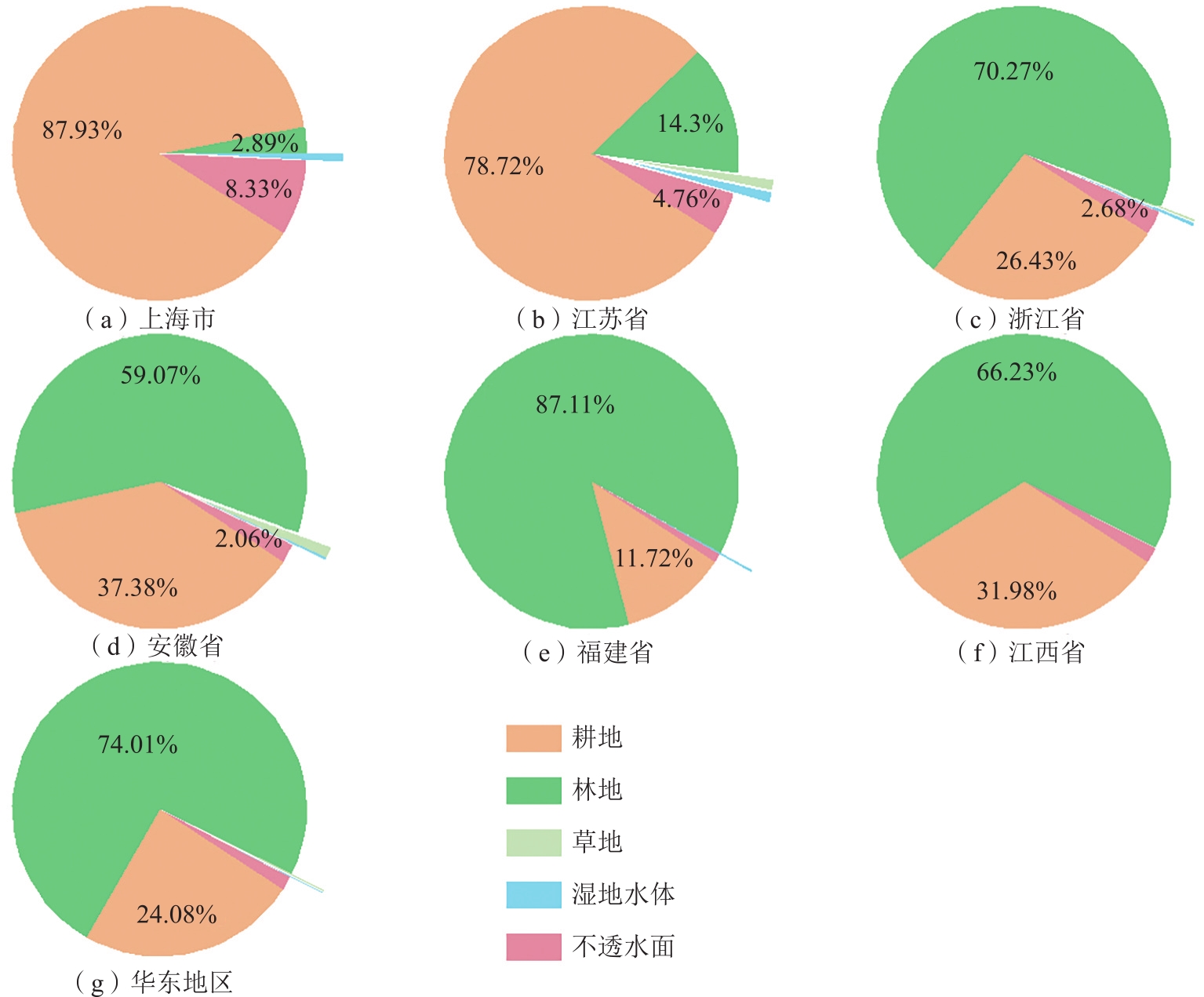
Fig.5
Percentage of land cover type area in forest loss areas of 2023
| [1] | BONAN G B. Forests,climate,and public policy:A 500-year interdisciplinary odyssey[J]. Annual Review of Ecology,Evolution,and Systematics, 2016, 47(1):97-121. |
| [2] | WORDEN J, SAATCHI S, KELLER M, et al. Satellite observations of the tropical terrestrial carbon balance and interactions with the water cycle during the 21st century[J]. Reviews of Geophysics, 2021, 59(1):1832999. |
| [3] | MOFFETTE F, ALIX-GARCIA J, SHEA K, et al. The impact of near-real-time deforestation alerts across thetropics[J]. Nature Climate Change, 2021, 11(2):172-178. |
| [4] | LAMBIN E F, MEYFROIDT P. Global land use change,economic globalization,and the looming landscarcity[J]. Proceedings of the national academy of sciences, 2011, 108(9):3465-3472. |
| [5] | PINTILII R D, ANDRONACHE I, DIACONU D C, et al. Using fractal analysis in modeling the dynamics of forest areas and economic impact assessment:Maramureş County,Romania,as a case study[J]. Forests, 2017, 8(1):25. |
| [6] | VAN DER SLUIS T, PEDROLI B, KRISTENSEN S B P, et al. Changing land use intensity in Europe-Recent processes in selected case studies[J]. Land Use Policy, 2016,57:777-785. |
| [7] | SHEN Wenjuan, HE Jiaying, HUANG Chengquan, et al. Quantifying the actual impacts of forest cover change on surface temperature in Guangdong,China[J]. Remote Sensing, 2020, 12(15):2354. |
| [8] | BACCINI A, GOETZ S J, WALKER W S, et al. Estimated carbon dioxide emissions from tropical deforestation improved by carbon-densitymaps[J]. Nature climate change, 2012, 2(3):182-185. |
| [9] | OCHOA-QUINTERO J M, GARDNER T A, ROSA I, et al. Thresholds of species loss in Amazonian deforestation frontier landscapes[J]. Conservation Biology, 2015, 29(2):440-451. |
| [10] | BAKER J C A, SPRACKLEN D V. Climate benefits of intact Amazon forests and the biophysical consequences ofdisturbance[J]. Frontiers in Forests and Global Change, 2019,2:47. |
| [11] | LI Yan, ZHAO Maosheng, MILDREXLER D J, et al. Potential and actual impacts of deforestation and afforestation on land surface temperature[J]. Journal of Geophysical Research:Atmospheres, 2016, 121(24):14,372-314. |
| [12] | CHEN He, ZENG Zhenzhong, WU Jie, et al. Large uncertainty on forest area change in the early 21st century among widely used global land cover datasets[J]. Remote Sensing, 2020, 12(21):3502. |
| [13] | YANG Jun, GONG Peng, FU Rong, et al. The role of satellite remote sensing in climate change studies[J]. Nature climate change, 2013, 3(10):875-883. |
| [14] | DE BEM PP, DE CARVALHO JUNIOR O A, Fontes Guimarães R, et al. Change detection of deforestation in the Brazilian Amazon using landsat data and convolutional neural networks[J]. Remote Sensing, 2020, 12(6):901. |
| [15] | SARZYNSKI T, GIAM X, CARRASCO L, et al. Combining radar and optical imagery to map oil palm plantations in Sumatra,Indonesia,using the Google EarthEngine[J]. Remote Sensing, 2020, 12(7):1220. |
| [16] | MITCHELL A L, ROSENQVIST A, MORA B. Current remote sensing approaches to monitoring forestdegradation in support of countries measurement,reporting and verification(MRV)systems for REDD+[J]. Carbon balance and management, 2017,12:1-22. |
| [17] | 白宇, 郑志忠, 修连存, 等. 无人机高光谱遥感技术在自然资源调查中的应用进展[J]. 华东地质, 2022, 43(4):527-538. |
| [18] | HANSEN M C, POTAPOV P V, MOORE R, et al. High-resolution global maps of 21st-century forest coverchange[J]. science, 2013, 342(6160):850-853. |
| [19] | ZHANG Yanlin, WANG Shujing, HAN Xujun. Spatial-Temporal Dynamics of Forest Extent Change in Southwest China in the Recent 20 Years[J]. Forests, 2023, 14(7):1378. |
| [20] | LIN Yuying, QIU Rongzu, YAO Jixue, et al. The effects of urbanization on China's forest loss from 2000 to 2012:Evidence from a panel analysis[J]. Journal of cleaner production, 2019,214:270-278. |
| [21] | XIONG Bo, CHEN Ruishan, XIA Zilong, et al. Large-scale deforestation of mountainous areas during the 21st Century in Zhejiang Province[J]. Land Degradation & Development, 2020, 31(14):1761-1774. |
| [22] | HARRIS N L, GOLDMAN E, GABRIS C, et al. Using spatial statistics to identify emerging hot spots of forest loss[J]. Environmental Research Letters, 2017, 12(2):024012. |
| [23] | 沈文娟, 李明诗, 黄成全. 长时间序列多源遥感数据的森林干扰监测算法研究进展[J]. 遥感学报, 2018, 22(6):1005-1022. |
| [24] | 林丰增, 郭佳, 林韶恺, 等. 山海组团型城市发展突围之道:以宁德市城市能级提升优化为例[J]. 华东地质, 2024, 45(2):206-217. |
| [25] | WANG Shangxiao, ZHANG Ming, XI Xi. Ecological environment evaluation based on remote sensing ecological index:A case study in East China over the past 20 years[J]. Sustainability, 2022, 14(23):15771. |
| [26] |
孙燕, 吴莉莉, 金晓斌, 等. 长三角区域一体化对城市群土地利用效率的空间协同效应[J]. 地理研究, 2024, 43(8):2104-2120.
doi: 10.11821/dlyj020240186 |
| [27] |
曾礼, 高艳红, 蒋盈沙, 等. 地形因子对华东地区降水影响的尺度效应研究[J]. 地球科学进展, 2022, 37(5):535-548.
doi: 10.11867/j.issn.1001-8166.2022.020 |
| [28] |
Zhang Xiao, Liu Liangyun, Chen Xidong, et al. GLC_FCS30:Global land-cover product with fine classification system at 30 m using time-series Landsat imagery[J]. Earth System Science Data, 2021, 13(6):2753-2776.
doi: 10.5194/essd-13-2753-2021 |
| [29] | 王尚晓, 牛晓楠, 张洁, 等. 新安江流域2000—2021年NDVI时空变化特征及其影响因素分析[J]. 华东地质, 2023, 44(3):273-281. |
| [30] | ROSA I M D, SOUZA JR C, EWERS R M. Changes in size of deforested patches in the BrazilianAmazon[J]. Conservation biology, 2012, 26(5):932-937. |
| [31] | MONTIBELLER B, KMOCH A, VIRRO H, et al. Increasing fragmentation of forest cover in Brazil’s Legal Amazon from 2001 to 2017[J]. Scientific reports, 2020, 10(1):5803. |
| [32] | KALAMANDEEN M, GLOOR E, MITCHARD E, et al. Pervasive rise of small-scale deforestation inAmazonia[J]. Scientific reports, 2018, 8(1):1600. |
| [33] | 向曦, 张素金, 赵婧, 等. 云贵高原典型区域气象灾害时空演变特征及影响因素分析[J]. 时空信息学报, 2024, 31(1):118-128. |
| [34] | ORD J K, GETIS A. Local spatial autocorrelation statistics:distributional issues and anapplication[J]. Geographical analysis, 1995, 27(4):286-306. |
| [35] | SARATHCHANDRA C, ALEMU ABEBE Y, WORTHY F R, et al. Impact of land use and land cover changes on carbon storage in rubber dominated tropical Xishuangbanna,South West China[J]. Ecosystem Health and Sustainability, 2021, 7(1):1915183. |
| [36] | 张雪梅, 王克林, 岳跃民, 等. 生态工程背景下西南喀斯特植被变化主导因素及其空间非平稳性. 生态学报, 2017, 37(12):4008-4018. |
| [37] | WANG Shujing, LAI Peiyu, HAO Binfei, et al. Remote Sensing Monitoring and Spatio-temporal Pattern of Deforestation in Southwest China from 2001 to 2019[J]. Remote Sensing Technology and Application, 2021, 36(3):552-563. |
| [38] |
WU Zhiwei, YAN Saijia, HE Lei, et al. Spatiotemporal changes in forest loss and its linkage to burned areas in China[J]. Journal of Forestry Research, 2020, 31(6):2525-2536.
doi: 10.1007/s11676-019-01062-0 |
| [1] | CAI Yingli, ZHU Hongge. Research on Forest Loss Assessment Based on Multi-Source Datasets [J]. Forest and Grassland Resources Research, 2024, 0(6): 27-34. |
| [2] | PENG Yan, SHI Zhengtao, HE Li, SHEN Run, XU Rui, CHEN Yuehao. Temporal and Spatial Changes of Natural Forest Loss in Xishuangbanna and its Landscape Ecological Response Based on Landsat Data [J]. FOREST RESOURCES WANAGEMENT, 2022, 0(3): 73-80. |
| [3] | HE Meicheng, ZHANG Minghui, WANG Jufang, XU Geng, ZHANG Xiaoxi. The Investigation on Sattlement of Forest Ownership Disputes in Six Provinces of East China [J]. FOREST RESOURCES WANAGEMENT, 2014, 0(3): 1-6. |
| [4] | JIANG Rongchun. Summary of Introduction and Application of Tree Species for Greening in Northeast China [J]. FOREST RESOURCES WANAGEMENT, 2010, 0(3): 13-15. |
| Viewed | ||||||
|
Full text |
|
|||||
|
Abstract |
|
|||||
