

Forest and Grassland Resources Research ›› 2024›› Issue (6): 35-44.doi: 10.13466/j.cnki.lczyyj.2024.06.005
• Scientific Research • Previous Articles Next Articles
YANG Guang1( ), WANG Xinyu1, MA Yunjia1, LIU Zhaoyan1, WANG Lixuan1, SUN Jian2()
Received:2024-11-08
Revised:2024-12-10
Online:2024-12-28
Published:2025-04-18
CLC Number:
YANG Guang, WANG Xinyu, MA Yunjia, LIU Zhaoyan, WANG Lixuan, SUN Jian. The Impact of Fire Severity on Soil Microbial Biomass and Community Composition in Larix gmelinii Forests[J]. Forest and Grassland Resources Research, 2024, (6): 35-44.
Add to citation manager EndNote|Ris|BibTeX
URL: https://www.lyzygl.com.cn/EN/10.13466/j.cnki.lczyyj.2024.06.005
Tab.1
Specific fatty acids of microbial groups
| 微生物类群 | 特征脂肪酸 |
|---|---|
| 真菌 | 18:1 ω9c;18:2 ω6c;18:3 ω6c |
| 细菌 | 14:0;15:0;16:0;17:0;18:0 |
| 丛枝菌根真菌 | 16:1 ω5c |
| 放线菌 | 16:0 10-methyl、17:0 10-methyl、18:0 10-methyl |
| 革兰氏阳性菌 | 13:0 iso、13:0 anteiso、14:0 iso、15:0 iso、15:0 anteiso、16:0 iso、17:0 iso、17:0 anteiso、18:0 iso |
| 革兰氏阴性菌 | 14:1 ω5c、15:1 ω6c、16:1 ω7c、16:1 ω7c alcohol、16:1 ω9c、18:1 ω5c、18:1 ω7c、22:1 ω9c |
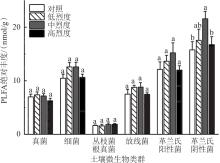
Fig.1
Absolute abundance of PLFA in soil microbial groups in burnt flat lands
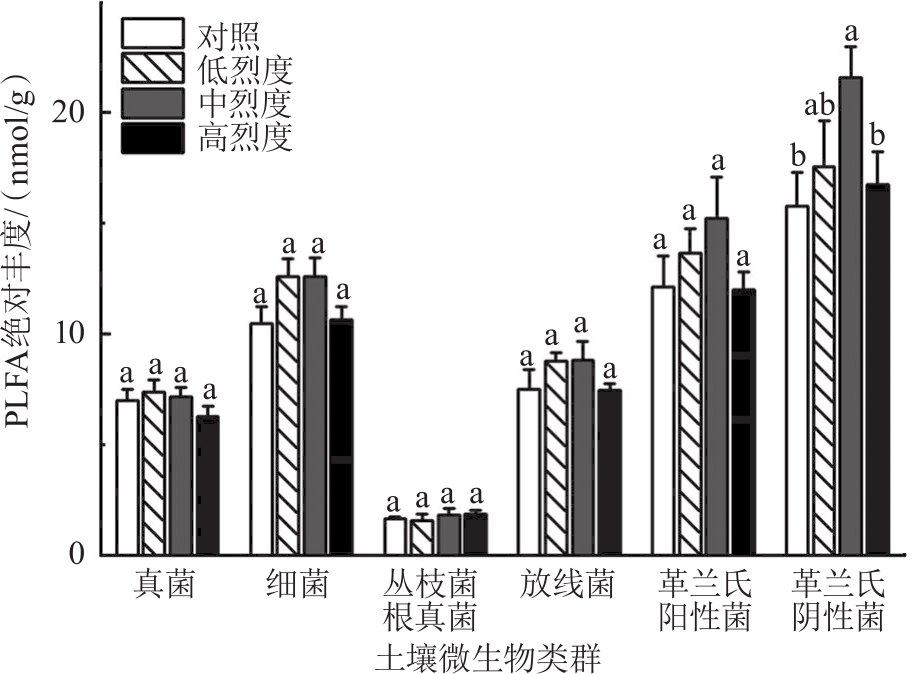
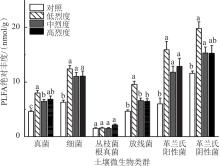
Fig.2
Absolute abundance of PLFA in soil microbial groups in burnt sloping lands
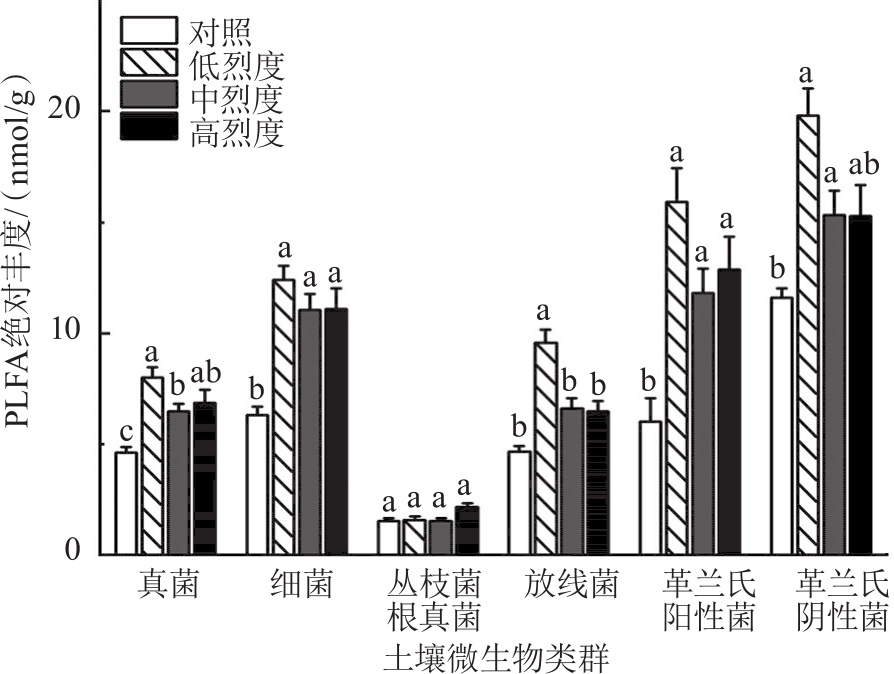
Tab.2
VIP values of differential soil microbes in sloping landsafterfire
| 低烈度 | 中烈度 | 高烈度 | ||||||
|---|---|---|---|---|---|---|---|---|
| 特征脂肪酸 | VIP值 | 微生物种类 | 特征脂肪酸 | VIP值 | 微生物种类 | 特征脂肪酸 | VIP值 | 微生物种类 |
| 18:1 ω7c | 1.689 | 革兰氏阴性菌 | 18:1 ω7c | 1.729 | 革兰氏阴性菌 | 18:1 ω7c | 1.369 | 革兰氏阴性菌 |
| 16:0 iso | 1.580 | 革兰氏阳性菌 | 18:0 iso | 1.612 | 革兰氏阳性菌 | 18:2 ω6c | 1.312 | 真菌 |
| 14:0 iso | 1.501 | 革兰氏阳性菌 | 15:0 anteiso | 1.590 | 革兰氏阳性菌 | 15:0 | 1.308 | 细菌 |
| 15:0 anteiso | 1.389 | 革兰氏阳性菌 | 18:0 10-methyl | 1.514 | 放线菌 | 16:1 ω5c | 1.305 | 丛枝菌根真菌 |
| 18:0 iso | 1.386 | 革兰氏阳性菌 | 15:0 iso | 1.410 | 革兰氏阳性菌 | 18:3 ω6c | 1.273 | 真菌 |
| 17:0 anteiso | 1.315 | 革兰氏阳性菌 | 14:0 | 1.390 | 细菌 | 14:0 iso | 1.269 | 革兰氏阳性菌 |
| 15:0 iso | 1.313 | 革兰氏阳性菌 | 16:0 iso | 1.270 | 革兰氏阳性菌 | 18:0 iso | 1.268 | 革兰氏阳性菌 |
| 18:2 ω6c | 1.232 | 真菌 | 18:1 ω5c | 1.206 | 革兰氏阴性菌 | 13:0 anteiso | 1.233 | 革兰氏阳性菌 |
| 14:0 | 1.195 | 细菌 | 18:1 ω9c | 1.194 | 真菌 | 14:0 | 1.219 | 细菌 |
| 18:1 ω5c | 1.188 | 革兰氏阴性菌 | 14:0 iso | 1.107 | 革兰氏阳性菌 | 18:1 ω9c | 1.177 | 真菌 |
| 16:1 ω5c | 1.155 | 丛枝菌根真菌 | 15:0 | 1.102 | 细菌 | 15:0 anteiso | 1.169 | 革兰氏阳性菌 |
| 17:0 iso | 1.148 | 革兰氏阳性菌 | 17:0 iso | 1.070 | 革兰氏阳性菌 | 15:0 iso | 1.146 | 革兰氏阳性菌 |
| 18:0 | 1.033 | 放线菌细菌 | 13:0 iso | 1.056 | 革兰氏阳性菌 | 18:0 10-methyl | 1.110 | 放线菌 |
| 18:2 ω6c | 1.044 | 真菌 | 17:0 iso | 1.019 | 革兰氏阳性菌 | |||
Tab.3
Diversity of soil microbial communities in flat and sloping landsafter fire
| 坡地类型 | 火烈度 | 香农指数 | 均匀度指数 | 辛普森指数 |
|---|---|---|---|---|
| 平地 | 对照 | 2.764±0.033 | 0.859±0.014 | 0.916±0.007 |
| 低烈度 | 2.782±0.045 | 0.865±0.005 | 0.920±0.006 | |
| 中烈度 | 2.769±0.053 | 0.850±0.013 | 0.916±0.008 | |
| 高烈度 | 2.754±0.031 | 0.852±0.014 | 0.916±0.005 | |
| 坡地 | 对照 | 2.626±0.092 | 0.831±0.015 | 0.893±0.015 |
| 低烈度 | 2.813±0.026* | 0.871±0.023* | 0.922±0.003* | |
| 中烈度 | 2.772±0.089*** | 0.841±0.020 | 0.914±0.012*** | |
| 高烈度 | 2.833±0.044* | 0.857±0.009 | 0.922±0.004 |
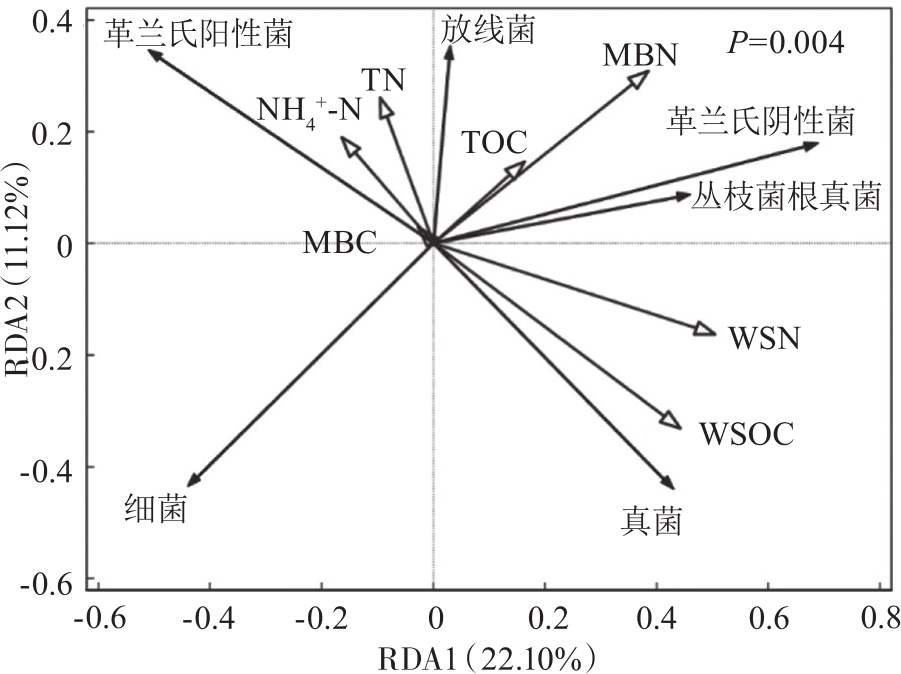
Fig.3
RDA analysis of soilmicrobial biomass groups and soil nutrient characteristics
Tab.4
Soil nutrient characteristics variables and corresponding RDA analysisresults
| 土壤养分特征 | 解释度/% | 贡献度/% | 伪F值 | P |
|---|---|---|---|---|
| WSOC | 8.3 | 16.9 | 3.0 | 0.034 |
| WSN | 5.0 | 10.0 | 1.8 | 0.130 |
| 7.0 | 14.1 | 2.7 | 0.046 | |
| TN | 3.9 | 7.9 | 1.5 | 0.184 |
| TOC | 3.8 | 7.8 | 1.5 | 0.200 |
| MBN | 5.3 | 10.7 | 2.2 | 0.080 |
| MBC | 7.9 | 16.1 | 3.7 | 0.026 |
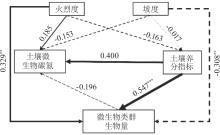
Fig.4
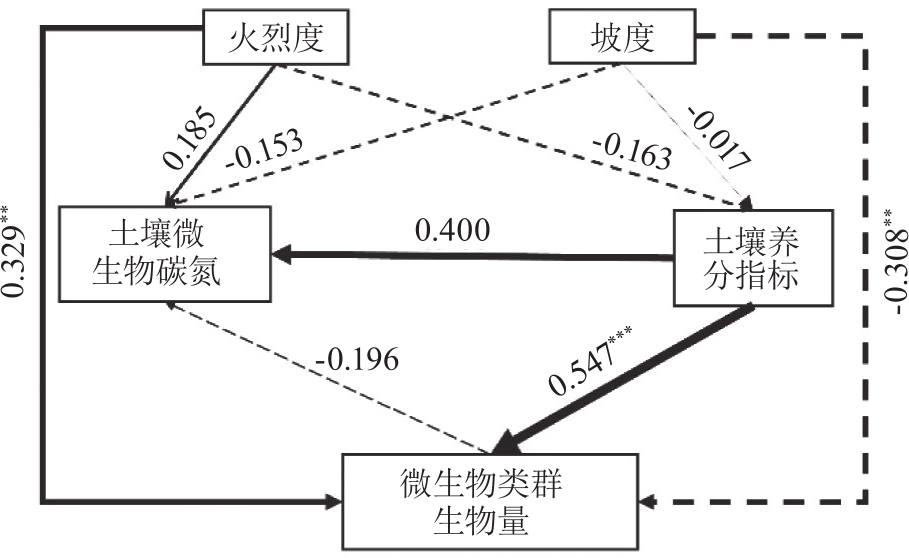
Structural equation modeling of absolute abundance of PLFA of different factors and soil microbial groups
| [1] | 胡海清, 罗碧珍, 罗斯生, 等. 林火干扰对森林生态系统碳库的影响研究进展[J]. 林业科学, 2020, 56(4):160-169. |
| [2] | 罗斯生, 罗碧珍, 魏书精, 等. 中度火灾一年后马尾松林土壤碳库特征[J]. 林业科学, 2022, 58(9):25-35. |
| [3] | AGBESHIE A A, ABUGRE S, ATTA-DARKWA T, et al. A review of the effects of forest fire on soil properties[J]. Journal of Forestry Research, 2022, 33(5):1419-1441. |
| [4] | 陶玉柱, 邸雪颖. 火对森林土壤微生物群落的干扰作用及其机制研究进展[J]. 林业科学, 2013, 49(11):146-157. |
| [5] | 胡海清, 孙龙, 国庆喜, 等. 大兴安岭1980-1999年乔木燃烧释放碳量研究[J]. 林业科学, 2007(11):82-88. |
| [6] | 付婧婧, 吴志伟, 闫赛佳, 等. 气候、植被和地形对大兴安岭林火烈度空间格局的影响[J]. 生态学报, 2020, 40(5):1672-1682. |
| [7] | GUO Hanwen, XIANG Dong, KONG Linyi, et al. Up slope fire spread and heat transfer mechanism over a pine needle fuel bed with different slopes and winds[J]. Applied Thermal Engineering, 2023,229:120605. |
| [8] | 赵杼祺, 胡振宏, 何鲜, 等. 森林木质残体微生物群落构建机制研究进展[J]. 林业科学, 2024, 60(2):106-117. |
| [9] | LORENZ M, HOFMANN D, STEFFEN B, et al. The molecular composition of extractable soil microbial compounds and their contribution to soil organic matter vary with soil depth and tree species[J]. Science of The Total Environment, 2021,781:146732. |
| [10] | HARTS C, DELUCA T H, NEWMAN G S, et al. Post-fire vegetative dynamics as drivers of microbial community structure and function in forest soils[J]. Forest Ecology and Management, 2005, 220(1):166-184. |
| [11] | 黄晓霖, 彭晓娟, 张彦玲, 等. 火灾事故对森林土壤微生物生物量的影响研究[J]. 环境科学与管理, 2024, 49(5):151-155. |
| [12] | 石炳东, 韩懂懂, 李兆国, 等. 兴安落叶松林火烧迹地土壤微生物量碳氮特征[J]. 东北林业大学学报, 2022, 50(12):78-82. |
| [13] | 郑琼, 崔晓阳, 邸雪颖, 等. 不同林火强度对大兴安岭偃松林土壤微生物功能多样性的影响[J]. 林业科学, 2012, 48(5):95-100. |
| [14] | 张乐妍, 陈春兰, 王逗, 等. 化肥有机肥配施比例对油菜根际土壤利用光合同化碳微生物的影响[J]. 植物营养与肥料学报, 2024, 30(2):221-231. |
| [15] | 雷海迪, 尹云锋, 张鹏, 等. 生物质炭输入对杉木人工林土壤碳排放和微生物群落组成的影响[J]. 林业科学, 2016, 52(5):37-44. |
| [16] | TUNLID A, BAIRD B H, TREXLER M B, et al. Determination of phospholipid ester-linked fatty acids and poly β-hydroxybutyrate for the estimation of bacterial biomass and activity in the rhizosphere of the rape plant Brassica napus(L.)[J]. Canadian Journal of Microbiology, 1985,31:1113-1119. |
| [17] | 林英华, 卢萍, 赵鲁安, 等. 大兴安岭森林沼泽类型与火干扰对土壤微生物群落影响[J]. 林业科学研究, 2016, 29(1):93-102. |
| [18] |
彭瑶, 曹凤艳, 曲来叶. 兴安落叶松林不同强度火烧迹地土壤微生物群落特性研究[J]. 植物研究, 2017, 37(4):549-555.
doi: 10.7525/j.issn.1673-5102.2017.04.010 |
| [19] | 杨欣晨, 孙术发, 孙美欧, 等. 内蒙古大兴安岭北部原始林区防火瞭望塔选址研究[J]. 消防科学与技术, 2023, 42(11):1572-1577. |
| [20] | 李树铭. 内蒙古自治区毕拉河林业局和陈巴尔虎旗两起特大森林火灾应急处置评析[J]. 中国应急管理, 2017(7):63-64. |
| [21] | 贺红士, 梁宇, 吴志伟, 等. 林火烈度的量化指标构建[J]. 林业资源管理, 2014(6):140-145. |
| [22] | BOSSIO D A, SCOW K M, GUNAPALA N, et al. Determinants of soil microbial communities:Effects of agricultural management,season,and soil type on phospholipid fatty acid profiles[J]. Microbial Ecology, 1998, 36(1):1-12. |
| [23] | 瓮岳太. 兴安落叶松林火烧迹地土壤微生物群落演变特征与形成机制[D]. 哈尔滨: 东北林业大学, 2021. |
| [24] | WILLERS C, RENSBURG V P J, CLAASSENS S. Phospholipid fatty acid profiling of microbial communities:A review of interpretations and recent applications[J]. Journal of Applied Microbiology, 2015, 119(5):1207-1218. |
| [25] | Frostegard A, Baath E. The use of phospholipid fatty acid analysis to estimate bacterial and fungal biomass in soil[J]. Biology and Fertility of Soils, 1996, 22(1-2):59-65. |
| [26] | GIRAY K, BANFIELD C, PIEPHO H, et al. Main soil microbial groups assessed by phospholipid fatty acid analysis of temperate alley agroforestry systems on crop- and grassland[J]. Applied Soil Ecology, 2024,195:105277. |
| [27] | LIU Ziqiang, WEI Hui, ZHANG Jia’en, et al. Seasonality regulates the effects of acid rain on microbial community in a subtropical agricultural soil of Southern China[J]. Ecotoxicology and Environmental Safety, 2021,224:112681. |
| [28] | 逄梦璇, 刘红文, 韩旭, 等. 典型黑土带玉米农田土壤微生物群落地理分布及驱动因素[J]. 土壤与作物, 2024, 13(1):1-12. |
| [29] | 姚晓东, 王娓, 曾辉. 磷脂脂肪酸法在土壤微生物群落分析中的应用[J]. 微生物学通报, 2016, 43(9):2086-2095. |
| [30] | CHENG Zhichao, WU Song, PAN Hong, et al. Effect of forest fires on the Alpha and Beta diversity of soil bacteria in Taiga forests:Proliferation of rare species as successional pioneers[J]. Forests, 2024, 15(4):606. |
| [31] | 李素美, 王银桥, 刘润进. 特殊生境中丛枝菌根真菌多样性[J]. 应用生态学报, 2013, 24(11):3325-3332. |
| [32] | 李伟克, 刘晓东, 牛树奎, 等. 火烧对河北平泉油松林土壤微生物量的影响[J]. 北京林业大学学报, 2017, 39(10):70-77. |
| [33] |
左壮, 张韫, 崔晓阳. 火烧对兴安落叶松林土壤氮形态和含量的初期影响[J]. 南京林业大学学报(自然科学版), 2024, 48(1):147-154.
doi: 10.12302/j.issn.1000-2006.202209021 |
| [34] | 李兆国, 瓮岳太, 徐建楠, 等. 模拟地表火行为对燃烧剩余物水溶性碳氮的影响[J]. 生态学报, 2022, 42(4):1500-1511. |
| [35] | 翟凯涛, 梁晶文, 李静, 等. 不同干扰方式形成的内蒙古大兴安岭白桦次生林的土壤肥力[J]. 东北林业大学学报, 2024, 52(2):60-67. |
| [36] | ROY M, KUNDU K. Production of biochar briquettes from torrefaction of pine needles and its quality analysis[J]. Bioresource Technology Reports, 2023,22:101467. |
| [37] | 王子郡, 黄菁华, 麦建军, 等. 外源有机物料性质对黑土农田土壤微生物碳组分的影响[J]. 植物营养与肥料学报, 2024, 30(5):980-995. |
| [38] | MOYA D, VEGA G S, LOZANO E, et al. The burn severity and plant recovery relationship affect the biological and chemical soil properties of Pinushalepensis Mill.stands in the short and mid-terms after wildfire[J]. Journal of Environmental Management, 2019,235:250-256. |
| [39] |
舒洋, 陈金平, 丁兆华, 等. 林火强度对兴安落叶松林土壤氮循环功能基因的影响[J]. 草地学报, 2024, 32(3):726-735.
doi: 10.11733/j.issn.1007-0435.2024.03.008 |
| [40] | 李金业, 程昊, 梁晓敏, 等. 酸化土壤改良与固碳研究进展[J]. 生态学报, 2024, 44(17):1-14. |
| [41] | 刘小菊. 火干扰对喀纳斯泰加林土壤化学性质的影响[J]. 贵州农业科学, 2019, 47(7):148-152. |
| [42] | LI Chengyi, LI Xilai, SHI Yan, et al. Effects of nitrogen addition on soil carbon-fixing microbial diversity on different slopes in a degraded Alpine meadow[J]. Frontiers in Plant Science, 2022,13:921278. |
| [43] | 韩懂懂, 杨光, 邸雪颖, 等. 兴安落叶松林火烧迹地土壤理化性质驱动因子[J]. 生态学报, 2023, 43(21):8727-8738. |
| [44] | KONG Jianjian, YANG Jian, CAI Wenhua. Topography controls post-fire changes in soil properties in a Chinese boreal forest[J]. Science of The Total Environment, 2019,651:2662-2670. |
| [45] | WENG Yuetai, YANG Guang, WANG Lixuan, et al. Changes in water-soluble nitrogen and organic carbon in the post-fire litter layer of Dahurian larch forests[J]. Plant and Soil, 2021, 464(1):131-148. |
| [1] | MA Yuan, WANG Zhibo, YE Dongmei, LIU Fengling. Construction of Compatibility Models for Aboveground Biomass of Individual Trees in Larix gmelinii var.principis-rupprechtii plantation [J]. Forest and Grassland Resources Research, 2024, 0(6): 129-139. |
| [2] | LIU Linfu, HONG Guangyu, MI Hongzhuo, WANG Zhiqiang, XU Ronghui, HU Yongning. Biomass and Carbon Fixation and Oxygen Release Function of Larix gmelinii at Different Ages in Daxing 'anling [J]. Forest and Grassland Resources Research, 2024, 0(3): 88-95. |
| [3] | GUAN Lei, ZHANG Xin, ZHANG Qiuliang, JIAN Ya’nan, ZHANG Yongliang. Response of Net Photosynthetic Rate of Larix gmelinii to Physiological and Ecological Factors in Different Phenophases [J]. Forest and Grassland Resources Research, 2024, 0(2): 101-108. |
| [4] | HAN Xiaorong, YANG Lin, MA Xiuzhi, LIANG Lei, LI Yiqian, LIANG Zhi. Soil Nutrients and Stoichiometric Characteristics of Xing'an Larch Forest in Different Age Groups [J]. FOREST RESOURCES WANAGEMENT, 2021, 0(3): 129-136. |
| [5] | ZHAO Yichen, ZHANG Xin, ZHANG Junqing. Study on Soil Microbial Characteristics of Primitive Broad-leaved Korean Pine Forest [J]. FOREST RESOURCES WANAGEMENT, 2019, 0(3): 132-138. |
| [6] | SA Rula, XU Jiarui, WANG Zhihui, ZHANG Ke, YU Xianjun. Study on Tree Growth Model of Larix Gmelinii Plantation Based on Trunk Analysis [J]. FOREST RESOURCES WANAGEMENT, 2019, 0(2): 88-92. |
| [7] | YANG Da, WU Zhiwei, LIANG Yu, HE Hongshi. Establishment of Quantitative Indexes of Forest Fire Severity in Forest Region [J]. FOREST RESOURCES WANAGEMENT, 2014, 0(6): 140-145. |
| Viewed | ||||||
|
Full text |
|
|||||
|
Abstract |
|
|||||
