

Forest and Grassland Resources Research ›› 2024›› Issue (5): 48-55.doi: 10.13466/j.cnki.lczyyj.2024.05.006
• Scientific Research • Previous Articles Next Articles
ZOU Wentao1( ), ZENG Weisheng2(), YANG Xueyun2, WEN Xuexiang2
Received:2024-08-26
Revised:2024-09-26
Online:2024-10-28
Published:2025-04-18
CLC Number:
ZOU Wentao, ZENG Weisheng, YANG Xueyun, WEN Xuexiang. Comparison of Dummy Variable Model and Mixed Model: A Case Study on Constructing Biomass Models for Cunninghamia lanceolata and Larix spp.Forests in Different Regions[J]. Forest and Grassland Resources Research, 2024, (5): 48-55.
Add to citation manager EndNote|Ris|BibTeX
URL: https://www.lyzygl.com.cn/EN/10.13466/j.cnki.lczyyj.2024.05.006

Tab.1
Modeling samples and validation samples of Cunninghamia lanceolata and Larix spp.forests
| 类型 | 区域 | 样地数/个 | 检验样本 | 检验样本 | |||||||
|---|---|---|---|---|---|---|---|---|---|---|---|
| 样地数/ 个 | 最大蓄积量/ (m3/hm2) | 最大生物量/ (t/hm2) | 样地数/ 个 | 最大蓄积量/ (m3/hm2) | 最大生物量/ (t/hm2) | ||||||
| 杉木林 | 华东 | 1 439 | 960 | 456 | 257 | 479 | 454 | 262 | |||
| 中南 | 1 121 | 745 | 418 | 256 | 376 | 368 | 228 | ||||
| 西南 | 592 | 395 | 312 | 254 | 197 | 342 | 236 | ||||
| 合计 | 3 152 | 2 100 | 456 | 257 | 1 052 | 454 | 262 | ||||
| 落叶松林 | 东北 | 1 034 | 690 | 317 | 257 | 344 | 349 | 292 | |||
| 华北 | 1 047 | 700 | 338 | 265 | 347 | 304 | 240 | ||||
| 西部 | 414 | 275 | 485 | 381 | 139 | 522 | 379 | ||||
| 合计 | 2 495 | 1 665 | 485 | 381 | 830 | 522 | 379 | ||||
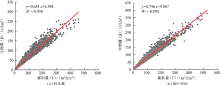
Fig.1
The scatter plot between biomass and stock volume

Tab.2
The parameter estimates of models
| 类型 | 模型 | 全局参数或固定参数 | 特定参数或随机参数 | |||||||||||
|---|---|---|---|---|---|---|---|---|---|---|---|---|---|---|
| a0 | b0 | a1 | a2 | a3 | b1 | b2 | b3 | |||||||
| 杉木林 | 哑变量模型(2) | 0.599 7 | 0.715 8 | 0.217 2 | -0.108 9* | -0.108 3* | -0.017 2 | 0.006 8* | 0.010 4* | |||||
| 混合模型(3) | 0.594 4 | 0.715 3 | 0.002 0* | -0.001 5* | -0.000 5* | -0.013 2 | 0.005 1* | 0.008 1* | ||||||
| 落叶松林 | 哑变量模型(2) | 1.226 1 | 0.819 0 | -0.769 9 | -0.664 9 | 1.434 8 | -0.019 1 | 0.105 8 | -0.086 7 | |||||
| 混合模型(3) | 1.019 9 | 0.820 2 | -0.505 8 | -0.415 9 | 0.921 7 | -0.020 8 | 0.104 2 | -0.083 4 | ||||||
Tab.3
The parameter estimates of models for Cunninghamia lanceolata
| 类型 | 模型 | 全局参数或固定参数 | 特定参数或随机参数 | ||||||||
|---|---|---|---|---|---|---|---|---|---|---|---|
| a0 | b0 | a1 | a2 | b1 | b2 | ||||||
| 杉木林 | 哑变量模型 | 0.652 9 | 0.711 4 | 0.164 0 | -0.164 0 | -0.012 7 | 0.012 7 | ||||
| 混合模型 | 0.592 7 | 0.711 9 | -0.010 3 | 0.010 3 | |||||||
Tab.4
The parameter estimates and evaluation indicators of basic models for Cunninghamia lanceolata and Larix spp.forests
| 类型 | 范围 | 模型 | 参数估计值 | 评价指标 | |||||||||||||||
|---|---|---|---|---|---|---|---|---|---|---|---|---|---|---|---|---|---|---|---|
| a | b | R2 | ESE/ (t/hm2) | EMP/ % | ETR/ % | EAS/ % | EMPS/ % | ||||||||||||
| 杉木林 | 全国 | 哑变量模型 | 0.937 | 11.90 | 0.85 | 0.00 | 4.13 | 13.84 | |||||||||||
| 混合模型 | 0.937 | 11.93 | 0.86 | 0.00 | 4.23 | 13.83 | |||||||||||||
| 华东地区 | 哑变量模型 | 0.817 | 0.699 | 0.920 | 14.31 | 1.39 | 0.00 | 4.49 | 16.20 | ||||||||||
| 混合模型 | 0.593 | 0.702 | 0.919 | 14.42 | 1.40 | -0.08 | 5.20 | 16.30 | |||||||||||
| 中西南地区 | 哑变量模型 | 0.489 | 0.724 | 0.955 | 9.40 | 0.99 | 0.00 | 3.83 | 11.85 | ||||||||||
| 混合模型 | 0.593 | 0.722 | 0.955 | 9.34 | 0.99 | 0.08 | 3.41 | 11.75 | |||||||||||
| 落叶松林 | 全国 | 哑变量模型 | 0.962 | 11.55 | 0.63 | 0.00 | 1.31 | 10.35 | |||||||||||
| 混合模型 | 0.962 | 11.57 | 0.63 | 0.00 | 1.45 | 10.42 | |||||||||||||
| 东北地区 | 哑变量模型 | 0.561 | 0.925 | 0.967 | 9.26 | 0.87 | 0.00 | 1.59 | 9.94 | ||||||||||
| 混合模型 | 0.604 | 0.924 | 0.967 | 9.26 | 0.87 | 0.00 | 1.48 | 9.94 | |||||||||||
| 华北地区 | 哑变量模型 | 0.456 | 0.800 | 0.939 | 12.49 | 1.12 | 0.00 | 0.81 | 10.26 | ||||||||||
| 混合模型 | 0.514 | 0.799 | 0.939 | 12.48 | 1.12 | 0.00 | 0.71 | 10.30 | |||||||||||
| 西部地区 | 哑变量模型 | 2.661 | 0.732 | 0.973 | 13.97 | 1.36 | -0.01 | 1.85 | 11.58 | ||||||||||
| 混合模型 | 1.942 | 0.737 | 0.972 | 14.09 | 1.37 | 0.00 | 3.25 | 11.90 | |||||||||||
Tab.5
The independent validation results of biomass models for Cunninghamia lanceolata and Larix spp.forests
| 类型 | 范围 | 模型 | 检验样本评价指标 | |||||
|---|---|---|---|---|---|---|---|---|
| R2 | ESE/(t/hm2) | EMP/% | ETR/% | EAS/% | EMPS/% | |||
| 杉木林 | 华东地区 | 哑变量模型 | 0.928 | 13.54 | 1.90 | -0.31 | 3.21 | 15.92 |
| 混合模型 | 0.927 | 13.64 | 1.91 | -0.39 | 3.99 | 15.96 | ||
| 中西南地区 | 哑变量模型 | 0.955 | 9.36 | 1.42 | -0.27 | 3.61 | 11.49 | |
| 混合模型 | 0.955 | 9.30 | 1.41 | -0.19 | 3.14 | 11.55 | ||
| 落叶松林 | 东北地区 | 哑变量模型 | 0.975 | 8.39 | 1.09 | -0.05 | 1.90 | 9.15 |
| 混合模型 | 0.975 | 8.38 | 1.09 | -0.05 | 1.79 | 9.13 | ||
| 华北地区 | 哑变量模型 | 0.957 | 10.56 | 1.36 | -0.16 | 0.18 | 10.04 | |
| 混合模型 | 0.957 | 10.56 | 1.36 | -0.16 | 0.07 | 10.08 | ||
| 西部地区 | 哑变量模型 | 0.981 | 12.36 | 1.61 | -0.59 | 1.53 | 12.26 | |
| 混合模型 | 0.981 | 12.53 | 1.64 | -0.61 | 2.70 | 12.39 | ||

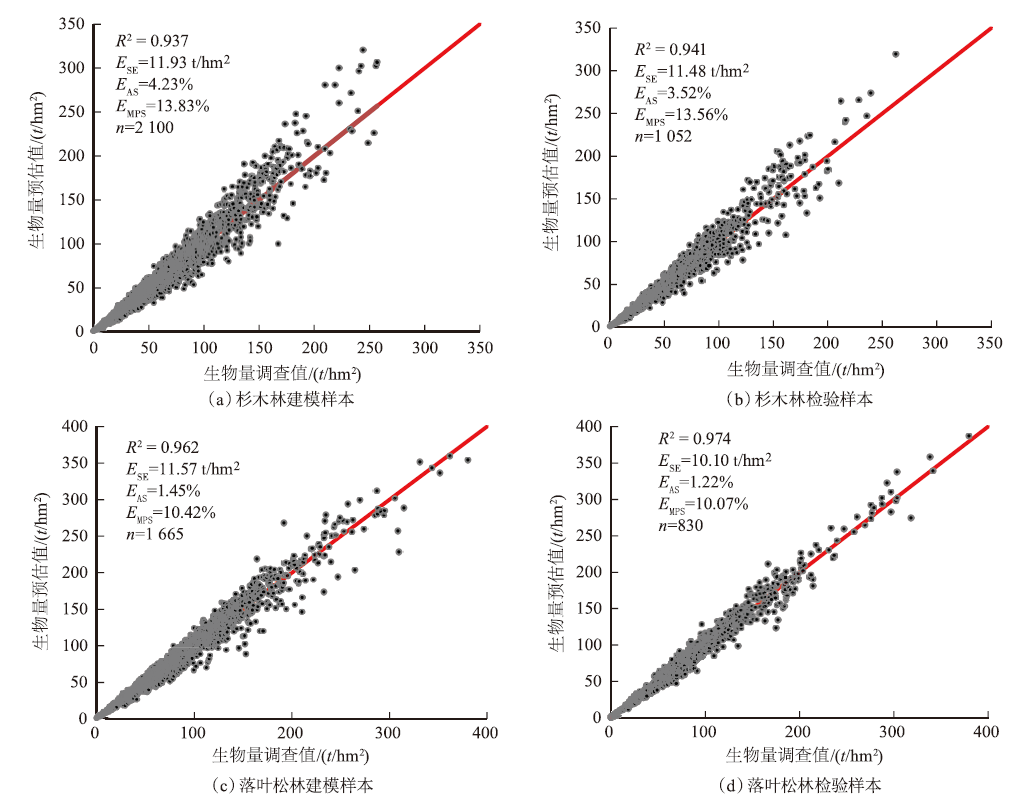
Fig.2
The fitting performance of biomass models for Cunninghamia lanceolata and Larix spp.forests
| [1] | 唐守正. 多元统计分析方法[M]. 北京: 中国林业出版社,1986. |
| [2] | 唐守正, 郎奎建, 李海奎. 统计和生物数学模型计算(ForStat教程)[M]. 北京: 科学出版社, 2008. |
| [3] | 李希菲, 洪玲霞. 用哑变量法求算立地指数曲线族的研究[J]. 林业科学研究, 1997, 10(2):215-219. |
| [4] | 华伟平, 丘甜, 江希钿, 等. 立地质量等级为哑变量的黄山松地位级指数模型的研制[J]. 武夷学院学报, 2015, 34(3):15-18. |
| [5] | 曾伟生, 唐守正, 夏忠胜, 等. 利用线性混合模型和哑变量模型方法建立贵州省通用性生物量方程[J]. 林业科学研究, 2011, 24(3):285-291. |
| [6] | ZENG Weisheng, ZHANG Huiru, TANG Shouzheng. Using the dummy variable model approach to construct compatible single-tree biomass equations at different scales:A case study for Masson pine(Pinus massoniana)in Southern China[J]. Canadian Journal of Forest Research, 2011, 41(7):1547-1554. |
| [7] | 郑冬梅, 曾伟生. 用哑变量方法构建东北落叶松和栎类分段地上生物量模型[J]. 北京林业大学学报, 2013, 35(6):1-5. |
| [8] | ZENG Weisheng. Using nonlinear mixed model and dummy variable model approaches to construct origin-based single tree biomass equations[J]. Trees, 2015, 29(1):275-283. |
| [9] | 吕常笑, 邓华锋, 王秋鸟, 等. 基于哑变量的马尾松生物量模型研究[J]. 河南农业大学学报, 2016, 50(3):304-310. |
| [10] | 高东启, 邓华锋, 王海滨, 等. 基于哑变量的蒙古栎林分生长模型[J]. 东北林业大学学报, 2014, 42(1):61-64. |
| [11] | 王勇, 王鑫梅, 牟洪香, 等. 哑变量在燕山地区华北落叶松人工林生长模型中的应用[J]. 东北林业大学学报, 2014, 42(10):44-49. |
| [12] | 王少杰, 邓华锋, 黄国胜, 等. 基于哑变量的油松人工林和天然林生长模型[J]. 森林与环境学报, 2016, 36(3):325-331. |
| [13] | 王金池, 邓华锋, 冉啟香, 等. 基于哑变量的云南松蓄积生长模型[J]. 森林与环境学报, 2017, 37(4):453-458. |
| [14] |
朱光玉, 胡松, 符利勇. 基于哑变量的湖南栎类天然林林分断面积生长模型[J]. 南京林业大学学报(自然科学版), 2018, 42(2):155-162.
doi: 10.3969/j.issn.1000-2006.201704059 |
| [15] | 雷相东, 李永慈, 向玮. 基于混合模型的单木断面积生长模型[J]. 林业科学, 2009, 45(1):74-80. |
| [16] | 李杨, 亢新刚. 长白山云冷杉针阔混交林林木空间利用率混合模型[J]. 北京林业大学学报, 2020, 42(5):71-79. |
| [17] | 张晓芳, 郭旭展, 洪亮, 等. 冬奥核心区华北落叶松和白桦单木冠幅预测模型:组级贝叶斯模型、加性模型和混合效应模型比较[J]. 林业科学, 2022, 58(10):89-100. |
| [18] | 符利勇, 张会儒, 唐守正. 基于非线性混合模型的杉木优势木平均高[J]. 林业科学, 2012, 48(7):66-71. |
| [19] | 王冬至, 张冬燕, 张志冬, 等. 基于非线性混合模型的针阔混交林树高与胸径的关系[J]. 林业科学, 2016, 52(1):30-36. |
| [20] | 李春明, 赵丽芳, 李利学. 基于混合效应模型和零膨胀模型方法的蒙古栎林分水平枯损模型[J]. 林业科学, 2019, 55(11):27-36. |
| [21] | 杜志, 陈振雄, 李锐, 等. 气候敏感的杉木树高-胸径非线性混合效应模型研建[J]. 北京林业大学学报, 2023, 45(9):52-61. |
| [22] | WANG Mingliang, BORDERS B E, ZHAO Dehai. An empirical comparison of two subject-specific approaches to dominant heights modeling:The dummy variable method and the mixed model method[J]. For Ecology Management, 2008, 255(7):2659-2669. |
| [23] | FU Liyong, ZENG Weisheng, SHARMA R P, et al. Using linear mixed model and dummy variable model approaches to construct compatible single-tree biomass equations at different scales:A case study for Masson pine in Southern China[J]. Journal of Fortest Science, 2012, 58(3):101-115. |
| [24] | 国家林业和草原局. 中国森林资源报告(2014-2018)[M]. 北京: 中国林业出版社, 2019. |
| [25] |
FANG Jingyun, CHEN Anping, PENG Changhui, et al. Changes in forest biomass carbon storage in China between 1949 and 1998[J]. Science, 2001, 292(5525):2320-2322.
doi: 10.1126/science.1058629 pmid: 11423660 |
| [26] | 王斌, 刘某承, 张彪. 基于森林资源清查资料的森林植被净生产量及其动态变化研究[J]. 林业资源管理, 2009(1):35-42. |
| [27] | ZHAO Miaomiao, YANG Jilin, ZHAO Na, et al. Estimation of China’s forest stand biomass carbon sequestration based on the continuous biomass expansion factor model and seven forest inventories from 1977 to 2013[J]. Forest Ecology Management, 2019,448:528-534. |
| [28] | 张煜星, 王雪军. 全国森林蓄积生物量模型建立和碳变化研究[J]. 中国科学:生命科学, 2021, 51(2):199-214. |
| [29] | ZENG Weisheng, CHEN Xinyun, YANG Xueyun. Estimating changes of forest carbon storage in China for 70 years(1949-2018)[J]. Scientific Reports, 2023,13:16864. |
| [30] | ZHOU Xiaolu, LEI Xiangdong, PENG Changhui, et al. Correcting the overestimate of forest biomass carbon on the national scale[J]. Methods Ecology and Evolution, 2016, 7(4):447-455. |
| [31] | 曾伟生, 唐守正. 非线性模型对数回归的偏差校正及与加权回归的对比分析[J]. 林业科学研究, 2011, 24(2):137-143. |
| [32] | 曾伟生, 唐守正. 立木生物量模型的优度评价和精度分析[J]. 林业科学, 2011, 47(11):106-113. |
| [33] | FU Liyong, ZENG Weisheng, TANG Shouzheng. Individual tree biomass models to estimate forest biomass for large spatial regions developed using four pine species in China[J]. Forest Science, 2017, 63(3):241-249. |
| [34] | ZENG Weisheng, ZHANG Lianjin, CHEN Xinyun, et al. Construction of compatible and additive individual-tree biomass models for Pinus tabulaeformis in China[J]. Canadian Journal of Forest Research, 2017, 47(4):467-475. |
| [1] | ZOU Wentao, ZENG Weisheng, WEN Xuexiang. Modeling the relationships between tree crown and DBH and tree height for eight pine species in China [J]. Forest and Grassland Resources Research, 2025, 0(2): 141-150. |
| [2] | ZENG Weisheng. Analyzing the Impact of Sample Structure on Fitting Results of Forestry Mathematical Models [J]. Forest and Grassland Resources Research, 2024, 0(6): 45-53. |
| [3] | DU Zhi, CHEN Zhenxiong, HE Dongbei, LIU Ziwei, HUANG Xin. Development of Forest Volume Model Based on Nonlinear Mixed-effect for Cunninghamia lanceolata [J]. Forest and Grassland Resources Research, 2024, 0(4): 21-28. |
| [4] | ZENG Weisheng. Fitting Methods of Mutual Dependent Variable Models in Forestry [J]. Forest and Grassland Resources Research, 2024, 0(4): 78-83. |
| [5] | SUN Kun, WU Dayu, SUN Honggang. Effects of Mixed Betula luminifera and Phyllostachys edulis with Different Proportions on the Growth of Cunninghamia lanceolata after Thinning [J]. Forest and Grassland Resources Research, 2024, 0(2): 124-132. |
| [6] | WANG Guilin, TAN Wei, CHEN Botao. Height-diameter Model of Cunninghamia lanceolata Based on Deep Neural Network [J]. Forest and Grassland Resources Research, 2024, 0(1): 82-87. |
| [7] | CAO Cong, GUO Zexin, GUO Yanqing, MO Yanqing, LIU Ping. Spatial Distribution of Forest Carbon Storage in the Pearl River Delta Based on Geographically Weighted Regression Model [J]. Forest and Grassland Resources Research, 2023, 0(6): 98-104. |
| [8] | ZOU Weimin, CHEN Chao, HUANG Lei, SONG Meixuan, LI Xuejian, DU Huaqiang. Geographic Weighted Regression Model Combined with Remote Sensing for Estimating Forest Aboveground Carbon Storage of Songyang County [J]. FOREST RESOURCES WANAGEMENT, 2023, 0(4): 132-140. |
| [9] | DU Zhi, CHEN Zhenxiong, Li Rui, LUO Chongbin, YANG Guojin, ZENG Weisheng. Development of Tree Height-DBH Model for Cunninghamia lanceolata and Eucalyptus Robusta Based on Stand Dominant Height and Climatic Factors [J]. FOREST RESOURCES WANAGEMENT, 2023, 0(4): 36-42. |
| [10] | YAN Baoyin, JIANG Wenlong, FAN Junjun, XIANG Zheng, HUANG Jun. Research on Carbon Storage Estimation of Cunninghamia lanceolata Plantation Based on LiDAR Technology [J]. FOREST RESOURCES WANAGEMENT, 2023, 0(3): 134-139. |
| [11] | CAI Huide, LU Feng, XU Zhanyong, PAN Huangru, MENG Xiang, ZENG Weisheng. Research and Development of Compatible and Additive Individual Tree Biomass Model Systems for Eucalyptus [J]. FOREST RESOURCES WANAGEMENT, 2023, 0(1): 87-93. |
| [12] | HUANG Xiaofa, ZHANG Wei, CEN Juyan, WU Guoxin, HUANG Shuying. Study on the Optimization and Selection of Cunninghamia lanceolata Standing Volume Model in Guangxi [J]. FOREST RESOURCES WANAGEMENT, 2022, 0(6): 61-67. |
| [13] | SONG Yaxian, GU Guangtong. Driving Factors of Carbon Trading Price in Pilot Area of China Carbon Market and Its Temporal and Spatial Heterogeneity [J]. FOREST RESOURCES WANAGEMENT, 2022, 0(5): 32-41. |
| [14] | YAN Shu, DENG Houyin, HU Dehuo, WANG Runhui, WEI Ruping, ZHENG Huiquan, ZOU Yihua, CHEN Xiawei. Comprehensive Quality Evaluation of the Pure and Mixed Cunninghamia lanceolata Stands of the Ecological Public-Welfare Forests in Northern Guangdong [J]. FOREST RESOURCES WANAGEMENT, 2022, 0(5): 69-75. |
| [15] | HE Peng, CHEN Zhenxiong, LIU Xianzhao. Developing Stand Basal Area Growth Models for Pinus massoniana and Cunninghamia lanceolata in Hunan Province [J]. FOREST RESOURCES WANAGEMENT, 2021, 0(5): 56-61. |
| Viewed | ||||||
|
Full text |
|
|||||
|
Abstract |
|
|||||
