

Forest and Grassland Resources Research ›› 2025›› Issue (4): 15-29.doi: 10.13466/j.cnki.lczyyj.2025.04.003
Previous Articles Next Articles
GUO Benyu1,2( ), HUANG Heliang1(), HUANG Yan1
Received:2025-07-15
Revised:2025-08-20
Online:2025-08-28
Published:2026-02-13
CLC Number:
GUO Benyu, HUANG Heliang, HUANG Yan. Macroeconomic impacts analysis of forest carbon sinks under carbon neutrality constraints—based on a multi-sector dynamic general equilibrium simulation model[J]. Forest and Grassland Resources Research, 2025, (4): 15-29.
Add to citation manager EndNote|Ris|BibTeX
URL: https://www.lyzygl.com.cn/EN/10.13466/j.cnki.lczyyj.2025.04.003

Tab.1
Variable definition,calculation methods,and data sources
| 参数 | 含义 | 参数值设定 | 区间设定 | 计算方法/计算公式 | 参考文献 |
|---|---|---|---|---|---|
| β | 贴现率 | 0.95 | 校准法 | [ | |
| A | 资本产出率 | 0.25 | Y/K | [ | |
| δ | 资本折旧率 | 0.1 | 永续盘存法 | [ | |
| K0 | 期初生产资本存量 | 4 500 000 | 永续盘存法 | [ | |
| α | 碳中和技术函数的幂 | 0.30 | 0.25~0.35 | 校准法 | [ |
| θr | 碳减排技术的技术参数 | 0.005 4 | 0.001 8~0.009 0 | (1-α)×(C×N)α-1 | [ |
| θc | CCS技术的技术参数 | 0.003 3 | 0.001 1~0.005 5 | (1-α)×(C×N)α-1 | [ |
| θf | 森林碳汇的技术参数 | 0.016 7 | 0.005 5~0.027 8 | (1-α)×(C×N)α-1 | [ |
| η | 碳排放的技术参数 | 0.000 03 | E/K | [ |
Tab.2
The meanings and parameter settings of each scenario
| 情景名称 | 含义 | 参数设置 |
|---|---|---|
| 情景1 | 无碳中和约束,无约束基准情景 | 设置碳排放技术系数和碳中和技术系数为0 |
| 情景2 | 面临碳中和约束,仅使用碳减排技术达成碳中和,减排约束情景 | 设置碳排放和碳减排技术系数不为0 |
| 情景3 | 面临碳中和约束,在碳减排的基础上,进一步引入CCS碳汇技术和森林碳汇技术,协同治理情景 | 设置各项技术系数为正常技术测算值 |
| 情景4 | 面临碳中和约束,在碳减排的基础上,大幅调高森林碳汇成本,调减森林碳汇技术效益值,模拟森林碳汇存在上限导致成本大幅上升的森林碳汇上限情景 | 设置森林碳汇的收益系数为0.1,其他各项技术系数为正常技术测算值 |
| 情景5 | 面临碳中和约束,引入各项碳中和技术,同时适当调低碳排放技术参数,模拟经济结构变化可能的碳排放减少时的转型情景 | 设置碳排放系数为0.5,其他各项技术系数为正常技术测算值 |
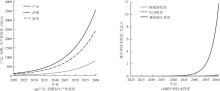
Fig.1
Variable paths under the carbon neutrality constraint
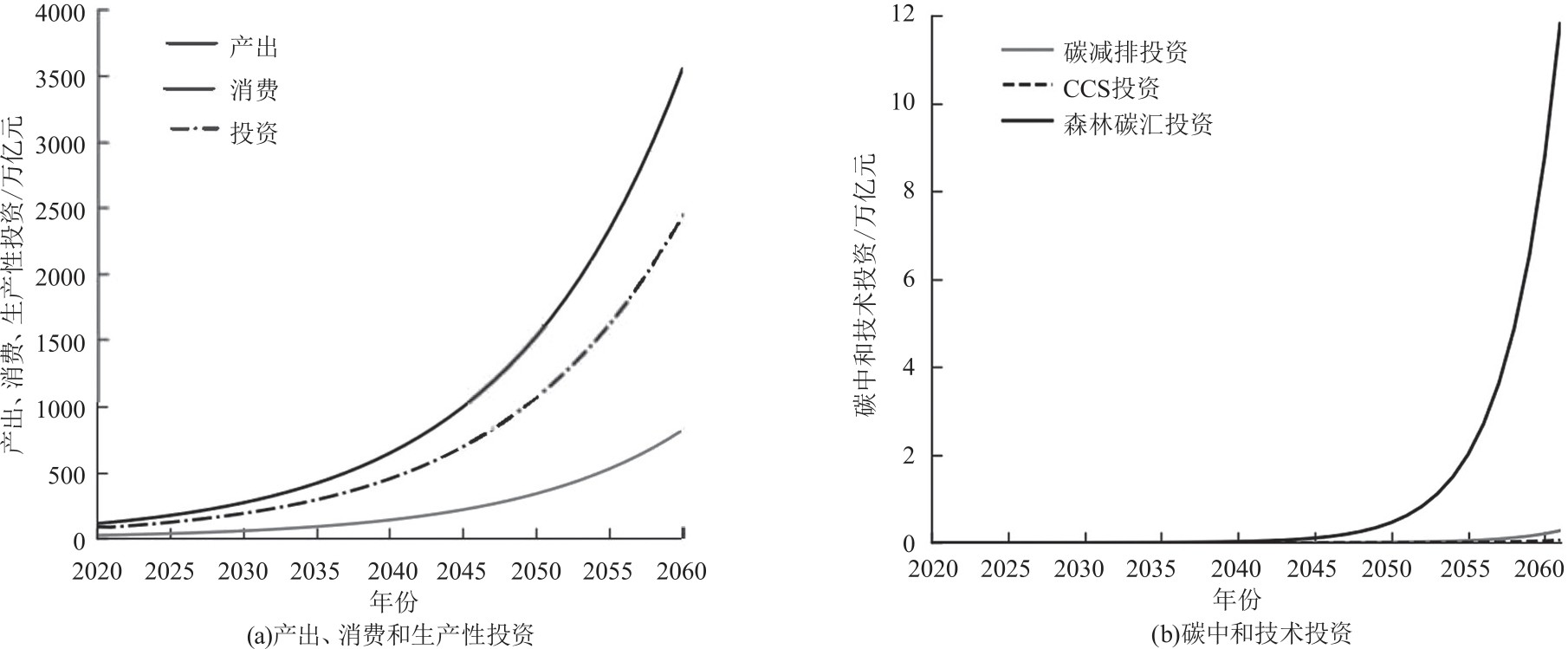
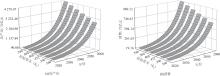
Fig.2
Impact of initial capital on optimal total output and consumption paths
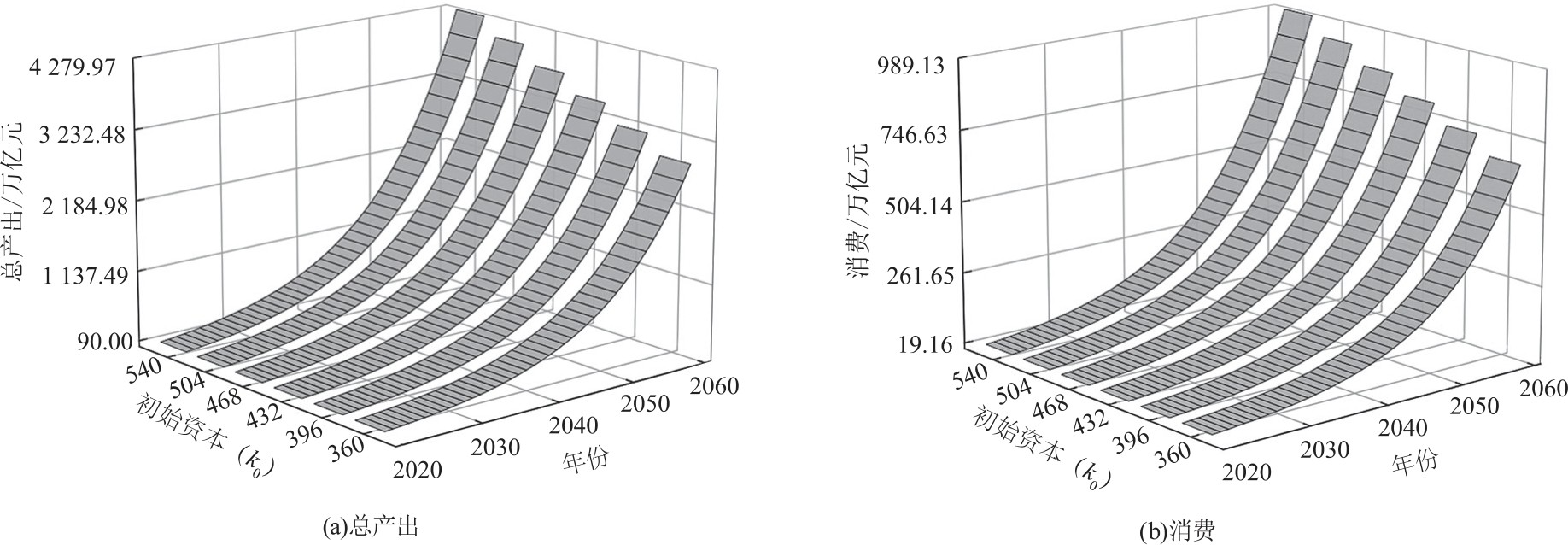
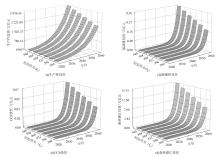
Fig.3
Effects of initial capital changes on various investments
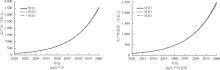
Fig.4
Dynamic paths of total output and productive investment under three scenarios
Tab.3
Comparison of economic loss results under different scenarios relative to the baseline scenario %
| 指标 | 情景2 (碳中和约束+碳减排) | 情景3 (碳中和约束+碳减排+CCS和森林碳汇) | 情景4 (森林碳汇受限) | 情景5 (碳排放降低) |
|---|---|---|---|---|
| 最后一期总支出损失 | 1.98 | 0.44 | 0.78 | 0.11 |
| 累计投资损失 | 1.31 | 0.28 | 0.49 | 0.07 |
| 累计碳减排投资 | 0.558 | 0.004 | 0.189 | 0.003 |
| 累计CCS投资 | 0.000 | 0.001 | 0.093 | 0.001 |
| 累计森林碳汇投资 | 0.000 | 0.157 | 0.001 | 0.036 |
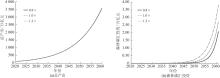
Fig.5
Dynamic paths of total output and forest carbon sink investment under different α
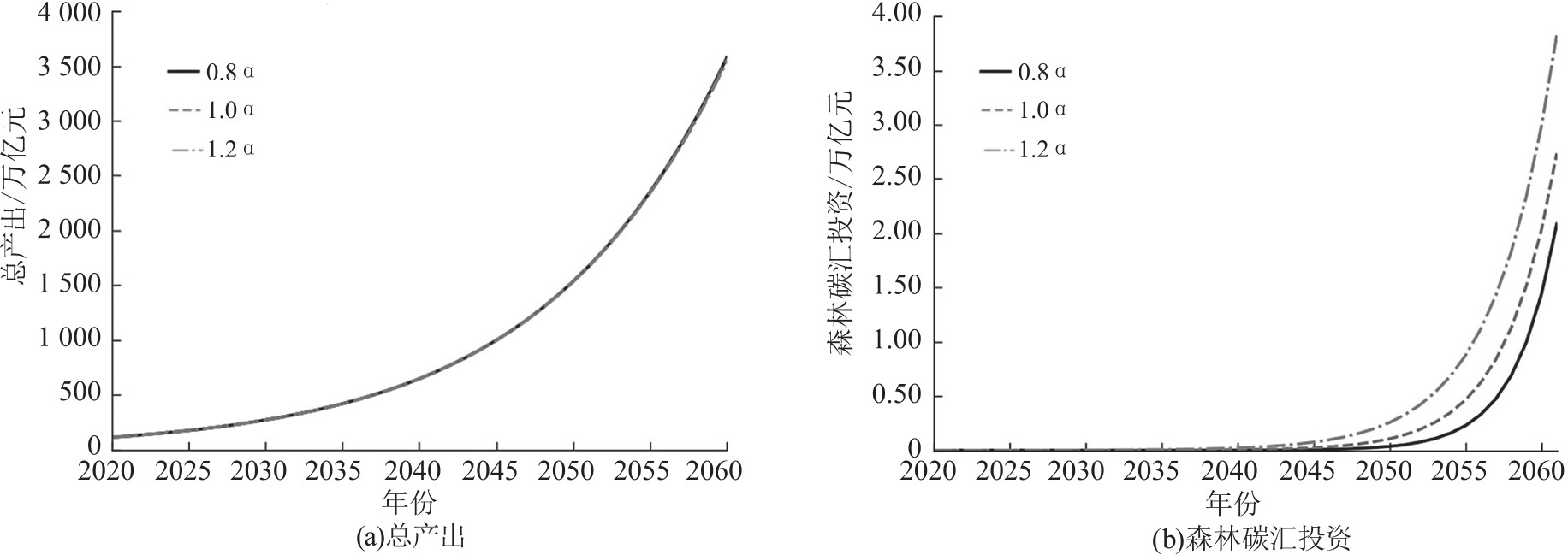
Fig.6
Effects of different technology parameters of carbon abatement on total output and emission reduction investment
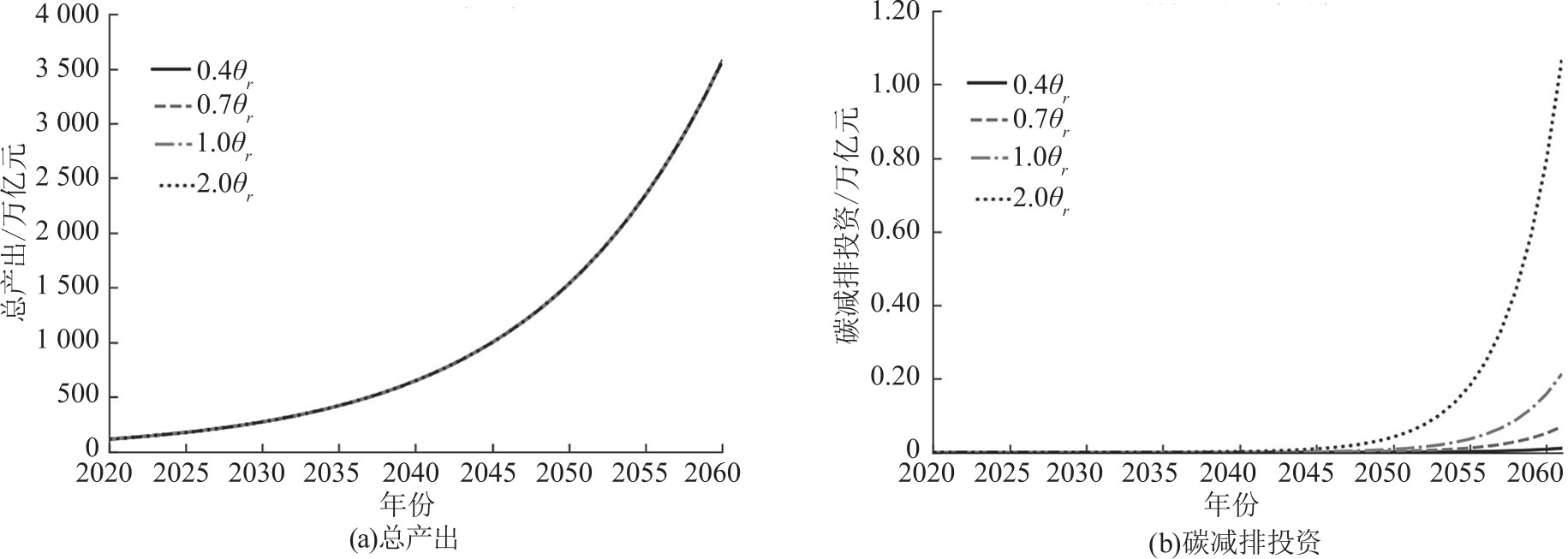
Fig.7
Effects of different technology parameters of CCS on total output and CCS investment
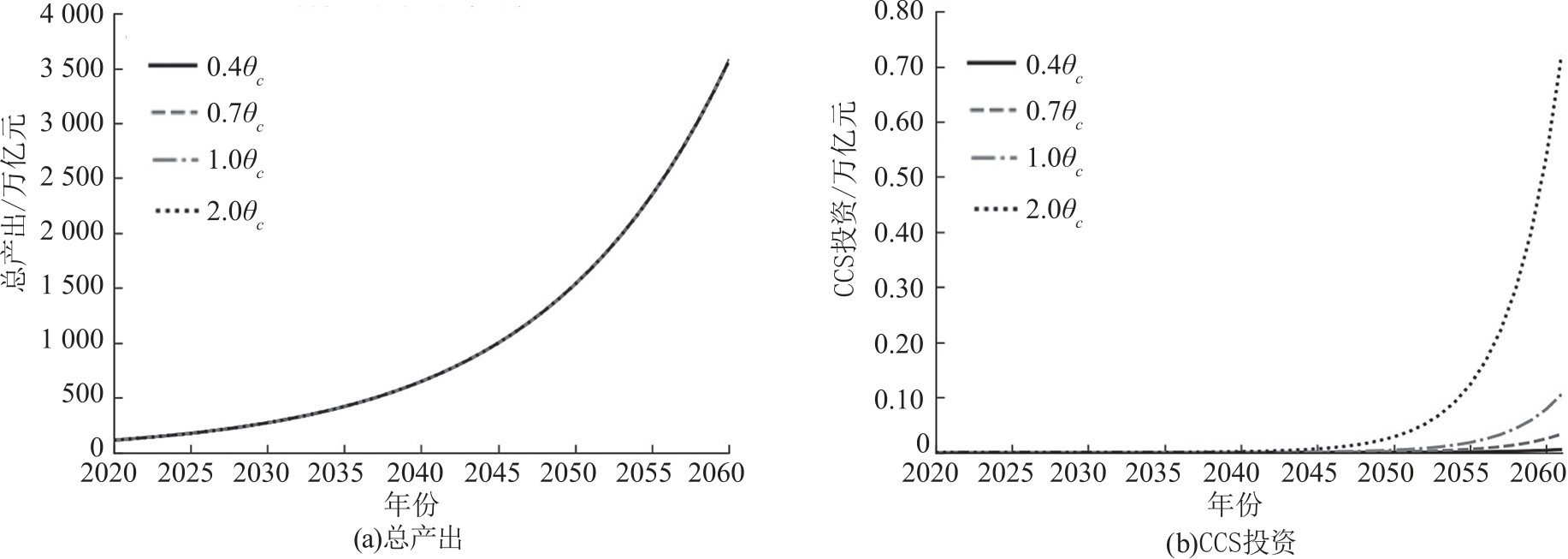
Fig.8
Effects of different technology parameters of forest carbon sink on total output and forest carbon sink investment
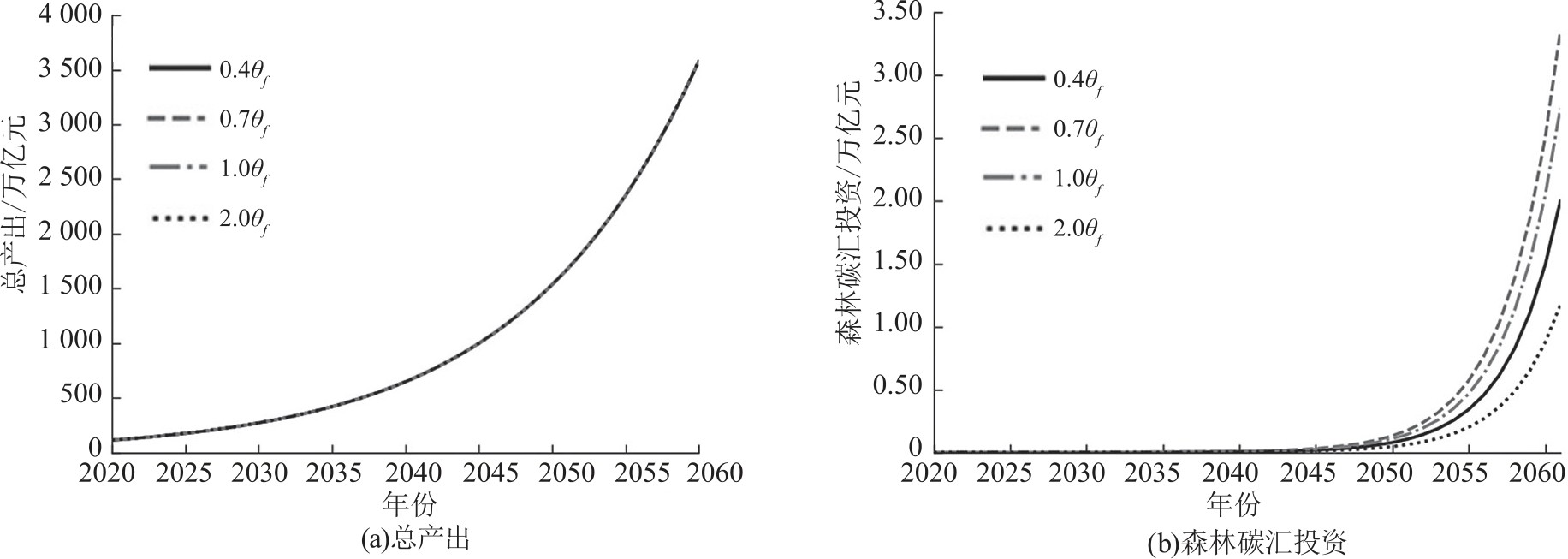
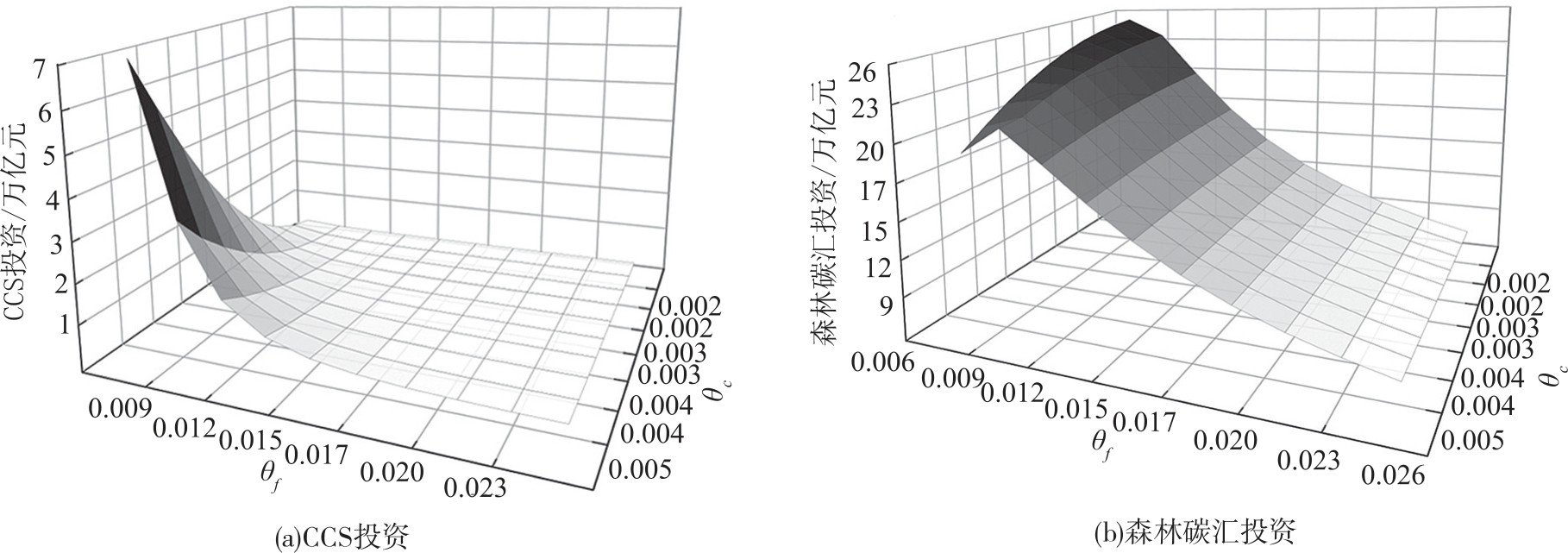
Fig.9
Effects of different technical parameters on CCS investment and forest carbon sink investment
| [1] | United Nations Framework Convention on Climate Change(UNFCCC). Paris Agreement[EB/OL].(2015-12-12)[2025-08-14] https://unfccc.int/sites/default/files/english_paris_agreement.pdf. |
| [2] | 中国政府网. 落实“双碳”行动建设美丽中国[EB/OL].(2024-04-28)[2025-08-14]. https://www.gov.cn/yaowen/liebiao/202404/content_6948005.htm. |
| [3] | 徐晋涛, 易媛媛. “双碳”目标与基于自然的解决方案:森林碳汇的潜力和政策需求[J]. 农业经济问题, 2022(9):11-23. |
| [4] | 敖贵艳, 吴伟光, 曹先磊, 等. 基于三阶段DEA模型的碳汇竹林生产效率分析:来自浙江安吉的实证[J]. 农林经济管理学报, 2019, 18(5):656-666. |
| [5] | 沈月琴, 王枫, 张耀启, 等, 中国南方杉木林业碳汇供给的经济分析[J]. 林业科学, 2013, 49(9):140-147. |
| [6] | 龙飞, 沈月琴, 祁慧博, 等. 基于企业减排需求的森林碳汇定价机制[J]. 林业科学, 2020, 56(2):164-173 |
| [7] | 姜霞, 黄祖辉. 经济新常态下中国森林碳汇潜力分析[J]. 中国农村经济, 2016(11):57-67. |
| [8] | 刘国华, 傅伯杰, 方精云. 中国森林碳动态及其对全球碳平衡的贡献[J]. 生态学报, 2000, 20(5):733-740. |
| [9] |
NORDHAUS W D. An optimal transition path for controlling greenhouse gases[J]. Science, 1992, 258(5086):1315-1319.
pmid: 17778354 |
| [10] | NORDHAUS W D. The climate casino:Risk,uncertainty,and economics for a warming world[M]. New Haven: Yale University Press, 2013. |
| [11] | NORDHAUS W D, Yang Z. A regional dynamic general-equilibrium model of alternative climate-change strategies[J]. American Economic Review, 1996, 86(4):741-765. |
| [12] |
ACEMOGLU D, AGHION P, BURSZTYN L, et al. The environment and directed technical change[J]. American Economic Review, 2012, 102(1):131-166.
pmid: 26719595 |
| [13] |
ANNICCHIARICO B, DIO D F. Environmental policy and macroeconomic dynamics in a New Keynesian model[J]. Journal of Environmental Economics and Management, 2015, 73:1-21.
doi: 10.1016/j.jeem.2015.06.001 |
| [14] |
SOHNGEN B, MENDELSOHN R. An optimal control model of forest carbon sequestration[J]. American Journal of Agricultural Economics, 2003, 85(2):448-457.
doi: 10.1111/ajae.v85.2 |
| [15] |
GOLOSOV M, HASSLER J, KRUSELL P, et al. Optimal taxes on fossil fuel in general equilibrium[J]. Econometrica, 2014, 82(1):41-88.
doi: 10.3982/ECTA10217 |
| [16] | 沈月琴, 曾程, 王成军, 等. 碳汇补贴和碳税政策对林业经济的影响研究:基于CGE的分析[J]. 自然资源学报, 2015, 30(4):560-568. |
| [17] | 吴伟光, 许骞骞, 羊凌玉, 等. 林业增汇潜力及其对中国碳中和的经济影响分析[J]. 农业技术经济, 2024(8):128-144. |
| [18] | 丁冠群, 王铮, 孙翊. 基于多行业DSGE模型的中国碳减排政策效应[J]. 中国人口·资源与环境, 2022, 32(1):19-30. |
| [19] | 沈维萍, 夏克郁, 陈迎. 碳中和目标下负排放策略的综合效应[J]. 中国人口·资源与环境, 2024, 34(2):1-10. |
| [20] | 清华大学气候变化与可持续发展研究院项目综合报告编写组. 中国长期低碳发展战略与转型路径研究》综合报告[J]. 中国人口·资源与环境, 2020, 30(11):1-25. |
| [21] | LJUNGQVIST L, SARGENT T J. Recursive Macroeconomic Theory[M]. 4 ed. Cambridge,MA: The MIT Press, 2018. |
| [22] | ACEMOGLU D. Introduction to Modern Economic Growth[M]. Princeton: Princeton University Press, 2009. |
| [23] | HEER B, MAUSSNER A. Dynamic General Equilibrium Modeling:Computational Methods and Applications[M]. 3rd ed. Cham: Springer, 2023. |
| [24] | 陈昆亭, 龚六堂. 中国经济增长的周期与波动的研究[J]. 经济学(季刊), 2004(3):803-818. |
| [25] | 张军, 吴桂英, 张吉鹏. 中国省际物质资本存量估算:1952—2000[J]. 经济研究, 2004(10):35-44. |
| [26] | 单豪杰. 中国资本存量K的再估算:1952—2006年[J]. 数量经济技术经济研究, 2008(10):17-31. |
| [27] | 田友春. 中国工业分行业资本存量测算:1985—2014年[J]. 数量经济技术经济研究, 2016, 33(6):3-21. |
| [28] | 白重恩, 张琼. 中国的资本回报率及其影响因素分析[J]. 世界经济, 2014(10):3-30. |
| [29] | 李宏瑾, 唐黎阳. 中国资本回报率变化趋势及主要行业比较研究[J]. 南方金融, 2024(7):3-15. |
| [30] | 中华人民共和国生态环境部. 全国碳市场发展报告(2024)[EB/OL].(2024-07-22)[2025-08-14]. https://www.mee.gov.cn/ywdt/xwfb/202407/t20240722_1082192.shtml. |
| [31] | 中华人民共和国生态环境部. 中华人民共和国气候变化第一次双年透明度报告[EB/OL].(2024-12-31)[2025-08-14]. https://unfccc.int/sites/default/files/resource/中华人民共和国气候变化第一次双年透明度报告.pdf. |
| [32] | 蔡博峰, 李琦, 张贤, 等. 中国二氧化碳捕集利用与封存年度报告(2021):中国CCUS路径研究[EB/OL].(2024-10-25)[2025-08-14]. http://www.yrdcpcn.org.cn/c91/20241106/i264922.phtml. |
| [33] | 陈诗一. 工业二氧化碳的影子价格:参数化和非参数化方法[J]. 世界经济, 2010(8):93-111. |
| [34] | 陈诗一, 王畅, 郭越. 面向碳中和目标的中国工业部门减排路径与战略选择[J]. 管理科学学报, 2024(4):1-20. |
| [35] | 国际能源署. 通过CCUS(碳捕集、利用与封存)技术改造实现中国煤电碳减排[R]. 巴黎: 国际能源署, 2019. |
| [36] | 阳平坚, 彭栓, 王静, 等. 碳捕集、利用与封存(CCUS)技术发展现状及应用展望[J]. 中国环境科学, 2024, 44(1):404-416. |
| [37] | 杜强, 李琦, 黄馨. 碳捕集技术经济性评价综述与展望[J]. 生态经济, 2025, 41(5):219-227. |
| [38] | 王群伟, 周鹏, 周德群. 我国二氧化碳排放绩效的动态变化、区域差异及影响因素[J]. 中国工业经济, 2010(1):45-54. |
| [39] | 魏丽莉, 候宇琦. 中国工业二氧化碳边际减排成本测算与行业碳达峰预测[J]. 经济理论与经济管理, 2023, 43(2):63-77. |
| [40] | 茹雪, 雷鹏飞, 刘培. 二氧化碳动态边际减排成本及其影响机制[J]. 中国人口·资源与环境, 2022, 32(11):43-57. |
| [41] |
黄宰胜, 陈钦. 基于造林成本法的林业碳汇成本收益影响因素分析[J]. 资源科学, 2016, 38(3):485-492.
doi: 10.18402/resci.2016.03.11 |
| [42] |
许骞骞, 曹先磊, 孙婷, 等. 中国森林碳汇潜力与增汇成本评估[J]. 自然资源学报, 2022, 37(12):3217-3233.
doi: 10.31497/zrzyxb.20221213 |
| Viewed | ||||||
|
Full text |
|
|||||
|
Abstract |
|
|||||
