

Forest and Grassland Resources Research ›› 2025›› Issue (4): 30-41.doi: 10.13466/j.cnki.lczyyj.2025.04.004
Previous Articles Next Articles
ZHANG Miao( ), WANG Bing(), MENG Xiangyuan, WANG Zihao, ZHANG Qiuliang, SA Rula
Received:2025-06-03
Revised:2025-08-10
Online:2025-08-28
Published:2026-02-13
CLC Number:
ZHANG Miao, WANG Bing, MENG Xiangyuan, WANG Zihao, ZHANG Qiuliang, SA Rula. Spatiotemporal patterns of ecosystem services and their trade-off and synergy relationship in western Inner Mongolia[J]. Forest and Grassland Resources Research, 2025, (4): 30-41.
Add to citation manager EndNote|Ris|BibTeX
URL: https://www.lyzygl.com.cn/EN/10.13466/j.cnki.lczyyj.2025.04.004
Tab.1
Maximum impact distance and weight of stress factors
| 威胁因子 | 最大影响距离/m | 权重 | 衰退类型 |
|---|---|---|---|
| 耕地 | 4 | 0.6 | 线性 |
| 建设用地 | 10 | 1.0 | 指数 |
| 未利用地 | 6 | 0.5 | 线性 |
Tab.2
Habitat suitability and sensitivity
| 土地利用类型 | 生境适宜度 | 敏感度 | ||
|---|---|---|---|---|
| 耕地 | 建设用地 | 未利用地 | ||
| 耕地 | 0.30 | 0.00 | 0.40 | 0.80 |
| 林地 | 1.00 | 0.60 | 0.20 | 0.80 |
| 草地 | 0.90 | 0.80 | 0.60 | 0.70 |
| 水域 | 0.70 | 0.50 | 0.40 | 0.70 |
| 建设用地 | 0.50 | 0.06 | 0.00 | 0.60 |
| 未利用地 | 0.00 | 0.00 | 0.10 | 0.00 |
Tab.3
Land use area and proportion in 1990,2000,2010,2020 in western Inner Mongolia
| 土地利用 类型 | 面积/km2 | 比例/% | |||||||
|---|---|---|---|---|---|---|---|---|---|
| 1990年 | 2000年 | 2010年 | 2020年 | 1990年 | 2000年 | 2010年 | 2020年 | ||
| 耕地 | 16 781.31 | 16 479.43 | 16 545.74 | 16 352.69 | 3.99 | 3.92 | 3.93 | 3.89 | |
| 林地 | 4 858.01 | 4 822.08 | 5 405.35 | 5 584.42 | 1.16 | 1.15 | 1.29 | 1.33 | |
| 草地 | 133 898.72 | 132 155.32 | 130 581.66 | 130 776.70 | 31.84 | 31.42 | 31.05 | 31.09 | |
| 水域 | 4 942.58 | 4 934.39 | 4 868.62 | 5 065.86 | 1.18 | 1.17 | 1.16 | 1.20 | |
| 建设用地 | 3 405.05 | 3 479.80 | 3 803.78 | 5 551.37 | 0.80 | 0.83 | 0.90 | 1.32 | |
| 未利用地 | 256 715.56 | 258 730.21 | 259 396.08 | 257 270.19 | 61.03 | 61.51 | 61.67 | 61.17 | |
Tab.4
Land use area transition matrix from 1990 to 2020 in western Inner Mongolia
| 1990年土地 利用类型 | 2020年 | ||||||
|---|---|---|---|---|---|---|---|
| 耕地/km2 | 林地/km2 | 草地/km2 | 水域/km2 | 建设用地/km2 | 未利用地/km2 | 转出率/% | |
| 耕地 | 14 388.912 9 | 341.382 6 | 1 177.375 5 | 202.338 0 | 408.240 0 | 263.063 7 | 14.26 |
| 林地 | 56.189 7 | 4 262.471 1 | 352.358 1 | 35.048 7 | 76.480 2 | 75.459 6 | 12.26 |
| 草地 | 1 441.265 4 | 612.635 4 | 125 837.752 5 | 276.550 2 | 1 242.037 8 | 4 488.477 3 | 6.02 |
| 水域 | 97.216 2 | 20.331 0 | 234.146 7 | 4 207.796 1 | 41.885 1 | 341.204 4 | 14.87 |
| 建设用地 | 36.126 0 | 2.575 8 | 40.726 8 | 12.231 0 | 3 305.010 6 | 8.375 4 | 2.94 |
| 未利用地 | 332.974 8 | 345.027 6 | 3 134.343 6 | 331.897 5 | 477.713 7 | 252 093.610 8 | 1.80 |
| 转入率/% | 12.01 | 23.67 | 3.78 | 16.94 | 40.46 | 2.01 | |
Tab.5
Carbon stock and carbon stock per unit area in various regions in 1990,2000,2010,and 2020 in western Inner Mongolia
| 土地利用 类型 | 碳储量/t | 单位面积碳储量/(t/hm2) | |||||||
|---|---|---|---|---|---|---|---|---|---|
| 1990年 | 2000年 | 2010年 | 2020年 | 1990年 | 2000年 | 2010年 | 2020年 | ||
| 耕地 | 1.18×10⁸ | 1.16×10⁸ | 1.34×10⁸ | 1.15×10⁸ | 70.14 | 70.13 | 80.75 | 70.37 | |
| 林地 | 5.56×10⁷ | 5.53×10⁷ | 5.61×10⁷ | 6.38×10⁷ | 114.36 | 114.67 | 103.83 | 114.20 | |
| 草地 | 1.02×10⁹ | 1.00×10⁹ | 8.96×10⁸ | 9.93×10⁸ | 75.89 | 75.85 | 68.61 | 75.92 | |
| 水域 | 4.66×10⁶ | 4.65×10⁶ | 4.14×10⁶ | 4.76×10⁶ | 9.43 | 9.41 | 8.51 | 9.40 | |
| 建设用地 | 8.10×10⁶ | 8.24×10⁶ | 9.58×10⁶ | 1.28×10⁷ | 23.79 | 23.69 | 25.18 | 23.07 | |
| 未利用地 | 7.51×10⁸ | 7.57×10⁸ | 7.90×10⁸ | 7.53×10⁸ | 29.25 | 29.26 | 30.46 | 29.26 | |
| 合计 | 1.95×10⁹ | 1.94×10⁹ | 1.88×10⁹ | 1.94×10⁹ | 46.43 | 46.20 | 44.93 | 44.18 | |
Tab.6
Soil retention amounts and soil retention amount per unit area in various regions in 1990,2000,2010,and 2020 in western Inner Mongolia
| 土地利用 类型 | 土壤保持量/t | 单位面积土壤保持量/(t/hm2) | |||||||
|---|---|---|---|---|---|---|---|---|---|
| 1990年 | 2000年 | 2010年 | 2020年 | 1990年 | 2000年 | 2010年 | 2020年 | ||
| 耕地 | 7.08×10⁷ | 3.54×10⁷ | 6.33×10⁷ | 9.30×10⁷ | 42.19 | 21.50 | 38.28 | 56.89 | |
| 林地 | 6.12×10⁷ | 3.20×10⁷ | 5.62×10⁷ | 7.78×10⁷ | 125.88 | 66.33 | 103.93 | 139.33 | |
| 草地 | 4.90×10⁸ | 2.47×10⁸ | 4.28×10⁸ | 6.05×10⁸ | 36.60 | 18.72 | 32.76 | 46.24 | |
| 水域 | 1.59×10⁷ | 8.11×10⁶ | 1.26×10⁷ | 1.95×10⁷ | 32.17 | 16.43 | 25.98 | 38.57 | |
| 建设用地 | 1.01×10⁷ | 5.18×10⁶ | 1.58×10⁷ | 1.32×10⁷ | 29.72 | 14.90 | 41.59 | 23.79 | |
| 未利用地 | 3.85×10⁸ | 2.84×10⁸ | 4.24×10⁸ | 4.09×10⁸ | 15.03 | 10.98 | 16.33 | 15.90 | |
| 合计 | 1.03×10⁹ | 6.12×10⁸ | 9.99×10⁸ | 1.21×10⁹ | 24.58 | 14.56 | 23.76 | 44.18 | |
Tab.7
Area and average per unit area of windbreak and sand-fixing levels in 1990,2000,2010,and 2020 in western Inner Mongolia
| 等级 | 面积/km2 | 单位面积均值/(kg/m2) | |||||||
|---|---|---|---|---|---|---|---|---|---|
| 1990年 | 2000年 | 2010年 | 2020年 | 1990年 | 2000年 | 2010年 | 2020年 | ||
| 低 | 291 987.03 | 320 058.08 | 322 817.41 | 268 202.01 | 0.05 | 0.06 | 0.05 | 0.06 | |
| 中 | 58 774.30 | 54 169.97 | 51 912.34 | 91 074.56 | 0.75 | 0.65 | 0.70 | 0.76 | |
| 高 | 15 177.80 | 2 093.25 | 1 833.20 | 1 6916.40 | 1.76 | 1.53 | 1.50 | 1.76 | |
Tab.8
Habitat quality area and proportion in 1990,2000,2010,and 2020 in western Inner Mongolia
| 等级 | 面积/km2 | 比例/% | |||||||
|---|---|---|---|---|---|---|---|---|---|
| 1990年 | 2000年 | 2010年 | 2020年 | 1990年 | 2000年 | 2010年 | 2020年 | ||
| 低 | 276 595.67 | 278 691.16 | 292 146.20 | 280 761.72 | 65.82 | 66.26 | 69.46 | 66.76 | |
| 较低 | 15 872.19 | 16 339.26 | 17 936.69 | 20 485.47 | 3.78 | 3.88 | 4.26 | 4.87 | |
| 中 | 19 757.50 | 19 995.97 | 19 325.35 | 27 651.11 | 4.70 | 4.75 | 4.59 | 6.57 | |
| 较高 | 26 083.22 | 25 569.66 | 24 580.46 | 31 238.86 | 6.21 | 6.08 | 5.84 | 7.43 | |
| 高 | 81 907.99 | 79 981.32 | 66 588.96 | 60 440.22 | 19.49 | 19.02 | 15.83 | 14.37 | |
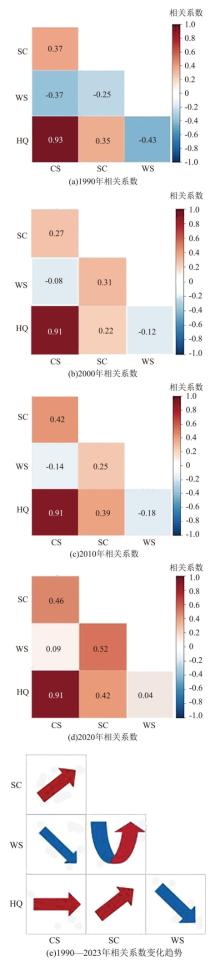
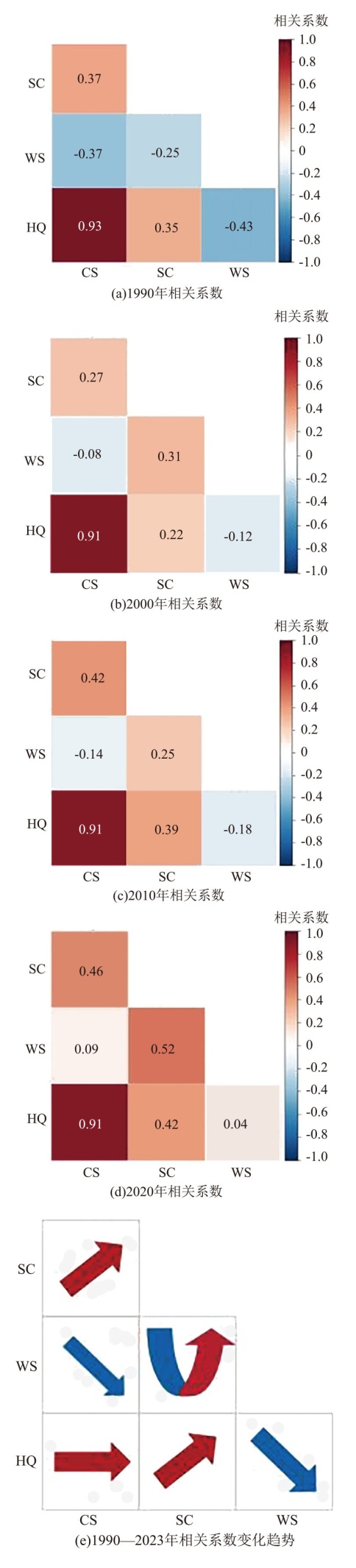
Fig.1
Correlation coefficients and trends of ecosystem services in western Inner Mongolia
| [1] | YIN Dengyu, SHI Yangyang, et al. Matching supply and demand for ecosystem services in the Yellow River Basin,China:A perspective of the water-energy-food nexus[J]. Journal of Cleaner Production, 2023, 384:135469. |
| [2] | 马克明, 傅伯杰, 黎晓亚, 等. 区域生态安全格局:概念与理论基础[J]. 生态学报, 2004, 24(4):761-768. |
| [3] | 欧阳志云, 王如松. 生态系统服务功能、生态价值与可持续发展[J]. 世界科技研究与发展, 2000, 22(5):45-50. |
| [4] |
李林云, 陈璐, 韩梦娟, 等. 河北省生态系统碳储量的时空演变及多情景模拟[J]. 应用生态学报, 2024, 35(12):3247-3256.
doi: 10.13287/j.1001-9332.202412.020 |
| [5] |
武文欢, 彭建, 刘焱序, 等. 鄂尔多斯市生态系统服务权衡与协同分析[J]. 地理科学进展, 2017, 36(12):1571-1581.
doi: 10.18306/dlkxjz.2017.12.012 |
| [6] |
王洋洋, 肖玉, 谢高地, 等. 基于RWEQ的宁夏草地防风固沙服务评估[J]. 资源科学, 2019, 41(5):980-991.
doi: 10.18402/resci.2019.05.14 |
| [7] | 包玉斌, 刘康, 李婷, 等. 基于InVEST模型的土地利用变化对生境的影响:以陕西省黄河湿地自然保护区为例[J]. 干旱区研究, 2015, 32(3):622-629. |
| [8] | 王志芳, 彭瑶瑶, 徐传语. 生态系统服务权衡研究的实践应用进展及趋势[J]. 北京大学学报(自然科学版), 2019, 55(4):773-781. |
| [9] | 兰紫橙, 贾岚, 程煜. 闽江流域生态系统服务价值评估及权衡协同关系[J]. 生态学报, 2020, 40(12):3909-3920. |
| [10] | 许静, 刘慧. 甘肃省生态系统服务权衡协同关系评估与预测[J]. 中国环境科学, 2024, 44(4):1863-1874. |
| [11] | 江凌, 肖燚, 欧阳志云, 等. 基于RWEQ模型的青海省土壤风蚀模数估算[J]. 水土保持研究, 2015, 22(1):21-25,32. |
| [12] | 贾婉琳, 吴赛男, 陈昂. 基于InVEST模型的赤水河流域生态系统服务功能评估研究[J]. 中国水利水电科学研究院学报, 2020, 18(4):313-320. |
| [13] | 邓喆, 丁文广, 蒲晓婷, 等. 基于InVEST模型的祁连山国家公园碳储量时空分布研究[J]. 水土保持通报, 2022, 42(3):324-334,396. |
| [14] | 李鹏, 姜鲁光, 封志明, 等. 生态系统服务竞争与协同研究进展[J]. 生态学报, 2012, 32(16):5219-5229. |
| [15] | 王奕淇, 孙学莹. 黄河流域生态系统服务权衡协同关系及其时空异质性[J]. 环境科学, 2025, 46(2):972-989. |
| [16] |
TALLIS H, KAREIVA P, MARVIER M, et al. An ecosystem services framework to support both practical conservation and economic development[J]. Proceedings of the National Academy of Sciences, 2008, 105(28):9457-9464.
doi: 10.1073/pnas.0705797105 |
| [17] |
QIU Jiangxiao, TURNER M G. Spatial interactions among ecosystem services in an urbanizing agricultural watershed[J]. Proceedings of the National Academy of Sciences, 2013, 110(29):12149-12154.
doi: 10.1073/pnas.1310539110 |
| [18] | 万虹麟, 王凤春, 李佳亮, 等. 雄安新区土地利用变化驱动生态系统服务时空变化及权衡协同分析[J]. 地球物理学进展, 2023, 38(5):1978-1998. |
| [19] | 张晓瑶, 张潇, 李冬花, 等. 城市土地利用变化对生态系统服务价值影响的多情景模拟:以深圳市为例[J]. 生态学报, 2022, 42(6):2086-2097. |
| [20] | 张玉虎, 贾海峰, 于长青. 永定河流域典型区土地利用/覆被变化[J]. 山地学报, 2009, 27(5):564-572. |
| [21] | 钟绍卓, 孙浩源. 不同情景下祁连山国家级自然保护区生态系统服务时空变化及权衡与协同关系[J]. 水土保持研究, 2023, 30(5):358-369. |
| [22] |
GIARDINA C P, RYAN M G. Evidence that decomposition rates of organic carbon in mineral soil do not vary with temperature[J]. Nature, 2000, 404(6780):858-861.
doi: 10.1038/35009076 |
| [23] |
ALAM S A, STARR M, CLARK B J F. Tree biomass and soil organic carbon densities across the Sudanese woodland savannah:A regional carbon sequestration study[J]. Journal of arid environments, 2013, 89:67-76.
doi: 10.1016/j.jaridenv.2012.10.002 |
| [24] | 章文波, 付金生. 不同类型雨量资料估算降雨侵蚀力[J]. 资源科学, 2003, 25(1):35-41. |
| [25] | WILLIAMS J R. The erosion-productivity impact calculator (EPIC) model:a case history[J]. Philosophical Transactions of the Royal Society of London.Series B:Biological Sciences, 1990, 329(1255):421-428. |
| [26] |
LIU Baoyuan, NEARING M A, RISSE L M. Slope gradient effects on soil loss for steep slopes[J]. Transactions of the ASAE, 1994, 37(6):1835-1840.
doi: 10.13031/2013.28273 |
| [27] | 蔡崇法, 丁树文, 史志华, 等. 应用USLE模型与地理信息系统IDRISI预测小流域土壤侵蚀量的研究[J]. 水土保持学报, 2000, 14(2):19-24. |
| [28] | 陆建忠, 陈晓玲, 李辉, 等. 基于GIS/RS和USLE鄱阳湖流域土壤侵蚀变化[J]. 农业工程学报, 2011, 27(2):337-344. |
| [29] |
张晓明, 宿星, 张军, 等. 基于PLUS-InVEST模型的甘肃通渭滑坡区生境质量时空变化及预测[J]. 干旱区地理, 2025, 48(7):1220-1232.
doi: 10.12118/j.issn.1000-6060.2024.425 |
| [30] | 苏军德, 赵晓冏, 李国霞, 等. 祁连山国家自然保护区生境质量时空特征及驱动因素分析[J]. 中国环境科学, 2024, 44(5):2595-2605. |
| [31] | 刘梦园. 基于InVEST模型的河西地区碳储量与生境质量评价[D]. 兰州: 兰州大学, 2023. |
| [32] |
傅伯杰, 张立伟. 土地利用变化与生态系统服务:概念、方法与进展[J]. 地理科学进展, 2014, 33(4):441-446.
doi: 10.11820/dlkxjz.2014.04.001 |
| [33] | 谢金君. 基于Invest模型的包头地区生态系统服务功能研究[D]. 呼和浩特: 内蒙古农业大学, 2024. |
| [34] |
董彭蓓, 任宗萍, 李鹏, 等. 土地利用变化下宁夏生态系统服务权衡协同关系研究[J]. 干旱区研究, 2024, 41(6):1032-1044.
doi: 10.13866/j.azr.2024.06.12 |
| [35] |
巩国丽, 刘纪远, 邵全琴. 基于RWEQ的20世纪90年代以来内蒙古锡林郭勒盟土壤风蚀研究[J]. 地理科学进展, 2014, 33(6):825-834.
doi: 10.11820/dlkxjz.2014.06.011 |
| [36] | 江凌, 肖燚, 饶恩明, 等. 内蒙古土地利用变化对生态系统防风固沙功能的影响[J]. 生态学报, 2016, 36(12):3734-3747. |
| [37] |
迟文峰, 白文科, 刘正佳, 等. 基于RWEQ模型的内蒙古高原土壤风蚀研究[J]. 生态环境学报, 2018, 27(6):1024-1033.
doi: 10.16258/j.cnki.1674-5906.2018.06.005 |
| [38] |
李潇飞, 龚健, 叶菁, 等. 生态系统服务权衡协同下的甘肃省生态功能分区优化[J]. 干旱区地理, 2025, 48(3):467-479.
doi: 10.12118/j.issn.1000-6060.2024.319 |
| [1] | ZHANG Zhaoxiang, LUO Qinghong, HE Miao, NING Husen, ZHANG Zhijun, BAO Qiang, SUN Qian. Assessment and Analysis of Carbon Storage in Aksu Kekeya Ecosystem Based on the InVEST Model [J]. Forest and Grassland Resources Research, 2024, 0(5): 148-156. |
| [2] | LI Huijie, LI Wanting, WANG Bing, NIU Xiang, LIANG Yongliang, LI Jingyao. Assessment of Ecosystem Services in Helan Mountain National Nature Reserve in Ningxia [J]. Forest and Grassland Resources Research, 2024, 0(1): 25-33. |
| [3] | LIU Yan, NIU Xiang, WANG Bing. Spatial-Temporal Evolution of Habitat Quality and Its Prediction in Luoxiao Mountain Area in the Past 25 Years [J]. Forest and Grassland Resources Research, 2023, 0(6): 39-51. |
| [4] | YUAN Yuan, SHENG Yan, LIU Linfu, WANG Shuo, LI Juan, AN Li. Spatial-Temporal Evolution Characteristics and Driving Influence Mechanism of Habitat Quality in Kuye River Basin [J]. Forest and Grassland Resources Research, 2023, 0(6): 67-74. |
| [5] | QIU Tianqi, WANG Xiangrong. Research on the Temporal and Spatial Evolution of Habitat Quality in Changsha-Zhuzhou-Xiangtan Urban Agglomeration Based on InVEST Model [J]. FOREST RESOURCES WANAGEMENT, 2022, 0(5): 99-106. |
| [6] | SUN Zhongyuan, GUAN Jing, TAO Jian, XU Fuxiang, WU Jianwei, QU Honghui, JIANG Nannan. Benchmark Price System Construction of Forest Ecosystem and Case Study [J]. FOREST RESOURCES WANAGEMENT, 2021, 0(5): 112-120. |
| [7] | PU Ying, MU Yaojie, SHAO Jing'an. Analysis of Forest Ecological Service Function Change and its Influencing Factors of the Three Gorges Reservoir Area in the Past 20 Years:a Case Study of Shizhu County [J]. FOREST RESOURCES WANAGEMENT, 2020, 0(6): 31-39. |
| [8] | WANG Kai. Research on Nature Protected Area Governance from the Perspective of Network Governance [J]. FOREST RESOURCES WANAGEMENT, 2020, 0(5): 30-35. |
| [9] | LIU Jing. Development and Implementation of Innovative Forest Management Plan [J]. FOREST RESOURCES WANAGEMENT, 2020, 0(3): 6-10. |
| [10] | ZHU Jiatong, LIU Kai, WANG Ming, LIANG Xin. An Assessment of Forest Ecosystem Loss and Restoration in the Severely Affected Areas of Wenchuan Earthquake [J]. FOREST RESOURCES WANAGEMENT, 2020, 0(2): 154-160. |
| [11] | HE Rongxiao, ZHANG Hongwei, YAN Pengbo, CUI Xueqing, ZHANG Bolin. Analysis of Standard for Classification of Urban Green Space (CJJ/T 85-2017) in the Perspective of Multiple Attributes [J]. FOREST RESOURCES WANAGEMENT, 2018, 0(5): 29-34. |
| [12] | CHEN Mingye, GAO Baojia, LIU Suhong. Response of Ecosystem Service Value to the Changes of Landscape Pattern of Land Use [J]. FOREST RESOURCES WANAGEMENT, 2018, 0(2): 103-110. |
| [13] | YANG Ying, WANG Lixin, REN Weihua, ZHENG Dongmei, ZHI Changgui. Headwater Conservation Evaluation of Forest Resources in Xichuan County Based on InVEST Model [J]. FOREST RESOURCES WANAGEMENT, 2017, 0(3): 51-55. |
| [14] | LIN Lili, DONG Jianwen, LIU Xingzhao, HUANG Liujing, LIN Ri, WANG Qi, ZHANG Zengke. Review on Assessment of Forest Park Ecosystem Service Functions [J]. FOREST RESOURCES WANAGEMENT, 2017, 0(1): 19-26. |
| [15] | ZHI Changgui, DANG Yongfeng, YIN Gelan. Soil Conservation Evaluation of Forest Resources in Xichuan County Based on InVEST Model [J]. FOREST RESOURCES WANAGEMENT, 2016, 0(4): 79-82. |
| Viewed | ||||||
|
Full text |
|
|||||
|
Abstract |
|
|||||
