

Forest and Grassland Resources Research ›› 2026›› Issue (2): 60-69.doi: 10.13466/j.cnki.lczyyj.2026.02.006
• Scientific Research • Previous Articles Next Articles
YANG Liu1,2( ), CUI Hongna3, JIA Yanlong1, XU Zhongqi1()
Received:2025-10-24
Revised:2026-03-10
Online:2026-04-28
Published:2026-09-30
CLC Number:
YANG Liu, CUI Hongna, JIA Yanlong, XU Zhongqi. Effects of simulated nitrogen deposition on soil nutrients and nitrogen mineralization in Larix gmelinii var. principis-rupprechtii plantations[J]. Forest and Grassland Resources Research, 2026, (2): 60-69.
Add to citation manager EndNote|Ris|BibTeX
URL: https://www.lyzygl.com.cn/EN/10.13466/j.cnki.lczyyj.2026.02.006
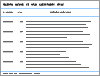
Tab.1
Effects of different N addition treatments on soil nutrient in Larix gmelinii var.principis-rupprechtii plantations
| 处理 | 氮添加量/ [kg/(hm2·a)] | 全氮(TN)/ (g/kg) | 全磷(TP)/ (g/kg) | 有机碳(SOC)/ (g/kg) | 速效磷(AP)/ (mg/kg) | 铵态氮 ( (mg/kg) | 硝态氮 ( (mg/kg) | pH |
|---|---|---|---|---|---|---|---|---|
| T0 | 0 | 2.27±0.16a | 0.45±0.09a | 68.46±3.8a | 9.01±1.23a | 8.10±0.49a | 38.86± 4.73abc | 6.26±0.12a |
| T5 | 5 | 2.15±0.21a | 0.44±0.07a | 67.04±4.8a | 8.27±1.35ab | 9.19±0.59a | 30.66± 7.76c | 5.99±0.24a |
| T10 | 10 | 2.15±0.21a | 0.47±0.07a | 66.88±6.3a | 8.11±0.98b | 8.45±0.40a | 31.34± 6.20c | 6.08±0.09a |
| T20 | 20 | 1.94±0.21a | 0.49±0.13a | 64.79±3.3a | 7.2±1.75ab | 8.43±0.83a | 35.65± 5.35bc | 6.16±0.03a |
| T40 | 40 | 2.13±0.18a | 0.45±0.14a | 64.66±6.7a | 9.12±1.57ab | 7.80±0.75a | 40.69± 2.24abc | 6.15±0.11a |
| T80 | 80 | 2.28±0.25a | 0.46±0.13a | 68.50±6.1a | 8.67±0.59ab | 7.86±0.99a | 45.75± 5.49ab | 6.11±0.06a |
| T160 | 160 | 2.20±0.13a | 0.42±0.09a | 66.95±5.4a | 8.72±0.76ab | 8.03±0.81a | 50.38±12.25a | 6.09±0.03a |
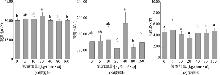
Fig.1
Changes of soil C∶N,C∶P,and N∶P ratios in Larix gmelinii var.principis-rupprechtii plantations under different N addition treatments
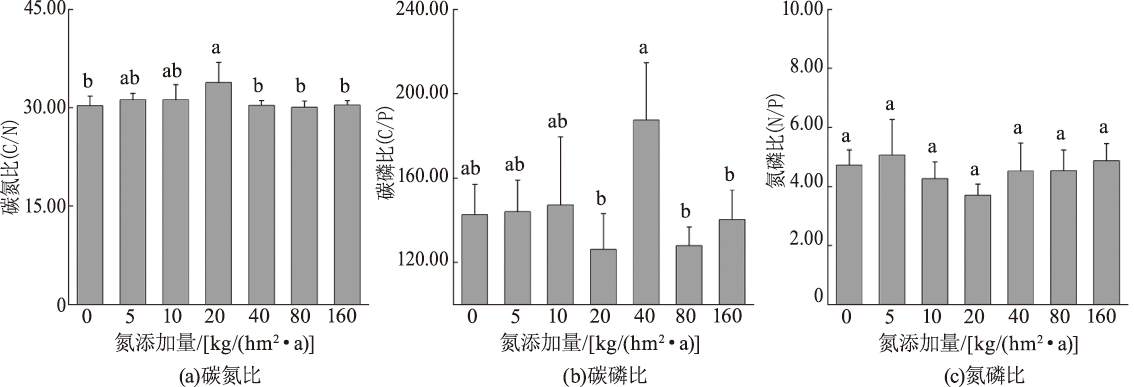
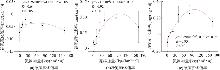
Fig.2
Effects of different N addition treatments of soil on net N ammonification rate,net N nitrification rate,and net N mineralization rate in Larix gmelinii var.principis-rupprechtii plantations
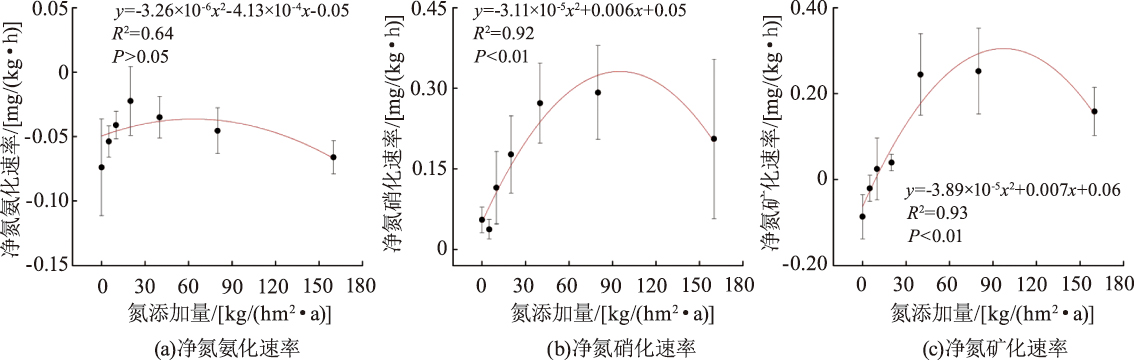
Fig.3
Effects of different N addition treatments of soil on gross N mineralization rate,and gross N nitrification rate in Larix gmelinii var. principis-rupprechtii plantations
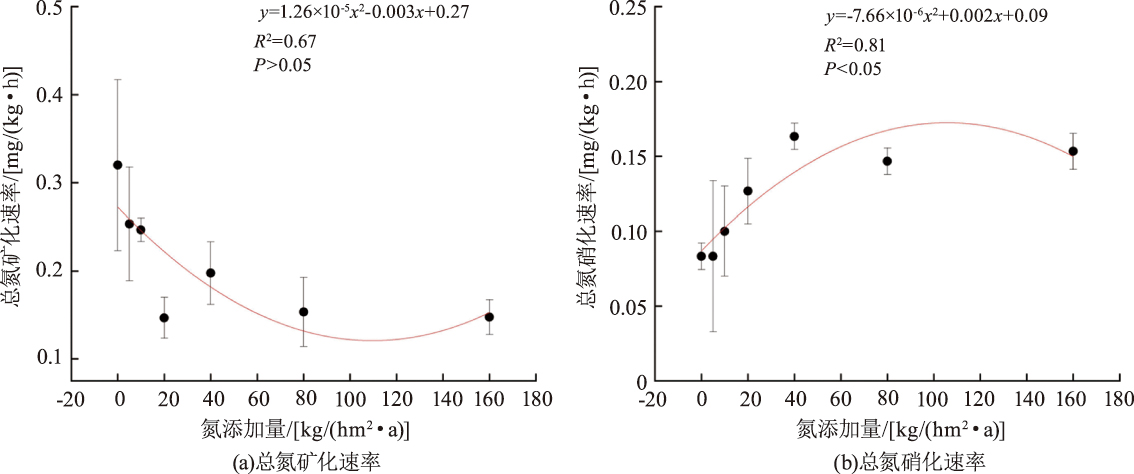
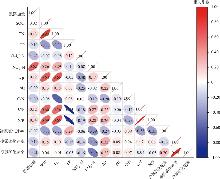
Fig.4
Correlation analysis between soil nutrients and net N ammonification rate,net N nitrification rate,and net mineralization rate under simulated nitrogen deposition in Larix gmelinii var.principis-rupprechtii plantations
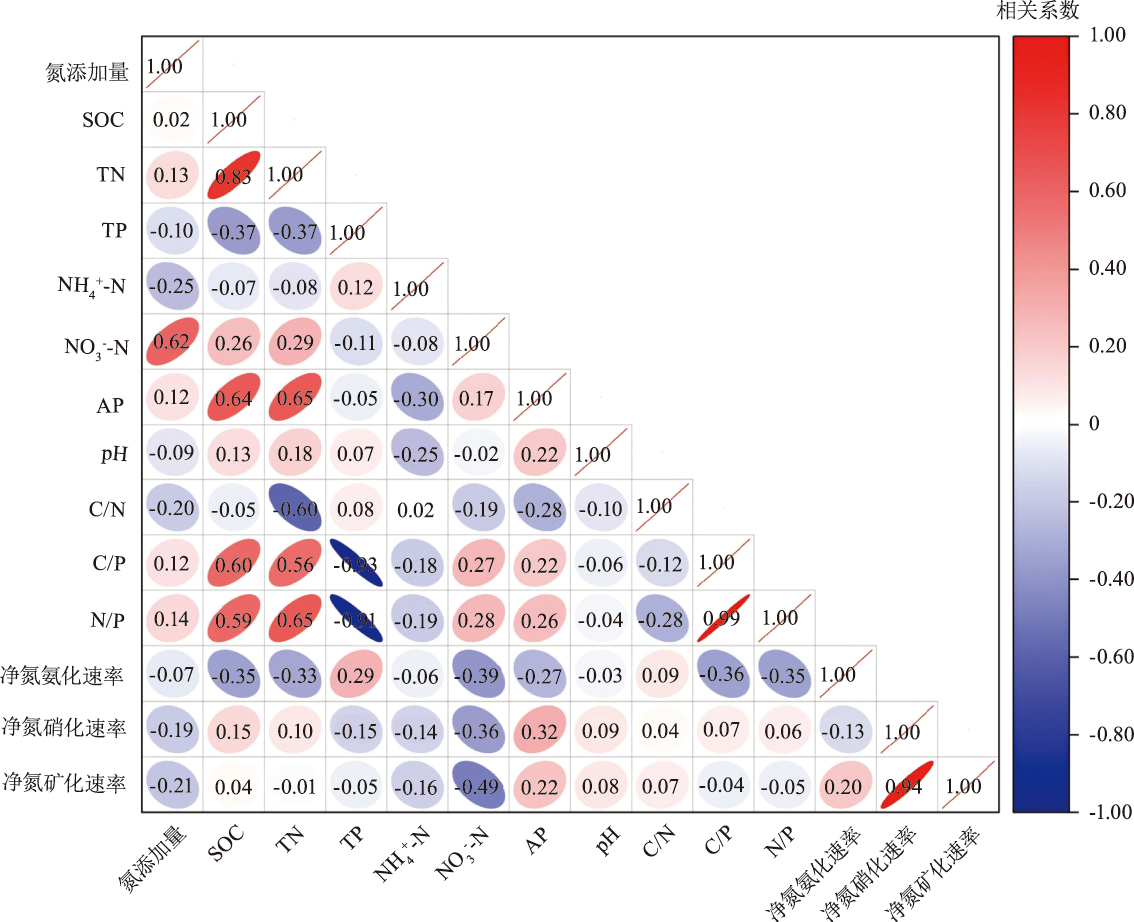
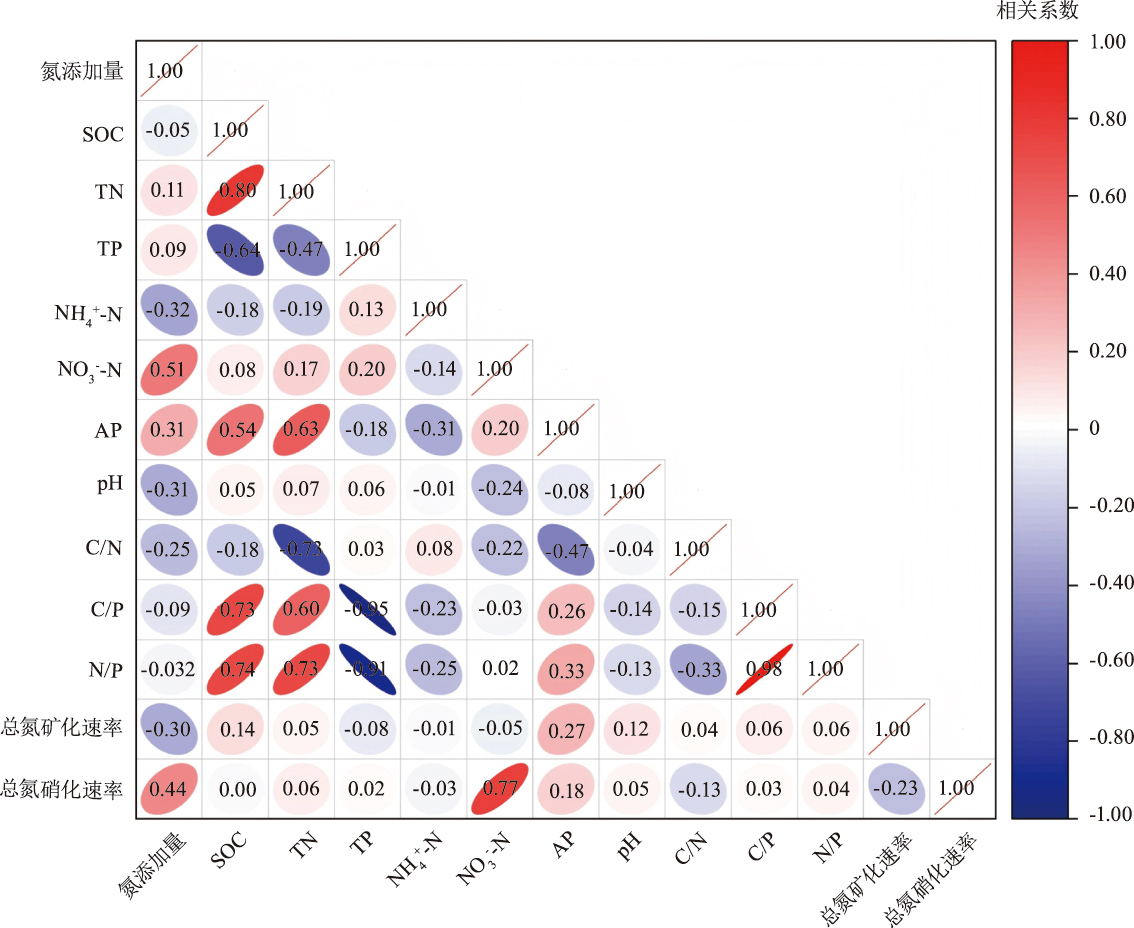
Fig.5
Correlation analysis between soil nutrients and gross N mineralization rate and gross N nitrification rate under simulated nitrogen deposition in Larix gmelinii var.principis-rupprechtii plantations
| [1] |
Zhu Jianxing, Jia Yanlong, Yu Guirui, et al. Changing patterns of global nitrogen deposition driven by socio-economic development[J]. Nature Communications, 2025, 16(1):16-26.
doi: 10.1038/s41467-024-55289-5 |
| [2] |
Cheng Yi, Wang Jing, Ge Zhiwei, et al. Background nitrogen deposition controls the effects of experimental nitrogen addition on soil gross N transformations in forest ecosystems[J]. Biogeochemistry, 2020, 151(2):335-341.
doi: 10.1007/s10533-020-00722-2 |
| [3] |
Li Yaying, Chapman S J, Nicol G W, et al. Nitrification and nitrifiers in acidic soils[J]. Soil Biology and Biochemistry, 2018, 116:290-301.
doi: 10.1016/j.soilbio.2017.10.023 |
| [4] |
Elrys A S, Zhu Qinlin, Jiang Chunlan, et al. Global soil nitrogen cycle pattern and nitrogen enrichment effects:tropical versus subtropical forests[J]. Global Change Biology, 2023, 29(7):1905-1921.
doi: 10.1111/gcb.v29.7 |
| [5] |
Aber J D, Nadelhoffer K J, Steudler P, et al. Nitrogen saturation in northern forest ecosystems[J]. BioScience, 1989, 39(6):378-386.
doi: 10.2307/1311067 |
| [6] |
He Xiaoxiang, Dai Shenyan, Meng Lei, et al. Effects of 18 years repeated N fertilizer applications on gross N transformation rates in a subtropical rain-fed purple soil[J]. Applied Soil Ecology, 2023, 189:104952.
doi: 10.1016/j.apsoil.2023.104952 |
| [7] |
Yang Liu, Jia Yanlong, Li Qianru, et al. Ecoenzymatic stoichiometry in the rhizosphere and bulk soil of a Larix principis-rupprechtii plantation in North China[J]. Forests, 2023, 14(7):1315.
doi: 10.3390/f14071315 |
| [8] |
Yang Xiaocong, Yang Liu, Li Qianru, et al. Short-term responses of soil nutrients and enzyme activities to nitrogen addition in a Larix principis-rupprechtii plantation in North China[J]. Frontiers in Ecology and Evolution, 2023, 11:1105150.
doi: 10.3389/fevo.2023.1105150 |
| [9] | 鲍士旦. 土壤农化分析[M]. 3版. 北京: 中国农业出版社, 2000. |
| [10] |
Zhao Ningning, Li Xiaogang. Effects of aspect-vegetation complex on soil nitrogen mineralization and microbial activity on the Tibetan Plateau[J]. Catena, 2017, 155:1-9.
doi: 10.1016/j.catena.2017.02.025 |
| [11] |
Xu Hongwei, Qu Qing, Li Guanwen, et al. Impact of nitrogen addition on plant-soil-enzyme C-N-P stoichiometry and microbial nutrient limitation[J]. Soil Biology and Biochemistry, 2022, 170:108714.
doi: 10.1016/j.soilbio.2022.108714 |
| [12] |
Sinsabaugh R L, Lauber C L, Weintraub M N, et al. Stoichiometry of soil enzyme activity at global scale[J]. Ecology Letters, 2008, 11(11):1252-1264.
doi: 10.1111/j.1461-0248.2008.01245.x pmid: 18823393 |
| [13] | 许延琴, 周冰倩, 刘隋赟昊, 等. 模拟氮沉降对土壤酶活性和微生物组成的影响[J]. 生态学报, 2023, 43(20):8417-8429. |
| [14] |
Li Lan, Liu Yang, Xiao Tianhao, et al. Different responses of soil C∶N∶P stoichiometry to stocking rate and nitrogen addition level in an alpine meadow on the Qinghai-Tibetan Plateau[J]. Applied Soil Ecology, 2021, 165:103961.
doi: 10.1016/j.apsoil.2021.103961 |
| [15] | Sun Yuan, Wang Cuiting, Chen Han Y.H., et al. Responses of C∶N stoichiometry in plants,soil,and microorganisms to nitrogen addition[J]. Plant & Soil, 2020, 456:1-11. |
| [16] |
Ding Yong, Sun Lianhao, Li Chong, et al. Effects of short-term simulated acid rain and nitrogen deposition on soil nutrients and enzyme activities in Cunninghamia lanceolata plantation[J]. Frontiers in Ecology and Evolution, 2024, 12:1365954.
doi: 10.3389/fevo.2024.1365954 |
| [17] |
Chen Chen, Xiao Wenya, Chen Han. Mapping global soil acidification under N deposition[J]. Global Change Biology, 2023, 29(16):4652-4661.
doi: 10.1111/gcb.16813 pmid: 37296534 |
| [18] |
Lu Meng, Yang Yuanhe, Luo Yiqi, et al. Responses of ecosystem nitrogen cycle to nitrogen addition:a meta-analysis[J]. New Phytologist, 2011, 189(4):1040-1050.
doi: 10.1111/j.1469-8137.2010.03563.x pmid: 21138438 |
| [19] |
Aitkenhead J A, McDowell W H. Soil C∶N ratio as a predictor of annual riverine DOC flux at local and global scales[J]. Global Biogeochemical Cycles, 2000, 14(1):127-138.
doi: 10.1029/1999GB900083 |
| [20] | 吴一群, 赵伟东, 郑祥洲, 等. 模拟氮沉降对亚热带阔叶林区土壤氮矿化过程及其温度敏感性的影响[J]. 林业与环境科学, 2025, 41(6):49-55. |
| [21] |
Carey C J, Dove N C, Beman J M, et al. Meta-analysis reveals ammonia-oxidizing bacteria respond more strongly to nitrogen addition than ammonia-oxidizing archaea[J]. Soil Biology and Biochemistry, 2016, 99:158-166.
doi: 10.1016/j.soilbio.2016.05.014 |
| [22] | 宋思意, 吕思扬, 邱岭军, 等. 华西雨屏区常绿阔叶林不同深度土壤氮矿化及酶活性对模拟氮沉降的响应[J]. 生态学报, 2022, 42(22):9045-9056. |
| [23] |
Cusack D F, Karpman J, Ashdown D, et al. Global change effects on humid tropical forests:evidence for biogeochemical and biodiversity shifts at an ecosystem scale[J]. Reviews of Geophysics, 2016, 54(3):523-610.
doi: 10.1002/rog.v54.3 |
| [24] |
Brenner R E, Boone R D, Ruess R W. Nitrogen additions to pristine,high-latitude,forest ecosystems:consequences for soil nitrogen transformations and retention in mid and late succession[J]. Biogeochemistry, 2005, 72(2):257-282.
doi: 10.1007/s10533-004-0356-y |
| [25] |
Vazquez E, Teutscherova N, Dannenmann M, et al. Gross nitrogen transformations in tropical pasture soils as affected by Urochloa genotypes differing in biological nitrification inhibition(BNI)capacity[J]. Soil Biology and Biochemistry, 2020, 151:108058.
doi: 10.1016/j.soilbio.2020.108058 |
| [26] |
Corre M D, Veldkamp E, Arnold J, et al. Impact of elevated N input on soil N cycling and losses in old-growth lowland and montane forests in Panama[J]. Ecology, 2010, 91(6):1715-1729.
pmid: 20583713 |
| [27] |
Gao Wenlong, Kou Liang, Zhang Jinbo, et al. Enhanced deposition of nitrate alters microbial cycling of N in a subtropical forest soil[J]. Biology and Fertility of Soils, 2016, 52(7):977-986.
doi: 10.1007/s00374-016-1134-4 |
| [28] |
Wang Hao, Qiu Yunpeng, Zhang Kangcheng, et al. Alterations in substrate stoichiometry control the responses of soil diazotrophs to nutrient enrichment[J]. Soil Biology and Biochemistry, 2023, 179:108975.
doi: 10.1016/j.soilbio.2023.108975 |
| [29] |
Niu Shuli, Classen A T, Dukes J S, et al. Global patterns and substrate-based mechanisms of the terrestrial nitrogen cycle[J]. Ecology Letters, 2016, 19(6):697-709.
doi: 10.1111/ele.12591 pmid: 26932540 |
| [30] |
Chen Tian, Cheng Ruimei, Xiao Wenfa, et al. Nitrogen addition enhances soil nitrogen mineralization through an increase in mineralizable organic nitrogen and the abundance of functional genes[J]. Journal of Soil Science and Plant Nutrition, 2024, 24(1):975-987.
doi: 10.1007/s42729-023-01600-0 |
| [31] |
Chen Hao, Li Dejun, Zhao Jie, et al. Nitrogen addition aggravates microbial carbon limitation:evidence from ecoenzymatic stoichiometry[J]. Geoderma, 2018, 329:61-64.
doi: 10.1016/j.geoderma.2018.05.019 |
| [32] |
Li Zhaolei, Tian Dashuang, Wang Bingxue, et al. Microbes drive global soil nitrogen mineralization and availability[J]. Global Change Biology, 2019, 25(3):1078-1088.
doi: 10.1111/gcb.14557 pmid: 30589163 |
| [33] |
Wendeborn S. The chemistry,biology,and modulation of ammonium nitrification in soil[J]. Angewandte Chemie International Edition, 2019, 59(6):2182-2202.
doi: 10.1002/anie.v59.6 |
| [34] |
Zak D R, Holmes W E, Tomlison M J, et al. Microbial cycling of C and N in northern hardwood forests receiving chronic atmospheric NO3-deposition[J]. Ecosystems, 2006, 9:242-253.
doi: 10.1007/s10021-005-0085-7 |
| [35] |
Cheng Yi, Wang Jing, Chang S X, et al. Nitrogen deposition affects both net and gross soil nitrogen transformations in forest ecosystems:a review[J]. Environmental Pollution, 2019, 244:608-616.
doi: S0269-7491(18)30982-5 pmid: 30384066 |
| [36] | 闫钟清, 齐玉春, 董云社, 等. 降水与氮沉降变化对草地关键氮过程的影响研究进展[J]. 中国环境科学, 2016, 36(4):1189-1197. |
| [1] | HAO Siran, MENG Zhongju. Impact of Different Vegetation Restoration Types on Soil in the Wind-sand Inflow Section of the Hobq Desert [J]. Forest and Grassland Resources Research, 2024, 0(5): 96-105. |
| [2] | YANG Yuhao, WANG Lingling, ZHANG Yong, ZHANG Quanzhi, SUN Hanjing, WANG Wenpeng, ZHOU Benzhi, WANG Zeng. Soil Physicochemical Properties and Plant Diversity Characteristics of Cupressus funebris with Different Stand Ages in Limestone Mountain Areas [J]. Forest and Grassland Resources Research, 2024, 0(5): 106-115. |
| [3] | LI Li, WU Yuehong, XIAO Zexin, JI Yanling, LIN Wenhuan, ZHU Xiaowu, FAN Zhenzhen. Characterization of Soil Ecological Stoichiometry in Plantation Forests of Different Stand Ages of Sonneratia apetala [J]. Forest and Grassland Resources Research, 2023, 0(6): 113-119. |
| [4] | ZHANG Yang, TIE Niu, CHANG Xiaoli. Effects of Permafrost Activity on Growth and Undergrowth of Larch in The Greater Hinggan Mountains [J]. FOREST RESOURCES WANAGEMENT, 2021, 0(3): 137-144. |
| [5] | XIAO Dongdong, SHANG Hailong, WANG Lianxiao. Research on Soil Ecological Stoichiometry Characteristic of Different Economic Forest Lands in Naban River Watershed [J]. FOREST RESOURCES WANAGEMENT, 2020, 0(4): 74-79. |
| [6] | WU Qiang, CHU Congying, SONG Wei, ZHANG Peng, GAO Chao, GU Jiancai, LU Guiqiao. Study on the Soil Nutrients of Scotch Pine Plantations in the Upper Dam of Saihanba [J]. FOREST RESOURCES WANAGEMENT, 2016, 0(1): 90-98. |
| [7] | ZHAO Chuanchuan, CUI Ting. Evaluation of the Forest Soil Nutrient Based on Element-Matter Model in Qinghai [J]. FOREST RESOURCES WANAGEMENT, 2015, 0(4): 84-91. |
| [8] | GUO Xin, LU Lina, HE Xiaohui, LI Weixiang, GE Jing. Study on Litter Decomposition and Soil Improvement in Artificial Shrub Forest in Maowusu Sandy Land [J]. FOREST RESOURCES WANAGEMENT, 2014, 0(5): 74-78. |
| Viewed | ||||||
|
Full text |
|
|||||
|
Abstract |
|
|||||
