

Forest and Grassland Resources Research ›› 2025›› Issue (2): 109-116.doi: 10.13466/j.cnki.lczyyj.2025.02.011
• Research paper • Previous Articles Next Articles
ZHAO Li1,2( ), ZHANG Haidong1, LIU Shanghua3, WANG Meizhen1, SANG Hao1, LI Jiatao1, WANG Fude4
Received:2024-12-18
Revised:2025-04-01
Online:2025-04-28
Published:2025-12-04
CLC Number:
ZHAO Li, ZHANG Haidong, LIU Shanghua, WANG Meizhen, SANG Hao, LI Jiatao, WANG Fude. Introduction performance of nine Picea species in Hohhot[J]. Forest and Grassland Resources Research, 2025, (2): 109-116.
Add to citation manager EndNote|Ris|BibTeX
URL: https://www.lyzygl.com.cn/EN/10.13466/j.cnki.lczyyj.2025.02.011
Tab.1
Introduction information and reproductive performance of nine Picea species
| 树种 | 原产地及生长表现 | 引种来源 | 引种后 繁殖表现 |
|---|---|---|---|
| 欧洲云杉 Picea abies | 原产于欧洲北部及中部。为原产地主要造林树种之一 | 1978年熊岳树木园引入种子并播种育苗 | 已开花 结实 |
| 白云杉 Picea glauca | 原产于加拿大与美国东北部。为原产地优良的用材和绿化树种之一 | 1982年加拿大引入种子并播种育苗 | 已开花 结实 |
| 青杄 Picea wilsonii | 为中国特有树种,原产于内蒙古、河北等地。适应性较强,为原产地造林树种 | 1985年四川炉霍县林业局引入种子并播种育苗 | 已开花 结实 |
| 雪岭云杉 Picea schrenkiana | 原产于新疆地区。为原产地的主要森林及用材树种 | 1979年新疆巩新引入种子并播种育苗 | 已开花 结实 |
| 紫果云杉 Picea purpurea | 为我国特有树种,原产于四川北部、甘肃榆中及洮河流域、青海西倾山北坡。材质优良,生长快,为原产地森林更新及荒山造林树种 | 1980年青海麦秀林场引入种子并播种育苗 | 已开花 结实 |
| 青海云杉 Picea crassifolia | 为我国特有树种,原产于祁连山区、青海、甘肃、宁夏、内蒙古大青山。材质优良、抗旱性较强,为青海东部、甘肃北部山区和祁连山区的优良造林树种 | 1979年内蒙古贺兰山引入种子并播种育苗 | 已开花 结实 |
| 新疆云杉 Picea obovata | 原产于新疆阿尔泰山西北部及东南部。生长较快,在天然林下更新良好,为新疆地区优良用材树种之一 | 1983年从新疆阿尔泰引入种子并播种育苗 | 已开花 结实 |
| 白杄 Picea meyeri | 为我国特有树种,原产于山西、河北、内蒙古西乌珠穆沁旗。为华北地区高山上部主要的乔木树种之一 | 1977年从山西关帝山引入2 a生野生苗 | 已开花 结实 |
| 云杉 Picea asperata | 为我国特有树种,原产于陕西西南部、甘肃东部及白龙江流域、洮河流域、四川岷江流域上游及大小金川流域。材质优良,生长快,适应性强,为当地造林树种 | 1979年从四川理县米亚罗夹壁沟采种子并播种育苗 | 已开花 结实 |
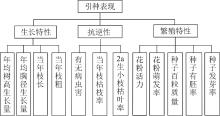
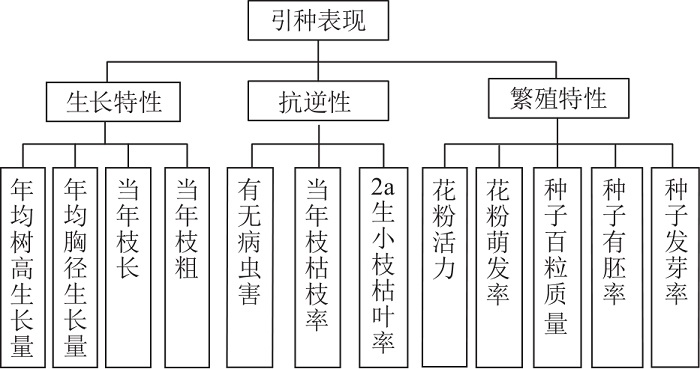
Fig.1
Evaluation index system
Tab.2
Comparison of the growth of nine Picea species
| 树种 | 年均树高生长量/m | 年均胸径生长量/cm | 当年枝长/mm | 当年枝粗/mm | |||
|---|---|---|---|---|---|---|---|
| 欧洲云杉Picea abies | 0.28±0.01ab | 0.94±0.03b | 88.43±11.51a | 2.01±0.63cd | |||
| 白云杉Picea glauca | 0.24±0.02cde | 0.46±0.01f | 38.83±4.93f | 1.18±0.19f | |||
| 青杄Picea wilsonii | 0.31±0.02a | 1.00±0.01a | 59.04±15.50cd | 1.65±0.36de | |||
| 雪岭云杉Picea schrenkiana | 0.28±0.04ab | 0.52±0.02e | 75.87±14.18b | 1.89±0.49cde | |||
| 紫果云杉Picea purpurea | 0.21±0.01e | 0.52±0.05e | 56.51±13.56cd | 1.22±0.34f | |||
| 青海云杉Picea crassifolia | 0.29±0.01ab | 0.59±0.02d | 63.58±15.78c | 3.92±0.94a | |||
| 新疆云杉Picea obovata | 0.26±0.01bcd | 0.49±0.03ef | 56.74±12.35cd | 2.17±0.45bc | |||
| 白杄Picea meyeri | 0.23±0.02de | 0.66±0.02c | 49.92±11.86de | 2.45±0.57b | |||
| 云杉Picea asperata | 0.23±0.02de | 0.53±0.03e | 75.58±18.49b | 2.15±0.58bc | |||
Tab.3
Comparison of stress resistance of nine Picea species
| 树种 | 病虫害 | 当年枝枯枝 率/% | 2 a生小枝 枯叶率/% |
|---|---|---|---|
| 欧洲云杉Picea abies | 无 | 4.54±1.13a | 3.33±0.52a |
| 白云杉Picea glauca | 无 | 0.00d | 0.00d |
| 青杄Picea wilsonii | 无 | 0.40±0.49c | 0.40±0.13d |
| 雪岭云杉Picea schrenkiana | 无 | 0.00d | 0.00d |
| 紫果云杉Picea purpurea | 无 | 0.00d | 1.13±0.52c |
| 青海云杉Picea crassifolia | 无 | 1.07±0.94b | 2.07±0.26b |
| 新疆云杉Picea obovata | 无 | 0.00d | 0.00d |
| 白杄Picea meyeri | 无 | 1.07±0.52b | 2.33±0.49b |
| 云杉Picea asperata | 无 | 0.87±0.35b | 1.27±0.46c |
Tab.4
Comparison of reproductive characteristics of nine Picea species
| 树种 | 花粉活力/% | 花粉萌发率/% | 种子百粒质量/g | 种子有胚率/% | 种子发芽率/% |
|---|---|---|---|---|---|
| 欧洲云杉Picea abies | 97.27± 1.99a | 54.12± 9.35f | 0.61±0.05a | 34.67± 3.06d | 39.33± 4.62b |
| 白云杉Picea glauca | 97.96± 1.85a | 78.72± 8.65b | 0.06±0.01g | 36.00± 3.00cd | 23.33± 2.31c |
| 青杄Picea wilsonii | 96.14± 3.91ab | 63.26±17.11ef | 0.15±0.00f | 43.33± 5.03cd | 40.67± 5.77b |
| 雪岭云杉Picea schrenkiana | 88.76±10.05cd | 70.21±14.19bcd | 0.45±0.08b | 37.33± 3.06cd | 44.67± 6.11b |
| 紫果云杉Picea purpurea | 85.32± 8.59d | 55.38± 4.95ef | 0.06±0.01fg | 44.67±10.07c | 4.89± 2.88d |
| 青海云杉Picea crassifolia | 99.34± 1.08a | 67.41±14.85cd | 0.10±0.01fg | 69.33± 8.08b | 68.86± 3.84a |
| 新疆云杉Picea obovata | 93.96± 5.41ab | 72.69± 9.21bc | 0.20±0.02e | 44.67± 3.06c | 45.33± 1.15b |
| 白杄Picea meyeri | 96.98± 4.71ab | 87.44± 3.67a | 0.29±0.04d | 84.67± 4.16a | 63.33± 4.62a |
| 云杉Picea asperata | 98.73±10.68a | 77.68±13.91b | 0.35±0.04c | 72.67± 5.30b | 64.67±11.37a |
Tab.5
Hierarchical structure model of Picea introduction performance evaluation
| 准则层 | 权重 | 因子层 | 权重 | 综合权重 | 归一化综合权重/% |
|---|---|---|---|---|---|
| 生长特性 | 0.384 9 | 年均树高生长量 | 0.058 9 | 0.022 7 | 5.31 |
| 年均胸径生长量 | 0.119 9 | 0.046 1 | 10.81 | ||
| 当年枝长 | 0.075 2 | 0.029 0 | 6.78 | ||
| 当年枝粗 | 0.130 8 | 0.050 4 | 11.79 | ||
| 抗逆性 | 0.095 8 | 有无病虫害 | 0.000 0 | 0.000 0 | 0.00 |
| 当年枝枯枝率 | 0.037 7 | 0.003 6 | 0.84 | ||
| 2 a生小枝枯叶率 | 0.058 1 | 0.005 6 | 1.30 | ||
| 繁殖特性 | 0.519 3 | 花粉活力 | 0.055 3 | 0.028 7 | 6.73 |
| 花粉萌发率 | 0.086 0 | 0.044 7 | 10.46 | ||
| 种子百粒质量 | 0.147 2 | 0.076 4 | 17.90 | ||
| 种子有胚率 | 0.172 8 | 0.089 7 | 21.02 | ||
| 种子发芽率 | 0.058 1 | 0.030 2 | 7.06 |
Tab.6
Comprehensive score of introduction performance of nine Picea species
| 树种 | 欧洲云杉 | 白云杉 | 青杄 | 雪岭云杉 | 紫果云杉 | 青海云杉 | 新疆云杉 | 白杄 | 云杉 |
|---|---|---|---|---|---|---|---|---|---|
| 年均树高生长量 | 0.041 | 0.014 | 0.059 | 0.040 | 0.000 | 0.042 | 0.029 | 0.022 | 0.024 |
| 年均胸径生长量 | 0.108 | 0.000 | 0.120 | 0.012 | 0.013 | 0.029 | 0.028 | 0.043 | 0.042 |
| 当年枝长 | 0.075 | 0.000 | 0.031 | 0.026 | 0.027 | 0.125 | 0.027 | 0.032 | 0.056 |
| 当年枝粗 | 0.040 | 0.000 | 0.023 | 0.034 | 0.002 | 0.449 | 0.047 | 0.061 | 0.046 |
| 有无病虫害 | 0.000 | 0.000 | 0.000 | 0.000 | 0.000 | 0.000 | 0.000 | 0.000 | 0.000 |
| 当年枝枯枝率 | 0.000 | 0.038 | 0.034 | 0.038 | 0.038 | 0.298 | 0.038 | 0.029 | 0.031 |
| 2 a生小枝枯叶率 | 0.000 | 0.058 | 0.051 | 0.058 | 0.038 | 0.022 | 0.058 | 0.017 | 0.036 |
| 花粉活力 | 0.047 | 0.050 | 0.043 | 0.014 | 0.000 | 0.055 | 0.034 | 0.046 | 0.053 |
| 花粉萌发率 | 0.000 | 0.063 | 0.024 | 0.042 | 0.003 | 0.034 | 0.048 | 0.086 | 0.061 |
| 种子百粒质量 | 0.147 | 0.000 | 0.024 | 0.104 | 0.000 | 0.011 | 0.037 | 0.062 | 0.078 |
| 种子有胚率 | 0.000 | 0.005 | 0.030 | 0.009 | 0.035 | 0.120 | 0.035 | 0.173 | 0.131 |
| 种子发芽率 | 0.031 | 0.017 | 0.032 | 0.036 | 0.000 | 0.058 | 0.037 | 0.053 | 0.054 |
| 综合评价值 | 0.489 | 0.245 | 0.470 | 0.413 | 0.155 | 1.243 | 0.418 | 0.624 | 0.612 |
| 综合评价排序 | 4 | 8 | 5 | 7 | 9 | 1 | 6 | 2 | 3 |
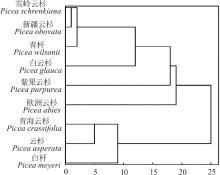
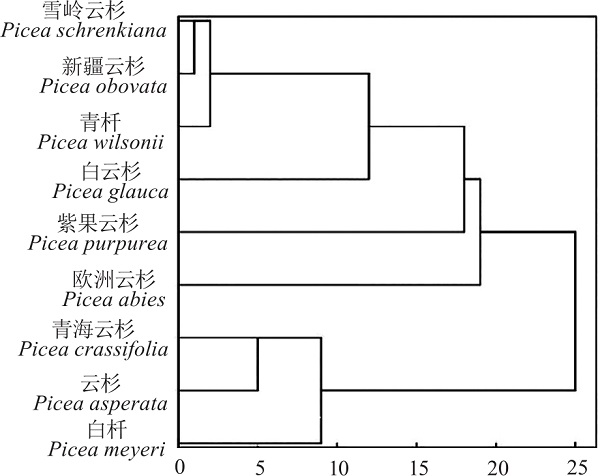
Fig.2
Cluster analysis of introduction performance of nine Picea species
| [1] |
贺炯坤, 许贞魏, 施如康, 等. 西天山雪岭云杉不同腐解等级倒木的更新幼苗数量特征及其影响因素[J]. 植物研究, 2024, 44(2):279-288.
doi: 10.7525/j.issn.1673-5102.2024.02.013 |
| [2] | 邹星晨, 王欣苗, 左亚凡, 等. 青海云杉不同演替阶段林下草本多样性特征及其环境解释[J]. 生态学报, 2023, 43(24):10285-10294. |
| [3] | 吕东, 张宏斌, 赵明, 等. 干旱半干旱区7个云杉属树种引种适应性研究[J]. 干旱区资源与环境, 2019, 33(5):146-150. |
| [4] | 赵一之, 赵利清, 曹瑞. 内蒙古植物志[M]. 3版. 呼和浩特: 内蒙古人民出版社, 2020. |
| [5] | 赵静英, 蒋明, 赵文英, 等. 塞尔维亚云杉在小陇山林区引种栽培实验初报[J]. 技术研究, 2019(9):80-83. |
| [6] | 祁生秀. 蓝云杉引种区域化试验研究初报[J]. 青海农林科技, 2019(2):101-105. |
| [7] | 金蓉, 杨振, 张拥军, 等. 云杉新品种引进栽培试验示范研究[J]. 现代农业科技, 2018(13):128. |
| [8] | 夏燕, 张建伟, 田开春, 等. 云杉5个种18个种源的早期评价[J]. 东北林业大学学报, 2014, 42(12):1-6. |
| [9] | 冯祥元, 于柱英, 种培芳. 不同种源地云杉的苗期抗旱性评价[J]. 甘肃农业大学学报, 2012, 47(1):95-102. |
| [10] | 许娜, 王军辉, 安三平, 等. 利用混合线性模型对青海云杉无性系生长性状进行早期评价[J]. 东北林业大学学报, 2024, 52(2):25-30. |
| [11] | 安三平, 许娜, 杜彦昌, 等. 云杉种和种源生长性状早期评价[J]. 林业科学研究, 2018, 31(5):20-26. |
| [12] | 黄三祥. 沙地云杉生态学特性及引种研究[D]. 北京: 北京林业大学, 2004. |
| [13] | 李青粉, 王军辉, 张建华, 等. 云杉引种及种和种源早期评价[J]. 林业科学研究, 2012, 25(5):644-650. |
| [14] | 闫婷, 黄海广, 张胜男. 沙地樟子松林天然更新研究进展[J]. 内蒙古林业科技, 2019, 45(2):59-61. |
| [15] | 国家林业和草原局. 中国森林资源报告(2019)[R]. 北京: 中国林业出版社, 2020. |
| [16] | 葛莉莉, 赵文义, 阿腾戈, 等. 云杉花粉生活力及贮藏方法试验研究[J]. 内蒙古林业科技, 2007, 33(4):33-37. |
| [17] | 郭艳兰, 牟德生, 赵连鑫, 等. 国外引入的 18 个酿酒葡萄营养系抗寒性评价[J]. 2023, 37(1):161-168. |
| [18] | 周龙, 杨晓雪, 段晓晨. 6种半干旱地区园林绿化植物综合适应性评价[J]. 林草资源研究, 2024(1):73-81. |
| [19] |
王欢欢, 王晶晶, 陈奇凌. 3种数学方法在灰枣果实品质评价中的应用[J]. 中国农学通报, 2025, 41(7):138-144.
doi: 10.11924/j.issn.1000-6850.casb2024-0363 |
| [20] |
蔺豆豆, 赵桂琴, 琚泽亮, 等. 15份燕麦材料苗期抗旱性综合评价[J]. 草业学报, 2021, 30(11):108-121.
doi: 10.11686/cyxb2021219 |
| [21] | 陈刚, 吕东, 赵明, 等. 基于层次分析法的干旱半干旱区15 种引进观赏植物适应性[J]. 干旱区资源与环境, 2022, 36(1):186-191. |
| [22] | 朱雅丽, 张景路, 张绘芳, 等. 新疆云杉蓄积与地上生物量模型拟合分析[J]. 中国野生植物资源, 2024, 43(1):100-106. |
| [23] | 安三平, 王丽芳, 蒋明, 等. 蓝云杉、欧洲云杉、白云杉在甘肃中部干旱半干旱区的适生性评价[J]. 林业科技通讯, 2018,(6):11-13. |
| [24] |
高艳如, 王军辉, 麻文俊, 等. 不同种源和家系红皮云杉细根形态与生物量垂直分布特征[J]. 植物研究, 2024, 44(3):380-388.
doi: 10.7525/j.issn.1673-5102.2024.03.007 |
| [25] | 王豁然, 江泽平, 傅紫岐. 林木引种驯化与森林可持续经营[M]. 北京: 中国环境科学出版社,1998:165-171. |
| [26] | 李兴芬, 苗雅慧, 孙永江, 等. 青杄 PwPEBP 基因及其启动子序列的克隆与表达分析[J]. 北京林业大学学报, 2019, 41(4):8-20. |
| [27] | 罗芊芊, 周志春, 邓宗付, 等. 南方红豆杉天然居群叶片的表型性状和氮磷化学计量特征的变异规律[J]. 植物资源与环境学报, 2021, 30(1):27-35. |
| [28] |
BUCCI S J, GOLDSTEIN G. Mechanisms contributing to seasonal homeostasis of minimum leaf water potential and predawn disequilibrium between soil and plant water potential in neotropical savanna trees[J]. Trees, 2005, 19(3):296-304.
doi: 10.1007/s00468-004-0391-2 |
| [29] |
GILL S S, TUTEJA N. Reactive oxygen species and antioxidant machinery in abiotic stress tolerance in crop plants[J]. Plant Physiology and Biochemistry, 2010, 48(12):909-930.
doi: 10.1016/j.plaphy.2010.08.016 pmid: 20870416 |
| [30] | KRAEMER G P, HACKE U G, SCHMID S. Differential stomatal and hydraulic responses to drought in Picea abies and Pinus sylvestris[J]. Tree Physiology, 2019, 39(5):725-735. |
| [31] | 赵丽, 包秀兰, 王福德, 等. 15 种云杉针叶解剖结构与其抗旱性研究[J]. 西北林学院学报. https://link.cnki.net/urlid/61.1202.S.20250402.1432.004 |
| [32] | 韩生慧, 徐先英, 贺访印, 等. 干旱荒漠区几种云杉属植物的生态适应性研究[J]. 西北林学院学报, 2016, 31(5):55-60. |
| [33] | 雷芳. 青海云杉不同生境与结果能力、产种量相关性研究[J]. 宁夏农林科技, 2022, 63(2):16-19. |
| [34] | KREMER A, POTTS B M, DELZON S. Long-term field trials reveal genetic adaptation of forest trees to climate change[J]. Science, 2016, 336(6083):1231-1233. |
| [35] | CLAPHAM D H, EKBERG I, ERIKSSON G, et al. Gene expression during Picea abies seed development[J]. Planta, 2002, 215(4):572-576. |
| [1] | CHEN Xuan, LU Peng, TIAN Yingjia, YANG Ting, YUAN Hedi, WANG Hua, SUN Qian. Calculation method of forestland quota occupation during the 15th Five-Year Plan period—Taking Guizhou Province as an example [J]. Forest and Grassland Resources Research, 2025, 0(6): 121-131. |
| [2] | ZHANG Xiaoyuan, LI Le, PEI Nancai, GAO Bingtao, HAO Zezhou, ZOU Jingyuan, CUI Kai, WANG Li. Construction of evaluation index system for damage of forest ecological services and functions in Guangdong Province using the analytic hierarchy process (AHP) [J]. Forest and Grassland Resources Research, 2025, 0(4): 112-121. |
| [3] | QIAO Yi’na, CAO Shuangcheng, SHI Mengdi, DANG Hongzhong, QIN Yuqian, ZHAO Xiaobin, GAO Rong, SHI Changchun. Health Assessment System of Forest Shelterbelts in Yulin Sandy Region of Mu Us Based on Analytic Hierarchy Process [J]. Forest and Grassland Resources Research, 2024, 0(2): 109-115. |
| [4] | LI Shuhui, WU Yan, SUN Zhidong, WANG Cai, LIAO Lili, CHEN Ji'en, XIAO Xuejun, SHEN Junhua. Bark Fire Resistance of 6 Tree Species Based on Entropy Weight Method [J]. Forest and Grassland Resources Research, 2024, 0(1): 41-47. |
| [5] | ZHOU Long, YANG Xiaoxue, DUAN Xiaochen. Comprehensive Adaptability Evaluation of Six Kinds of Landscapeing Plants in Semi-arid Region [J]. Forest and Grassland Resources Research, 2024, 0(1): 73-81. |
| [6] | YUAN Yang, ZENG Bing, WANG Yinchen, ZHAO Tian, DENG Mengqing, YANG Ling, LIAO Yan. Genetic Diversity Analysis of Phenotypic Traits of Rhus chinensis in Different Regions of Guizhou Province [J]. FOREST RESOURCES WANAGEMENT, 2023, 0(4): 107-114. |
| [7] | TAN Ying, XU Jun, LIN Congcong, WANG Ke, WANG Wenwu, CHEN Chunlei. Study on the Comprehensive Value Evaluation of Ancient and Famous Tree Resources in Zhejiang Province Based on Analytic Hierarchy Process [J]. FOREST RESOURCES WANAGEMENT, 2023, 0(4): 169-178. |
| [8] | LUO Dan, WANG Qingfei, CHAO Bixiao, LI Le, HAO Zezhou, LU Yuan, WANG Cheng, WU Ruichen, LIU Feipeng, PEI Nancai. Evaluation on Fire Risk Rating of Forest Stands in Wildland-Urban Interface—A Case Study of Guangzhou City [J]. FOREST RESOURCES WANAGEMENT, 2023, 0(3): 56-64. |
| [9] | JIANG Xuwang, YU Shuhan, LI Yihui, ZHAN Liyu. Research on Evaluation of Elderly Healing Forest Wellness Base [J]. FOREST RESOURCES WANAGEMENT, 2023, 0(3): 71-79. |
| [10] | LIU Lijie, XIE Zhuohong, LEI Ming, SHI Yuemou, LI Shengqiang, LIU Ping. Evaluation of Forest Quality Based on Analytic Hierarchy Process —A Case Study in Liuxihe Forest Farm,Guangzhou [J]. FOREST RESOURCES WANAGEMENT, 2022, 0(6): 89-94. |
| [11] | HAO Min, TANG Hui, WANG Manlian, LIU Baoyu, CHEN Yujiao. Evaluation and Screening of Ornamental Illicium difengpi Germplasm in Terms of Leaf Morphology Using Analytic Hierarchy Process Method [J]. FOREST RESOURCES WANAGEMENT, 2022, 0(5): 136-144. |
| [12] | HU Jiayi, WANG Ruihui, LIU Kaili, ZHANG Bin, ZHOU Yuhuai, LI Xuehui, GONG Yingyun. Effects of Thinning on Ecological Benefits of Cryptomeria fortunei Plantations in High Altitude Area of Western Sichuan [J]. FOREST RESOURCES WANAGEMENT, 2022, 0(4): 80-88. |
| [13] | WU Xuping, LV Yong, ZHANG Xiongqing, YI Xuan, ZHU Guangyu. Research on Growth Mixed Effect Model for Basal Area of Cunninghamia lanceolata Plantation Based on Site Factors [J]. FOREST RESOURCES WANAGEMENT, 2021, 0(2): 75-82. |
| [14] | Zhipeng XIAO, Polang LIU, Ye LIU, Fangwen HU, Huaizhen PENG, Ziyan ZHANG, Ping GAO. Evaluation and Selection of Potential Scenic View-point Distribution Areas Based on GIS and Fuzzy Analytic Hierarchy Process —An Example from Jiulangshan Mountain Park in Zhuzhou [J]. FOREST RESOURCES WANAGEMENT, 2020, 0(1): 158-165. |
| [15] | PENG Chucai, DIAN Yuanyong, ZHOU Zhixiang, CHENG Weijin, XIAO Zhiyan, DONG Lian, LI Xinyu. Quality Evaluation and Analysis on Factors Affecting the Quality of the Forest Belt Around Wuhan City [J]. FOREST RESOURCES WANAGEMENT, 2019, 0(6): 75-83. |
| Viewed | ||||||
|
Full text |
|
|||||
|
Abstract |
|
|||||
