

Forest and Grassland Resources Research ›› 2025›› Issue (4): 101-111.doi: 10.13466/j.cnki.lczyyj.2025.04.011
• Technical Application • Previous Articles Next Articles
LIU Gao1( ), XIE Zeqi1, ZHOU Jianhao2, LIAO Lipeng3
Received:2024-09-11
Revised:2025-07-30
Online:2025-08-28
Published:2026-02-13
CLC Number:
LIU Gao, XIE Zeqi, ZHOU Jianhao, LIAO Lipeng. Forest above ground biomass inversion using machine learning and sentinel data[J]. Forest and Grassland Resources Research, 2025, (4): 101-111.
Add to citation manager EndNote|Ris|BibTeX
URL: https://www.lyzygl.com.cn/EN/10.13466/j.cnki.lczyyj.2025.04.011
Tab.1
Sentinel data sources
| 数据源 | 获取时间 | 云量 | 数据量/副 | 数据来源 |
|---|---|---|---|---|
| Sentinel-1 | 2017-07-15 | <5% | 2 469 | https://sentinel.esa.int/web/sentinel/home |
| Sentinel-2 | 2017-07-10 | <5% | 3 581 | https://sentinel.esa.int/web/sentinel/home |
Tab.2
Statistical results of forest AGB values in sample sites
| 样地数量 | 最小值/(mg/hm2) | 最大值/(mg/hm2) | 平均值/(mg/hm2) | 标准差/(mg/hm2) | 变异系数/% |
|---|---|---|---|---|---|
| 151 | 21.4 | 218.9 | 121.86 | 45.86 | 37.6 |
Tab.3
Characteristic factors
| 特征参数 | 公式 | 释义 | ||
|---|---|---|---|---|
| VV | 垂直发射-垂直接收的SAR极化信号,用于表征地表散射特性 | |||
| VH | 垂直发射-水平接收的SAR极化信号,对植被结构和体积散射敏感 | |||
| VV+VH | VV+VH | VV和VH极化信号的和,增强对地表综合散射特征的表征 | ||
| VV-VH | VV - VH | VV和VH极化信号的差,突出植被与土壤散射的差异 | ||
| VV/VH | VV/VH | VV与VH极化信号的比值,能反映植被结构和生物量的变化 | ||
| VV×VH | VV×VH | VV与VH极化信号的乘积,放大植被和地表散射的交互效应 | ||
| 超蓝光 | 超蓝光波段(通常约400~450 nm),对植被色素和大气散射敏感 | |||
| 蓝光 | 蓝光波段(约450~500 nm),能反映叶绿素吸收和植被覆盖信息 | |||
| 绿光 | 绿光波段(约500~570 nm),与植被绿色反射峰相关 | |||
| 红光 | 红光波段(约620~670 nm),植被叶绿素强烈吸收 | |||
| 红边1 | 红边波段1(约680~710 nm),植被反射急剧增加的过渡区 | |||
| 红边2 | 红边波段2(约710~740 nm),进一步反映红边特征 | |||
| 红边3 | 红边波段3(约740~780 nm),红边高反射区 | |||
| 近红外1 | 近红外波段1(约780~850 nm),植被高反射区 | |||
| 近红外2 | 近红外波段2(约850~1 000 nm),进一步增强植被反射特征 | |||
| 短波红外1 | 短波红外波段1(约1 400~1 600 nm),对水分和植被干物质敏感 | |||
| 短波红外2 | 短波红外波段2(约2 100~2 300 nm),反映土壤和植被水分含量 | |||
| 短波红外3 | 短波红外波段3(约2 300~2 500 nm),进一步增强水分和植被特征提取 | |||
| 大气阻挡抗植被指数 | 通过减少大气影响增强植被监测精度 | |||
| 植被聚焦指数 | 突出近红外与绿光差异,反映植被覆盖和健康状态 | |||
| 增强型植被指数 | 2.5×(RNIR-RRED) | 增强植被反射特征,减少土壤和大气噪声 | ||
| 绿度植被指数 | 绿光与红光比值,反映植被绿色程度和叶绿素含量 | |||
| 改进型土壤调整植被指数 | 减少土壤背景影响 | |||
| 重归一化差异红边指数 | 利用红边波段与近红外的差异,监测植被叶绿素含量和健康状态 | |||
| 归一化植被指数 | 经典植被指数,反映植被覆盖和生长状态 | |||
| 归一化水体指数 | (RNIR-RISWIR)(RNIR+RISWIR) | 突出水体与植被的差异,用于水体分布和植被水分监测 | ||
| 优化的土壤调整植被指数 | 优化土壤影响校正,提高稀疏植被区域的监测精度 | |||
| 红边位置指数 | 705+ | 基于红边波段变化定位红边位置,反映植被应力和叶绿素含量动态 | ||
| 重归一化植被指数 | 改进NDVI,增强对高植被覆盖区域的敏感性 | |||
| 比值植被指数 | 近红外与红光比值,简单反映植被覆盖和健康状况 | |||
| 可见耐大气指数绿色 | 利用绿光和红光差异,减少大气影响 | |||
Tab.4
Optimal parameters of the model
| 模型 | 部分关键参数 | 依据 |
|---|---|---|
| RF[ | n_estimators=500 max_depth=15 | 扩大因子的网格搜索+ 十折交叉验证 |
| SVM[ | kernel=‘RBF’ C=10 gamma=0.1 | 扩大因子的网格搜索+ 十折交叉验证 |
| XGBoost[ | learning_rate=0.05 max_depth=8 | 扩大因子的网格搜索+ 十折交叉验证 |
| KNN[ | n_neighbors=5 weights=‘distance’ p=2 | 扩大因子的网格搜索+ 十折交叉验证 |
| Catboost[ | iterations=1 000 learning_rate=0.05 depth=8 | 扩大因子的网格搜索+ 十折交叉验证 |
| LR[ | fit_intercept=True normalize=False solver=‘auto’ | 扩大因子的网格搜索+ 十折交叉验证 |
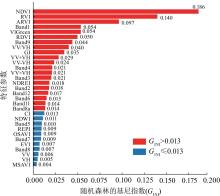
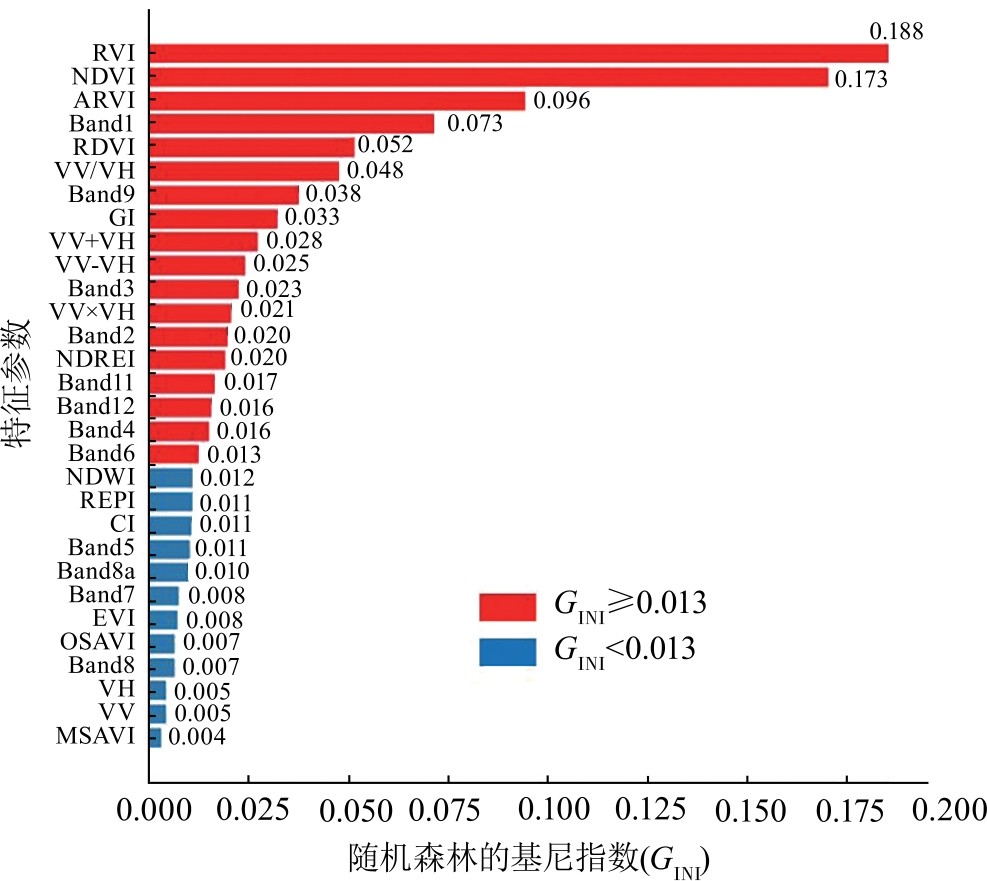
Fig.1
Feature Selection
Tab.5
Inversion results of each model
| 类型 | 预测数据 | 预测模型 | R2 | ERMS |
|---|---|---|---|---|
| 1 | SAR | RF | 0.35 | 6.50 |
| SVM | 0.33 | 7.87 | ||
| GBR | 0.31 | 7.47 | ||
| XGBoost | 0.21 | 7.67 | ||
| CatBoost | 0.31 | 8.48 | ||
| LR | 0.32 | 6.33 | ||
| 2 | 光学 | RF | 0.69 | 4.85 |
| SVM | 0.67 | 5.85 | ||
| GBR | 0.68 | 4.39 | ||
| XGBoost | 0.69 | 5.88 | ||
| CatBoost | 0.63 | 2.79 | ||
| LR | 0.69 | 5.29 | ||
| 3 | SAR+光学 | RF | 0.83 | 2.77 |
| SVM | 0.74 | 4.10 | ||
| GBR | 0.73 | 4.28 | ||
| XGBoost | 0.71 | 5.41 | ||
| CatBoost | 0.16 | 5.92 | ||
| LR | 0.47 | 4.60 |
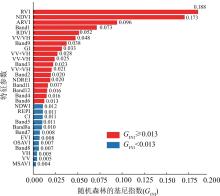
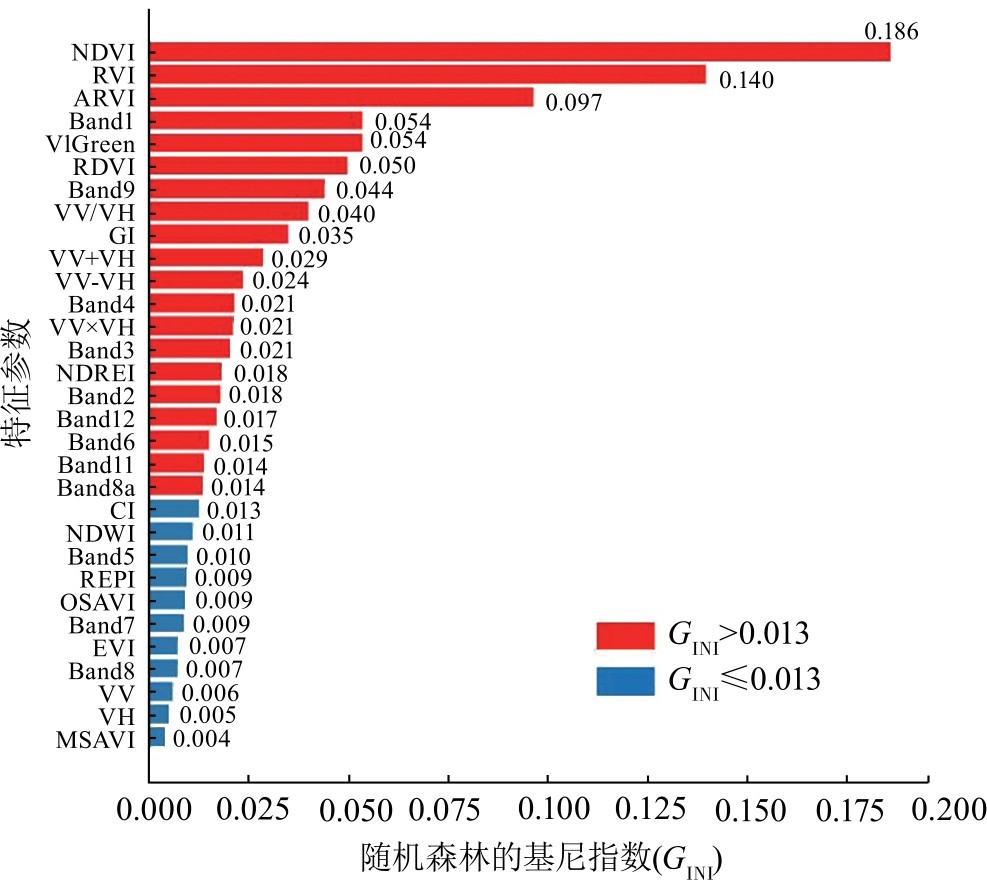
Fig.2
Feature selection (excluding VIGreen)
Tab.6
Inversion results of various models excluding VIGreen
| 类型 | 预测数据 | 预测模型 | R2 | ERMS |
|---|---|---|---|---|
| 1 | SAR | RF | 0.35 | 6.50 |
| SVM | 0.33 | 7.87 | ||
| GBR | 0.31 | 7.47 | ||
| XGBoost | 0.21 | 7.67 | ||
| CatBoost | 0.31 | 8.48 | ||
| LR | 0.32 | 6.33 | ||
| 2 | 光学 | RF | 0.66 | 5.89 |
| SVM | 0.63 | 6.25 | ||
| GBR | 0.63 | 4.78 | ||
| XGBoost | 0.66 | 5.97 | ||
| CatBoost | 0.61 | 3.04 | ||
| LR | 0.69 | 3.54 | ||
| 3 | SAR+光学 | RF | 0.78 | 3.77 |
| SVM | 0.74 | 4.10 | ||
| GBR | 0.75 | 5.18 | ||
| XGBoost | 0.73 | 6.41 | ||
| CatBoost | 0.15 | 6.22 | ||
| LR | 0.42 | 5.60 |
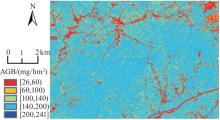
Fig.3
Forest AGB inversion based on RF
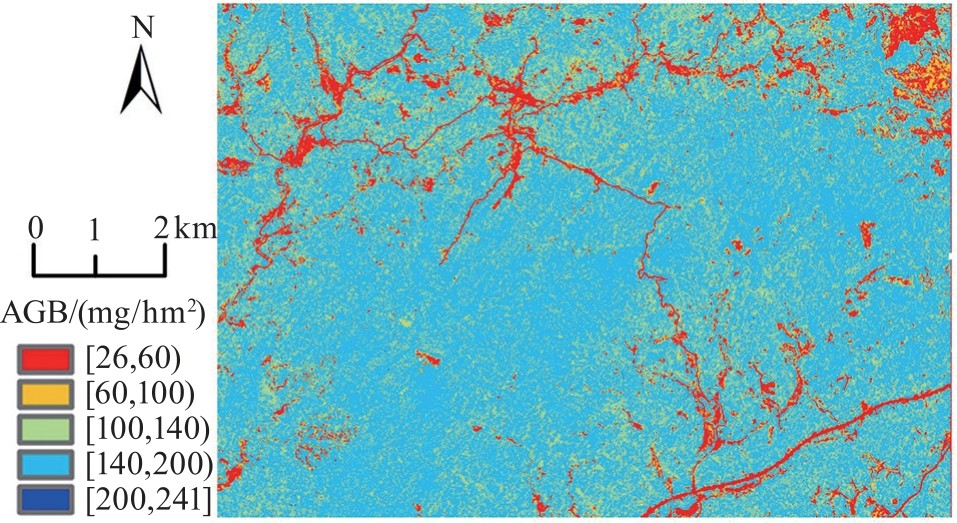
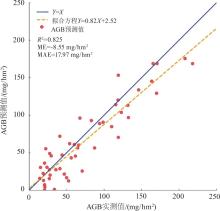
Fig.4
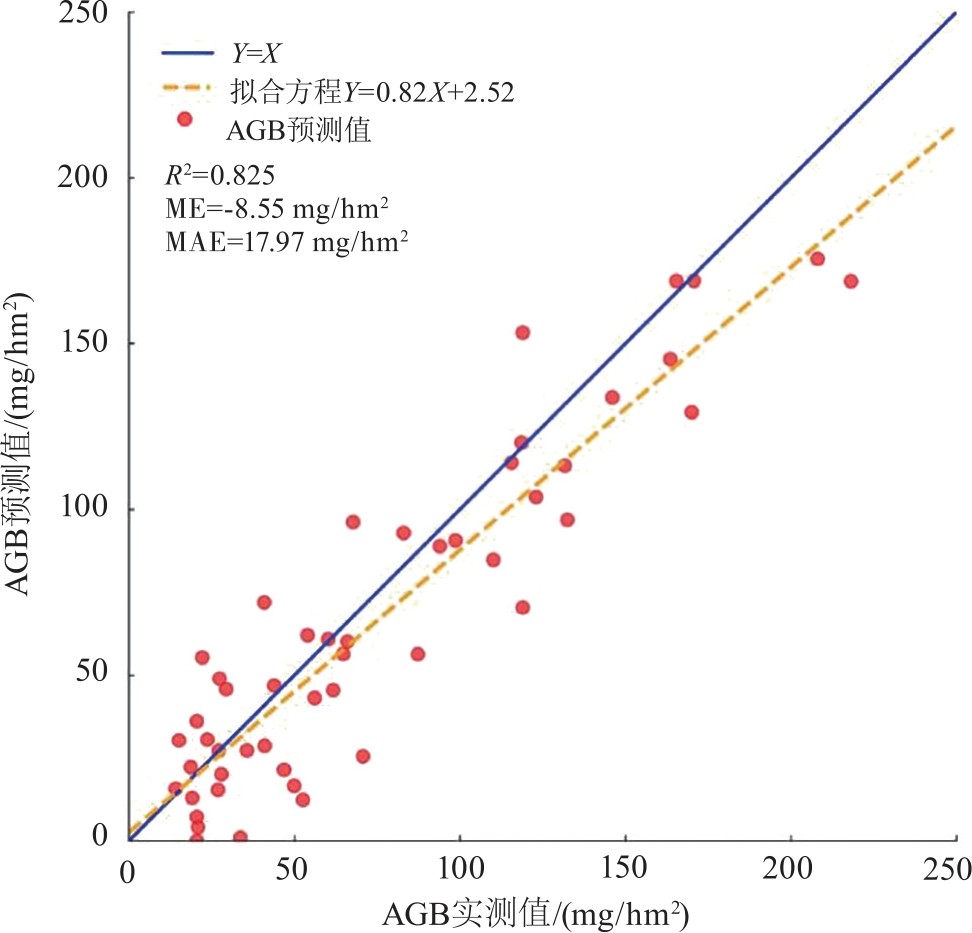
Accuracy of RF model forest AGB inversion
| [1] | SAINUDDIN F V, CHIRAKKAL S, ASOK S V, et al. A comparative study on the efficacy of dual-pol and full-pol ASAR data in radiative transfer modeling for forest above-ground biomass estimation[J]. International Journal of Remote Sensing,Taylor & Francis, 2024, 45(3):719-747. |
| [2] | ZHANG Junxiang, ZHOU Cui, ZHANG Gui, et al. A Novel Framework for Forest Above-Ground Biomass Inversion Using Multi-Source Remote Sensing and Deep Learning[J]. Forests,Multidisciplinary Digital Publishing Institute, 2024, 15(3):456-477. |
| [3] | CHEN Xinyang, YANG Keming, MA Jun, et al. Aboveground Biomass Inversion Based on Object-Oriented Classification and Pearson-mRMR-Machine Learning Model[J]. Remote Sensing,Multidisciplinary Digital Publishing Institute, 2024, 16(9):1537-1550. |
| [4] | ZHOU Wei, LI Haoran, XIE Lijun, et al. Remote sensing inversion of grassland aboveground biomass based on high accuracy surface modeling[J]. Ecological Indicators, 2021, 121:107215. |
| [5] | CUI Li, ZHANG Jiaying, DAI Yiqun, et al. Influence of BRDF Models and Solar Zenith Angles on Forest Above-Ground Biomass Derived from MODIS Multi-Angular Indices[J]. Forests,Multidisciplinary Digital Publishing Institute, 2024, 15(3):245-263. |
| [6] | 李敏, 陈利, 李静泰, 等. 基于Sentinel-2数据的互花米草地上生物量反演[J]. 海洋环境科学, 2024, 43(3):386-397. |
| [7] |
郝晴, 黄昌. 森林地上生物量遥感估算研究综述[J]. 植物生态学报, 2023, 47(10):1356-1374.
doi: 10.17521/cjpe.2023.0008 |
| [8] | YU Zhibo, WU Yang, ZHANG Ziyu, et al. A precise estimation framework for individual tree AGB of Pinus kesiya var.Langbianensis utilizing point cloud registration Optimization[J]. International Journal of Applied Earth Observation and Geoinformation, 2025, 140:104612. |
| [9] | 熊向阳, 杨小周, 赵银超, 等. 基于超参数优化随机森林算法的森林生物量遥感反演[J]. 中南林业科技大学学报, 2024, 44(5):102-111. |
| [10] | 李尉尉, 薛志泳, 朱建华, 等. 基于GEE平台多源遥感数据的海南岛红树林碳储量估算[J]. 自然资源遥感, 2025, 37(2):220-227. |
| [11] | WANG Chu, ZHANG Wangfei, JI Yongjie et al. Estimation of Aboveground Biomass for Different Forest Types Using Data from Sentinel-1,Sentinel-2,ALOS PALSAR-2,and GEDI[J]. Forests,Multidisciplinary Digital Publishing Institute, 2024, 15(1):215-238. |
| [12] | 李海奎, 雷渊才. 中国森林植被生物量和碳储量评估[M]. 北京: 中国林业出版社, 2010. |
| [13] | 熊珂, 邢元军, 和晓风, 等. 基于KNN算法的森林地上生物量遥感估测[J]. 林草资源研究, 2024(3):106-112. |
| [14] |
LE TOAN T, QUEGAN S, DAVIDSON M W J, et al. The BIOMASS mission:mapping global forest biomass to better understand the terrestrial carbon cycle[J]. Remote Sensing of Environment, 2011, 115(11):2850-2860.
doi: 10.1016/j.rse.2011.03.020 |
| [15] | JI Yongjie, WANG Lu, ZHANG Wangfei, et al. Forest above-ground biomass estimation using X,C,L,and P band SAR polarimetric observations and different inversion models[J]. International Journal of Digital Earth,Taylor & Francis, 2024, 17(1):2310730. |
| [16] |
SOJA M J, PERSSON H J, ULANDER L M H. Estimation of Forest Biomass From Two-Level Model Inversion of Single-Pass InSAR Data[J]. IEEE Transactions on Geoscience and Remote Sensing, 2015, 53(9):5083-5099.
doi: 10.1109/TGRS.36 |
| [17] |
BARRACHINA M, CRISTÓBAL J, TULLA A F. Estimating above-ground biomass on mountain meadows and pastures through remote sensing[J]. International Journal of Applied Earth Observation and Geoinformation, 2015, 38:184-192.
doi: 10.1016/j.jag.2014.12.002 |
| [18] | 宋洁, 刘学录. 基于星载激光雷达数据的森林地上生物量估算方法比较[J]. 生态科学, 2024, 43(5):52-62. |
| [19] |
JI S, DASHPUREV B, PHAN T N, et al. Above-ground biomass retrieval with multi-source data:Prediction and applicability analysis in Eastern Mongolia[J]. Land Degradation & Development, 2024, 35(9):2982-2992.
doi: 10.1002/ldr.v35.9 |
| [20] | 李正英, 舒清态, 李圣娇, 等. 遥感影像与激光雷达数据协同反演森林生物量综述[J]. 世界林业研究, 2024, 37(6):48-53. |
| [21] | ZHANG Wangfei, ZHAO Lixian, LI Yun, et al. Forest Above-Ground Biomass Inversion Using Optical and SAR Images Based on a Multi-Step Feature Optimized Inversion Model[J]. Remote Sensing,Multidisciplinary Digital Publishing Institute, 2022, 14(7):1608-1624. |
| [22] | 冯健昭, 潘永琪, 熊悦淞, 等. 基于mRMR-XGBoost的水稻关键生育期识别[J]. 农业工程学报, 2024, 40(15):111-118. |
| [23] | 朱龙祥, 王自法, 张昕, 等. 基于GIS和多种机器学习算法的广东省森林火灾预测模型[J]. 林业工程学报, 2024, 9(3):159-167. |
| [24] | LIU Xiao, NEIGH C S R, PARDINI M, et al. Estimating forest height and above-ground biomass in tropical forests using P-band TomoSAR and GEDI observations[J]. International Journal of Remote Sensing,Taylor & Francis, 2024, 45(9):3129-3148. |
| [25] |
VIÑA A, GITELSON A A. Sensitivity to Foliar Anthocyanin Content of Vegetation Indices Using Green Reflectance[J]. IEEE Geoscience and Remote Sensing Letters, 2011, 8(3):464-468.
doi: 10.1109/LGRS.8859 |
| [26] |
LAI Xiahua, ZHAO Xiaomin, WANG Chen, et al. Remote sensing aboveground biomass inversion of four vegetation types in the nanji wetland[J]. Forests, 2025, 16(9):1376-1396.
doi: 10.3390/f16091376 |
| [27] | LIU Pan, REN Chunying, WANG Zongming, et al. Improving aboveground biomass estimation by integrating ICESat-2 LiDAR sampling and tree species stratification strategies using multi-source datasets[J]. Geo-spatial Information Science, 28(3):1-21. |
| [1] | CHEN Xiaohua, CHEN Zongzhu, YANG Qingqing, LEI Jinrui, WU Tingtian, LI Yuanling, PAN Xiaoyan. Predicting the Probability of Tropical Forest Fires in Hainan Island Based on Random Forest Model [J]. Forest and Grassland Resources Research, 2024, 0(6): 140-145. |
| [2] | MA Rongfei, CHEN Yan, HOU Peng, REN Xiaoqi. Progress on Hyperspectral Remote Sensing Inversion Method for Vegetation Chlorophyll Content [J]. Forest and Grassland Resources Research, 2024, 0(5): 166-178. |
| [3] | XU Xiao, ZHANG Jialong. Classification of Urban Green Space in Yunnan Province Based on Sentinel-2A [J]. Forest and Grassland Resources Research, 2024, 0(2): 141-148. |
| [4] | TANG Jiajun, CHAI Zongzheng. Remote Sensing Estimation of Average Diameter at Breast Height of Forest Stands Based on Airborne LiDAR and Machine Learning Algorithms [J]. Forest and Grassland Resources Research, 2024, 0(1): 56-64. |
| [5] | REN Xiaoqi, HOU Peng, CHEN Yan. Advances in Remote Sensing Retrieval of Forest Aboveground Biomass [J]. Forest and Grassland Resources Research, 2023, 0(6): 146-158. |
| [6] | ZHANG Guoli, CI Xuelun, YANG Xueqing, JIANG Chunying, SUN Zhichao, MENG Haiding. Study on Spatio-Temporal Distribution Characteristics and Susceptibility Analysis of Forest Fire [J]. Forest and Grassland Resources Research, 2023, 0(5): 48-55. |
| [7] | JU Wenzhen, WEI Longbin, PENG Bolin, LI Changcheng, PAN Ting. Study on Driving Factors and Prediction Model of Forest Fire in Guangxi [J]. Forest and Grassland Resources Research, 2023, 0(5): 56-62. |
| [8] | LIANG Licheng, FU Xiaoqiang, ZHANG Bin, CHENG Guxun, LI Zuohui. Dynamic Monitoring of Spartina alterniflora in Xiangshan Harbor Based on GEE and Random Forest [J]. FOREST RESOURCES WANAGEMENT, 2023, 0(3): 38-45. |
| [9] | WANG Xiaohui, ZHANG Huiru, PANG Yong, QIN Xianlin, LI Haikui, MENG Shili, YU Tao. Forest Vegetation Type Monitoring in the Natural Forest Protection Project Area [J]. FOREST RESOURCES WANAGEMENT, 2023, 0(2): 96-103. |
| [10] | GAO Jinping, YU Huina, ZHAI Zhaokun. Application of High Resolution Multi-Mode Satellite in Forest Land Types and Tree Species Identification [J]. FOREST RESOURCES WANAGEMENT, 2023, 0(1): 127-132. |
| [11] | WANG Xiaoyang, JIANG Youyi, LI Xiao, HU Yaxuan, ZHANG Jiazheng, LIU Bowei. A Multi-Temporal and Multi-Feature Larch Plantation Extraction Study Based on GF-1 Images [J]. FOREST RESOURCES WANAGEMENT, 2022, 0(4): 109-118. |
| [12] | HUANG Bingqian, YUE Cairong, ZHU Bodong. Estimation of Forest Volume Based on Multi-Scale Remote Sensing Features of GF-1 [J]. FOREST RESOURCES WANAGEMENT, 2022, 0(3): 54-59. |
| [13] | HUANG Jincheng, LIU Hongsheng, NING Jinkui, OUYANG Xunzhi, ZANG Hao. Study of Adaptability of the Primary Afforestation Species in Chongyi County,Jiangxi Province Based on Random Forest [J]. FOREST RESOURCES WANAGEMENT, 2022, 0(2): 117-125. |
| [14] | LONG Zhihao, LUO Peng, XU Dengping, LI Zhen, DAI Huabin. Inversion Research of Forest Stock Volume Using the Red Edge Bands of Sentinel-2A [J]. FOREST RESOURCES WANAGEMENT, 2022, 0(2): 126-134. |
| [15] | TANG Jinhao, ZHANG Jialong, CHEN Liye, CHENG Tao. Research on Estimation of Aboveground Biomass and Scale Conversion for Pinus densata Mast [J]. FOREST RESOURCES WANAGEMENT, 2021, 0(6): 83-89. |
| Viewed | ||||||
|
Full text |
|
|||||
|
Abstract |
|
|||||
