

Forest and Grassland Resources Research ›› 2025›› Issue (3): 127-138.doi: 10.13466/j.cnki.lczyyj.2025.03.015
• Technical Application • Previous Articles
YE Peixia1( ), LUO Kai1, SHEN Zhenhai2, JIN Shanshan1, ZHOU Mengli1, YAN Dongfeng1()
Received:2025-03-07
Revised:2025-06-06
Online:2025-06-28
Published:2026-01-07
CLC Number:
YE Peixia, LUO Kai, SHEN Zhenhai, JIN Shanshan, ZHOU Mengli, YAN Dongfeng. Health assessment of Robinia pseudoacacia plantations in the Henan Old Yellow River Course area using PLS-SEM Model[J]. Forest and Grassland Resources Research, 2025, (3): 127-138.
Add to citation manager EndNote|Ris|BibTeX
URL: https://www.lyzygl.com.cn/EN/10.13466/j.cnki.lczyyj.2025.03.015
Tab.1
Basic overview of the sample plots
| 变量 | 均值±标准差 | 最小值 | 最大值 | 变异系数/% | 偏度 | 峰度 |
|---|---|---|---|---|---|---|
| 郁闭度 | 0.68± 0.20 | 0.26 | 0.92 | 28.9 | -0.712 | -0.702 |
| 林分密度/(株/hm2) | 769.00±207.00 | 350.00 | 1 283.33 | 26.9 | 0.087 | -0.189 |
| 单位面积蓄积量/(m3/hm2) | 57.05± 33.97 | 12.99 | 122.44 | 59.5 | 0.613 | -1.002 |
| 平均胸径/cm | 14.36± 2.98 | 10.12 | 20.74 | 20.7 | 0.138 | -1.237 |
| 平均树高/m | 8.56± 2.30 | 5.17 | 12.63 | 26.8 | 0.191 | -1.506 |
Tab.2
Health evaluation index system of Robinia pseudoacaciaplantations with scoring grade criteria
| 目标变量 | 潜变量 | 观测变量 | 等级分值 | ||||
|---|---|---|---|---|---|---|---|
| 5 | 4 | 3 | 2 | 1 | |||
| 刺槐人工林健康评价 | 林分生产力 | 平均胸径/cm | ≥17 | [15,17) | [12,15) | (11,12) | (0,11] |
| 平均树高/m | ≥11.1 | [8.8,11.1) | [7.3,8.8) | (6.3,7.3) | (0,6.3] | ||
| 平均冠幅/m | ≥12.2 | [11.0,12.2) | [9.5,11.0) | (8.2,9.5) | (0,8.2] | ||
| 单位面积蓄积量/(m3/hm2) | ≥102 | [55,102) | [36,55) | (27,36) | (0,27] | ||
| 地上部分总生物量/(g/m2) | ≥200 | [160,200) | [120,160) | (120,90) | (0,90] | ||
| 林分立地条件 | 郁闭度 | ≥0.85 | [0.79,0.85) | [0.73,0.79) | (0.47,0.73) | (0,0.47] | |
| 物种丰富度 | ≥7 | [6,5) | [5,4) | [4,3) | (0,3] | ||
| 土壤容重/(g/cm3) | (0,1.41] | (1.41,1.45) | [1.45,1.47) | [1.47,1.49) | ≥1.49 | ||
| 土壤有机质/(g/kg) | ≥4.3 | [3.3,4.3) | [1.7,3.3) | (0.99,1.7) | (0,0.99] | ||
| 土壤含水量/% | ≥22 | [19,22) | [14,19) | (12,14) | (0,12] | ||
| 林分抵抗力 | 枯死枝比例/% | (0,0.15] | (0.15,0.18) | [0.18,0.20) | [0.20,0.24) | ≥0.24 | |
| 断头比例/% | (0,0.06] | (0.06,0.13) | [0.13,0.23) | [0.23,0.38) | ≥0.38 | ||
| 感染病虫害比例/% | (0,0.16] | (0.16,0.42) | [0.42,0.67) | [0.61,0.91) | ≥0.91 | ||
| 火险等级 | (0,0.18] | [0.19,0.23) | [0.23,0.28) | [0.29,0.33) | ≥0.33 | ||
| 干扰等级 | 极轻 | 轻度 | 中度 | 重度 | 严重 | ||
| 更新苗多样性 | ≥0.69 | [0.61,0.69) | [0.56,0.61) | (0.45,0.56) | (0,0.45] | ||
| 更新苗数量 | ≥45 | [32,45) | [26,32) | (26,18) | (0,18] | ||
| 林分结构 | 竞争指数 | ≥0.26 | [0.24,0.26) | [0.23,0.24) | (0.22,0.23) | (0,0.219] | |
| 角尺度 | (0,0.45] | (0.45,0.49) | [0.49,0.52) | [0.52,0.54) | ≥0.54 | ||
| 大小比数 | ≥0.53 | [0.51,0.53) | [0.50,0.51) | (0.49,0.50) | (0,0.49] | ||
| 平均叶面积指数 | ≥1.43 | [1.27,1.43) | [1.18,1.27) | (1.07,1.18) | (0,1.07] | ||
| 冠层开度 | (0,14.6] | (14.6,21.9) | [21.9,35.0) | [35.0,53.6) | ≥53.8 | ||
Tab.3
Validation results of the health evaluation PLS-SEM
| 潜变量 | 可测变量 个数/个 | 测量模型 | 结构模型 | ||||
|---|---|---|---|---|---|---|---|
| 信度检验 | 效度检验 | 路径系数 | 拟合效度检验 | ||||
| 克朗巴赫系数 | 组合信度 | 平均方差提取量 | 拟合系数 | P值 | |||
| 林分生产力 | 5 | 0.937 | 0.954 | 0.806 | 0.947 | 0.895 | <0.01 |
| 林分立地条件 | 5 | 0.836 | 0.883 | 0.602 | 0.86 | 0.733 | <0.01 |
| 林分抵抗力 | 7 | 0.895 | 0.919 | 0.622 | 0.942 | 0.885 | <0.01 |
| 林分结构 | 5 | 0.877 | 0.91 | 0.671 | 0.936 | 0.873 | <0.01 |
Tab.4
Factor loadings and weight coefficients of health evaluation indicators
| 潜变量 | 路径系数 | 潜变量权重 | 观测变量 | 因子载荷 | 外部权重 | 观测变量权重 |
|---|---|---|---|---|---|---|
| 林分生产力 | 0.947 | 0.257 | 平均胸径 | 0.938 | 0.226 | 0.204 |
| 平均树高 | 0.950 | 0.243 | 0.219 | |||
| 平均冠幅 | 0.709 | 0.179 | 0.162 | |||
| 单位面积蓄积量 | 0.924 | 0.233 | 0.210 | |||
| 地上部分总生物量 | 0.943 | 0.227 | 0.205 | |||
| 林分立地条件 | 0.860 | 0.233 | 郁闭度 | 0.851 | 0.325 | 0.253 |
| 物种丰富度 | 0.740 | 0.282 | 0.220 | |||
| 土壤容重 | 0.814 | 0.250 | 0.196 | |||
| 土壤有机质 | 0.722 | 0.211 | 0.165 | |||
| 土壤含水量 | 0.745 | 0.213 | 0.166 | |||
| 林分抵抗力 | 0.942 | 0.256 | 枯死枝比例 | 0.875 | 0.201 | 0.161 |
| 断头比例 | 0.789 | 0.169 | 0.135 | |||
| 感染病虫害比例 | 0.884 | 0.229 | 0.182 | |||
| 火险等级 | 0.669 | 0.135 | 0.108 | |||
| 干扰等级 | 0.943 | 0.234 | 0.186 | |||
| 更新苗多样性 | 0.651 | 0.150 | 0.187 | |||
| 更新苗数量 | 0.651 | 0.123 | 0.153 | |||
| 林分结构 | 0.936 | 0.254 | 竞争指数 | 0.823 | 0.272 | 0.224 |
| 角尺度 | 0.823 | 0.248 | 0.204 | |||
| 大小比数 | 0.838 | 0.248 | 0.204 | |||
| 平均叶面积指数 | 0.739 | 0.193 | 0.159 | |||
| 冠层开度 | 0.865 | 0.256 | 0.210 |
Tab.5
Health evaluation indices of Robinia pseudoacacia plantations in different sample plots
| 样 地 编 号 | 潜变量贡献值 | 健康 评价 指数 | 样 地 编 号 | 潜变量贡献值 | 健康 评价 指数 | ||||||
|---|---|---|---|---|---|---|---|---|---|---|---|
| 林分生产力 | 林分立地条件 | 林分抵抗力 | 林分结构 | 林分生产力 | 林分立地条件 | 林分抵抗力 | 林分结构 | ||||
| 1 | 1.191 | 0.762 | 0.375 | 0.744 | 3.072 | 12 | 1.176 | 0.810 | 0.343 | 0.597 | 2.926 |
| 2 | 1.054 | 0.782 | 0.416 | 0.799 | 3.051 | 13 | 0.998 | 0.751 | 0.315 | 0.557 | 2.621 |
| 3 | 1.093 | 0.661 | 0.382 | 0.761 | 2.896 | 14 | 1.054 | 0.718 | 0.389 | 0.516 | 2.678 |
| 4 | 0.986 | 0.679 | 0.328 | 0.707 | 2.701 | 15 | 0.934 | 0.782 | 0.343 | 0.516 | 2.575 |
| 5 | 1.202 | 0.842 | 0.397 | 0.654 | 3.094 | 16 | 0.599 | 0.763 | 0.627 | 1.005 | 2.994 |
| 6 | 1.243 | 0.843 | 0.388 | 0.797 | 3.272 | 17 | 0.859 | 0.517 | 0.524 | 0.953 | 2.853 |
| 7 | 1.146 | 0.674 | 0.376 | 0.694 | 2.890 | 18 | 0.854 | 0.679 | 0.619 | 0.712 | 2.863 |
| 8 | 1.202 | 0.753 | 0.329 | 0.717 | 3.000 | 19 | 0.801 | 0.719 | 0.558 | 0.473 | 2.552 |
| 9 | 1.232 | 0.888 | 0.465 | 0.655 | 3.241 | 20 | 0.652 | 0.692 | 0.646 | 0.787 | 2.777 |
| 10 | 0.934 | 0.880 | 0.424 | 0.557 | 2.794 | 21 | 0.309 | 0.524 | 0.655 | 0.777 | 2.266 |
| 11 | 1.081 | 0.668 | 0.418 | 0.518 | 2.685 | 22 | 0.919 | 0.835 | 0.422 | 0.647 | 2.823 |
| 23 | 0.932 | 0.640 | 0.605 | 0.801 | 2.978 | 34 | 0.460 | 0.698 | 0.778 | 0.862 | 2.797 |
| 24 | 0.599 | 0.484 | 0.605 | 0.762 | 2.451 | 35 | 0.682 | 0.672 | 0.724 | 0.887 | 2.965 |
| 25 | 0.756 | 0.633 | 0.491 | 0.789 | 2.670 | 36 | 0.257 | 0.524 | 0.839 | 0.778 | 2.398 |
| 26 | 0.632 | 0.867 | 0.531 | 0.697 | 2.726 | 37 | 0.257 | 0.517 | 0.859 | 0.869 | 2.501 |
| 27 | 0.641 | 0.706 | 0.681 | 0.757 | 2.785 | 38 | 0.355 | 0.685 | 0.845 | 0.882 | 2.767 |
| 28 | 0.652 | 0.539 | 0.621 | 0.901 | 2.712 | 39 | 0.585 | 0.577 | 0.706 | 0.765 | 2.633 |
| 29 | 0.460 | 0.615 | 0.593 | 0.681 | 2.349 | 40 | 0.633 | 0.576 | 0.878 | 0.752 | 2.839 |
| 30 | 0.471 | 0.751 | 0.579 | 0.705 | 2.507 | 41 | 0.449 | 0.705 | 0.810 | 0.828 | 2.792 |
| 31 | 0.257 | 0.768 | 0.933 | 0.939 | 2.896 | 42 | 0.351 | 0.795 | 0.816 | 0.870 | 2.833 |
| 32 | 0.351 | 0.614 | 0.830 | 0.835 | 2.630 | 43 | 0.299 | 0.628 | 0.763 | 0.815 | 2.505 |
| 33 | 0.257 | 0.524 | 0.864 | 0.887 | 2.532 | 44 | 0.690 | 0.628 | 0.933 | 0.713 | 2.964 |
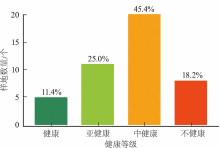
Fig.1
Cluster analysis results of plots
Tab.6
Test of Wilks'Lambda
| 样地编号 | 威尔克Lambda | 卡方 | 自由度 | 显著性 |
|---|---|---|---|---|
| 1、3 | 0.081 | 98.014 | 12 | 0.000 |
| 2、3 | 0.755 | 10.975 | 6 | 0.089 |
| 3 | 0.980 | 0.771 | 2 | 0.680 |
Tab.7
Validation results of health grades for different Robiniapseudoacaciaplantations%
| 健康等级 | 预测组占比 | 总计 | |||
|---|---|---|---|---|---|
| 健康 | 不健康 | 中健康 | 亚健康 | ||
| 健康 | 100 | 0 | 0 | 0 | 100 |
| 不健康 | 0 | 100 | 0 | 0 | 100 |
| 中健康 | 5 | 0 | 95 | 0 | 100 |
| 亚健康 | 0 | 0 | 0 | 100 | 100 |
| [1] | 北京市园林绿化国际合作项目管理办公室、 北京林业大学.森林健康经营与生态系统健康评价规程:DB11/T 725—2010[S]. 北京: 中国标准出版社, 2010. |
| [2] |
BADEA O, PITAR D, TAUT I, et al. Forest monitoring:assessment,analysis and warning system for forest ecosystem status[J]. Notulae Botanicae Horti Agrobotanici Cluj-Napoca, 2013, 41:613-625.
doi: 10.15835/nbha4129304 |
| [3] |
MCKINLEY D C, RYAN M G, BIRDSEY R A, et al. A synthesis of current knowledge on forests and carbon storage in the United States[J]. Ecological Applications, 2011, 21(6):1902-1924.
pmid: 21939033 |
| [4] | JOUBERT-VAN DER MERWE L, SAMWAYS M J, PRYKE J S. A new protocol for monitoring operational outcomes of environmental management in commercial forestry plantations[J]. Journal of Environmental Management, 2020, 271:110922. |
| [5] | CASTELLO J. Forest Health:An Integrated Perspective[M]. Cambridge: Cambridge University Press, 2011. |
| [6] | 姬文元, 邢韶华, 郭宁, 等. 川西米亚罗林区云冷杉林健康状态评价[J]. 林业科学, 2009, 45(3):13-18. |
| [7] | 严尚凯, 赵忠, 宋西德, 等. 黄土高原渭北地区油松林健康评价研究[J]. 西北林学院学报, 2010, 25(5):7-11. |
| [8] |
赵金满, 韩馨悦, 程瑞明, 等. 塞罕坝自然保护区华北落叶松和樟子松人工林健康评价[J]. 南京林业大学学报(自然科学版), 2024, 48(3):199-206.
doi: 10.12302/j.issn.1000-2006.202204058 |
| [9] | 吴秀丽, 吴涛, 刘羿. 国内外森林健康经营综述[J]. 世界林业研究, 2011, 24(4):7-12. |
| [10] | 彭泰来, 黄俊威, 刘金山, 等. 基于模糊综合评价法的天然林资源质量评价[J]. 林业资源管理, 2022(6):82-88. |
| [11] | 赵小亮, 周国娜, 高宝嘉, 等. 主成分分析法在承德县森林生态系统健康评价中的应用[J]. 中国农学通报, 2008(6):400-403. |
| [12] | 翁殊斐, 黎彩敏, 庞瑞君. 用层次分析法构建园林树木健康评价体系[J]. 西北林学院学报, 2009, 24(1):177-181. |
| [13] |
LAUGHLIN D C, ABELLA S R, COVINGTON W W, et al. Species richness and soil properties in Pinus ponderosa forests:A structural equation modeling analysis[J]. Journal of Vegetation Science, 2007, 18(2):231.
doi: 10.1111/jvs.2007.18.issue-2 |
| [14] |
董灵波, 刘兆刚. 森林健康评价及其多尺度转换方法[J]. 南京林业大学学报(自然科学版), 2021, 45(3):206-216.
doi: 10.12302/j.issn.1000-2006.201911007 |
| [15] | LEGUINA A. A primer on partial least squares structural equation modeling(PLS-SEM)[J]. International Journal of Research & Method in Education, 2015, 38(2):220-221. |
| [16] | 夏江宝, 许景伟, 李传荣, 等. 黄河三角洲低质低效人工刺槐林分类与评价[J]. 水土保持通报, 2012, 32(1):217-221. |
| [17] | 曹小玉, 委霞, 赵文菲, 等. 基于结构方程模型的森林健康评价[J]. 生态学杂志, 2021, 40(8):2635-2647. |
| [18] | 青海省林业和草原局. 人工生态公益林健康评价技术规范:DB63/T 2017—2022[S]. 青海: 青海省市场监督管理局, 2022. |
| [19] | 刘金良, 于泽群, 张顺祥, 等. 渭北黄土高原区刺槐人工林健康评价体系的构建[J]. 西北农林科技大学学报(自然科学版), 2014, 42(6):93-99. |
| [20] | 莫永俊. 基于结构方程模型的杉木公益林林分结构多样性评价[D]. 长沙: 中南林业科技大学, 2024. |
| [21] | 国家林业局应对气候变换和节能减排工作领导小组办公室. 中国绿色碳基金造林项目碳汇计量与监测指南[M]. 北京: 中国林业出版社, 2008. |
| [22] |
ROZAS V. Structural heterogeneity and tree spatial patterns in an old-growth deciduous lowland forest in Cantabria,Northern Spain[J]. Plant Ecology, 2006, 185(1):57-72.
doi: 10.1007/s11258-005-9084-1 |
| [23] | 吴明山, 周汝良, 张明莎, 等. 林分尺度上的森林火险动态评估[J]. 林业资源管理, 2020(2):126-134. |
| [24] | 董灵波, 刘兆刚, 李凤日, 等. 大兴安岭主要森林类型林分空间结构及最优树种组成[J]. 林业科学研究, 2014, 27(6):734-740. |
| [25] | 魏强, 柴春山, 凌雷, 等. 兰州南部山区天然次生林近自然化经营技术[J]. 林业资源管理, 2016(5):86-92. |
| [26] |
AMINI A, ALIMOHAMMADLOU M. Toward equation structural modeling:an integration of interpretive structural modeling and structural equation modeling[J]. Journal of Management Analytics, 2021, 8(4):693-714.
doi: 10.1080/23270012.2021.1881927 |
| [27] | JIA Honghong, LUO Peng, YANG Hao, et al. Constructing an indices system for evaluating the ecological integrity of forests in western Sichuan,China based on structural equation modeling[J]. Ecological Indicators, 2023, 146:109745. |
| [28] |
YUAN Kehai, WEN Yong, TANG Jiashan. Regression analysis with latent variables by partial least squares and four other composite scores:consistency,bias and correction[J]. Structural Equation Modeling:A Multidisciplinary Journal, 2020, 27(3):333-350.
doi: 10.1080/10705511.2019.1647107 |
| [29] |
HAIR J F, RINGLE C M, SARSTEDT M. Editorial partial least squares:The better approach to structural equation modeling?[J]. Long range planning, 2014, 47(6):391-391.
doi: 10.1016/j.lrp.2013.08.015 |
| [30] |
WANG Weiwei, XU Yanhong, YANG Junling, et al. Health evaluation of main forest vegetation types in Naban River Nature Reserve[J]. Chinese Agricultural Science Bulletin, 2021, 37(26):32-39.
doi: 10.11924/j.issn.1000-6850.casb2020-0755 |
| [31] | 熊樱. 延安城郊刺槐人工林健康评价及其林分结构配置研究[D]. 杨凌: 西北农林科技大学, 2013. |
| [32] | 李平平, 王彦辉, 于澎涛, 等. 黄土高原刺槐人工林生长对立地质量和林分密度的响应[J]. 林业科学, 2025, 61(7):192-207. |
| [33] | 郭艳荣, 王懿祥, 海龙, 等. 基于ChatGPT的科尔沁沙地杨树人工林健康评价[J]. 北京林业大学学报, 2025, 47(7):117-128. |
| [34] | 张顺祥, 刘金良, 赵忠. 基于多元统计分析的永寿县刺槐人工林健康评价研究[J]. 西北林学院学报, 2016, 31(2):109-114. |
| [35] | 曹志. 基于森林健康的林分结构调控技术研究[D]. 北京: 北京林业大学, 2021. |
| [36] | 刘恩田, 赵忠, 宋西德, 等. 渭北黄土高原刺槐林健康评价指标体系的构建[J]. 西北农林科技大学学报(自然科学版), 2010, 38(10):67-75. |
| [37] | 赵琳, 邓继峰, 周永斌, 等. 基于灰色理论分析辽西北半干旱地区适地适树造林决策[J]. 林业资源管理, 2016(5):77-85. |
| [38] | 曾伟生. 近自然森林经营是提高我国森林质量的可行途径[J]. 林业资源管理, 2009(2):6-11. |
| [1] | WANG Kaixuan, HU Yue, HU Lei, ZHANG Yahao, HAN Zemin, LI Bin, LI Xiaohui, ZHANG Zhuowen, DIAN Yuanyong. The Compilation and Implementation of Innovative Forest Management Plan Based on FLR and SFM [J]. FOREST RESOURCES WANAGEMENT, 2022, 0(zk1): 24-31. |
| [2] | CHEN Shaozhi, WU Keyi, HAN Dongyang, ZOU Wentao. Thoughts on the Compilation of New Forest Management Plan of State-Owned Forest Farms—Taking Mulan Weichang State-Owned Forest Farm as an Example [J]. FOREST RESOURCES WANAGEMENT, 2022, 0(zk1): 32-38. |
| [3] | TANG Xiaoping, OUYANG Junxiang. Summary on the Development of the Forest Management Plan [J]. FOREST RESOURCES WANAGEMENT, 2022, 0(zk1): 8-18. |
| [4] | QING Dongsheng, PENG Jinxiang, LI Jianjun, DENG Qiaoling, LIU Shuai. Autocorrelation Analysis of Quantitative Index of Stand Spatial Structure Based on Moran's I [J]. FOREST RESOURCES WANAGEMENT, 2022, 0(1): 8-17. |
| [5] | QING Dongsheng, ZHANG Jiang, LI Jianjun, PENG Jinxiang, LIU Shuai. Research on the Difference of Mingling Degree under Different Selection Schemes of Adjacent Trees [J]. FOREST RESOURCES WANAGEMENT, 2021, 0(4): 69-78. |
| [6] | WANG Qian, WANG Hongchun. Evaluation of Sustainable Forest Management in Yong'an City of Fujian Province [J]. FOREST RESOURCES WANAGEMENT, 2020, 0(6): 79-84. |
| [7] | YU Shitao, FU Jinchi, JIANG Lingling, MA Rong, XU Zhongqi. The Relationship between Herbaceous Biomass and Soil Factors of Sunny Slopes in the Mountains of Northern Hebei [J]. FOREST RESOURCES WANAGEMENT, 2019, 0(1): 32-37. |
| [8] | WANG Xiaolan, CHEN Jiarui, XING Zhen, ZHANG Chuanlong. Study on Relationship between DBH and Crown Diameter of Pinus densata and Its Application in Southeastern Tibet [J]. FOREST RESOURCES WANAGEMENT, 2019, 0(1): 63-69. |
| [9] | JIANG Yun’an, XIE Shouxin, JIN Aixian, CUI Haiou, WANG Hongchun, ZHOU Rui. Management Strategy of New Generation Eucalyptus Plantation in Brazil and Its Enlightenment [J]. FOREST RESOURCES WANAGEMENT, 2018, 0(6): 125-129. |
| [10] | ZHOU Quan, WANG Ruihui, ZHONG Cheng, ZHOU Yangchao, FU Weinan. Effects of Thinning on Soil Physical and Chemical Properties and Soil and Water Conservation of Cunninghamia lanceolata Plantation in Different Age Forests [J]. FOREST RESOURCES WANAGEMENT, 2018, 0(4): 47-54. |
| [11] | GONG Ningning, WANG Xiaoping, LI Hao, MA Luyi, JIA Zhongkui, DUAN Jie, LIN Ping. Management Density Effects of Pinus Tabulaeformis Plantation in Beijing [J]. FOREST RESOURCES WANAGEMENT, 2014, 0(4): 85-91. |
| [12] | MU Shuai, ZHANG Shuzi, GAI Liyan, ZHI Qiankun, HUANG Xuanrui. Analysis on Management Benefits of Larix pricipis-rupprechtii Forest in Yanshan Mountains [J]. FOREST RESOURCES WANAGEMENT, 2013, 0(4): 77-83. |
| [13] | WANG Lili, LI Weizhong. Conflicts and Coordination in Forest Management Planning Based on Public Participation [J]. FOREST RESOURCES WANAGEMENT, 2011, 0(5): 25-29. |
| [14] | BAN Meiling. Analysis on Sustainable Development of Commercial Forests in Guangxi [J]. FOREST RESOURCES WANAGEMENT, 2008, 0(2): 18-22. |
| [15] | CAI Daoxiong, GUO Wenfu, JIA Hongyan, LU Lihua, LI Jiliang, CHEN Jinxin. Sustainable Management of Plantations —Taking as an example the implementation of ecological management approach in Experimental Centre of Tropical Forestry [J]. FOREST RESOURCES WANAGEMENT, 2008, 0(2): 42-46. |
| Viewed | ||||||
|
Full text |
|
|||||
|
Abstract |
|
|||||
