

Forest and Grassland Resources Research ›› 2025›› Issue (2): 79-88.doi: 10.13466/j.cnki.lczyyj.2025.02.008
• Research paper • Previous Articles Next Articles
LUO Congcong1,2( ), HUANG Wenchao1, LIU Xinliang1, YE Tiantian1, LIU Linqi1, TANG Xinglin1()
Received:2024-12-23
Revised:2025-03-23
Online:2025-04-28
Published:2025-12-04
CLC Number:
LUO Congcong, HUANG Wenchao, LIU Xinliang, YE Tiantian, LIU Linqi, TANG Xinglin. Effects of light environments within Phoebe bournei canopy on leaf structural traits and photosynthetic induction[J]. Forest and Grassland Resources Research, 2025, (2): 79-88.
Add to citation manager EndNote|Ris|BibTeX
URL: https://www.lyzygl.com.cn/EN/10.13466/j.cnki.lczyyj.2025.02.008
Tab.1
Leaf anatomical traits and stomatal traits of Phoebe bournei under different canopy light environments
| 参数 | 冠层基部阳生叶 | 冠层顶部阳生叶 | 冠层基部阴生叶 | 冠层顶部阴生叶 |
|---|---|---|---|---|
| 叶片厚度/μm | 159.80±9.60ab | 180.20±4.10a | 121.80±5.70c | 130.80±5.90bc |
| 上表皮厚度/μm | 13.80±1.02ab | 16.40±0.83a | 12.30±0.44b | 12.20±0.37b |
| 下表皮厚度/μm | 13.70±0.42ab | 14.60±0.74a | 11.80±0.29b | 13.00±0.61ab |
| 栅栏组织厚度/μm | 83.70±4.41ab | 85.00±1.71a | 58.80±4.08c | 66.90±4.23bc |
| 海绵组织厚度/μm | 50.50±3.68ab | 62.70±6.55a | 41.20±3.38b | 42.00±2.96b |
| 栅海比 | 1.66±0.04a | 1.39±0.15a | 1.43±0.05a | 1.60±0.09a |
| 气孔大小/μm2 | 151.50±4.00a | 155.00±2.90a | 149.70±0.30a | 153.60±4.90a |
| 气孔密度/(个/mm2) | 932.20±33.30a | 970.30±5.30a | 703.60±25.40b | 773.90±13.40b |
| 气孔相对面积/(μm2/mm2) | 14.10±0.40a | 15.00±0.29a | 10.50±0.40b | 11.90±0.50b |
Tab.2
Photosynthesis-light response parameters of Phoebe bournei under different canopy light environments
| 参数 | 冠层基部阳生叶 | 冠层顶部阳生叶 | 冠层基部阴生叶 | 冠层顶部阴生叶 |
|---|---|---|---|---|
| 叶绿素相对含量 | 41.90± 0.50b | 40.70± 0.30b | 46.00± 0.40a | 44.30± 0.40a |
| 比叶质量/(g/m2) | 137.30± 2.07a | 133.60± 2.76a | 83.70±10.25b | 95.40± 2.77b |
| 表观量子效率/(mmol/mol) | 0.032± 0.002ab | 0.034± 0.000 3a | 0.024± 0.003bc | 0.023± 0.004c |
| 最大净光合速率①/[μmol/(m2·s)] | 7.16± 0.09a | 7.07± 0.30ac | 3.50± 0.42bc | 3.49± 0.56b |
| 暗呼吸速率/[μmol/(m2·s)] | 0.49± 0.02b | 0.78± 0.06a | 0.40± 0.12b | 0.33± 0.07b |
| 光补偿点/[μmol/(m2·s)] | 9.61± 0.46b | 15.57± 0.97a | 5.55± 1.62c | 5.07± 1.05c |
| 光饱和点①/[μmol/(m2·s)] | 757.30±14.82ab | 810.50±26.33a | 541.50±10.18c | 650.10±112.48bc |
| 初始斜率① | 0.340± 0.008bc | 0.320± 0.002c | 0.420± 0.003a | 0.410± 0.007ab |
| 最大电子传递速率①/[μmol/(m2·s)] | 116.60±15.37a | 122.70± 7.94a | 46.40± 0.24b | 49.60± 3.77ab |
| 饱和光强①/[μmol/(m2·s)] | 824.70±71.61ab | 888.90±59.45a | 540.80±4.61c | 578.40± 0.58bc |
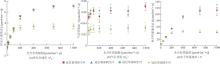
Fig.1
Light response curves of net photosynthetic rate stomatal conductance,and electron transfer rate of leaves of Phoebe bournei under different canopy light environments

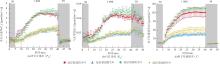
Fig.2
Light induction curves of net photosynthetic rate,stomatal conductance and electron transfer rate of leaves of Phoebe bournei under different canopy light environments

Tab.3
Photosynthetic induction traits of Phoebe bournei under different canopy light environments
| 参数 | 冠层基部阳生叶 | 冠层顶部阳生叶 | 冠层基部阴生叶 | 冠层顶部阴生叶 | ||||
|---|---|---|---|---|---|---|---|---|
| Pn 50/[μmol/(m2·s)] | 1.33±0.23a | 1.32±0.06a | 1.19±0.13a | 1.40±0.32a | ||||
| Pn 1000/[μmol/(m2·s)] | 6.66±0.21a | 6.77±0.27a | 3.80±0.32b | 3.50±0.43b | ||||
| Gs50/[μmol/(m2·s)] | 20.30±4.40a | 21.40±1.40a | 11.40±2.70a | 11.10±1.60a | ||||
| GS 1000①/[μmol/(m2·s)] | 66.10±4.20ab | 69.60±5.60a | 30.60±1.90b | 30.10±2.20b | ||||
| J50/[μmol/(m2·s)] | 15.20±0.20a | 15.20±0.20a | 15.00±0.10a | 14.90±0.10a | ||||
| J1 000/[μmol/(m2·s)] | 106.90±12.00a | 131.00±4.40a | 46.10±4.10b | 54.00±6.70b | ||||
| Vcmax/[μmol/(m2·s)] | 158.20±24.20a | 201.10±6.20a | 63.40±8.70b | 77.90±10.70b | ||||
| t50Pn/min | 14.70±0.30a | 14.30±1.30a | 18.00±1.50a | 17.70±1.20a | ||||
| t90Pn/min | 22.00±1.00b | 23.00±1.50b | 31.70±0.90a | 35.00±1.50a | ||||
| t50Gs① /min | 17.00±0.60a | 17.00±0.10a | 20.70±2.90a | 17.30±1.70a | ||||
| t90Gs①/min | 26.30±2.80a | 26.00±2.10a | 34.30±5.70a | 27.30±6.40a | ||||
| t50J/min | 11.30±0.30a | 10.70±0.70a | 10.30±0.30a | 9.30±0.30a | ||||
| t90J/min | 21.30±0.90a | 21.30±1.50a | 20.70±2.30a | 21.70±1.30a | ||||
Tab.4
Correlation analysis between leaf structural characteristics and photosynthetic parameters of Phoebe bournei
| 参数 | Pn 50 | Pn 1000 | Gs 50 | Gs1 000① | J50 | J1 000 | t50Pn | t90Pn | t50Gs① | t90Gs① | t50J | t90J |
|---|---|---|---|---|---|---|---|---|---|---|---|---|
| 叶片厚度/μm | ns | 0.85** | 0.86** | 0.80* | 0.62* | 0.90** | -0.64* | -0.72** | ns | ns | ns | ns |
| 上表皮厚度/μm | ns | 0.67* | 0.76** | ns | ns | 0.82* | ns | ns | ns | ns | ns | ns |
| 下表皮厚度/μm | ns | 0.61* | ns | 0.59* | ns | 0.65* | ns | ns | ns | ns | ns | ns |
| 栅栏组织厚度/μm | ns | 0.82** | 0.87** | 0.69* | 0.68* | 0.83** | -0.63* | -0.17* | ns | ns | ns | ns |
| 海绵组织厚度/μm | ns | 0.78** | 0.77** | 0.79** | 0.49* | 0.81* | -0.58* | -0.61* | ns | ns | ns | ns |
| 栅海比 | ns | ns | ns | ns | ns | ns | ns | ns | ns | ns | ns | ns |
| 气孔密度/(个/mm2) | ns | 0.85** | 0.64* | 0.78** | ns | 0.86** | -0.61* | -0.81** | ns | ns | ns | ns |
| 气孔大小/μm2 | ns | ns | ns | ns | ns | ns | ns | ns | ns | ns | ns | ns |
| 气孔相对面积/(μm2/mm2) | ns | 0.82** | 0.65* | 0.73** | ns | 0.91** | ns | -0.74** | ns | ns | ns | ns |
| [1] | 骆丹, 王春胜, 曾杰. 西南桦幼林冠层光合特征及其对造林密度的响应[J]. 中南林业科技大学学报, 2020, 40(4):44-49. |
| [2] | 刘晓东, 朱春全, 雷静品, 等. 杨树人工林冠层光合辐射分布的研究[J]. 林业科学, 2000, 36(3):2-7. |
| [3] |
TANG Xinglin, LIU Guangzheng, JIANG Jiang, et al. Effects of growth irradiance on photosynthesis and photorespiration of Phoebe bournei leaves[J]. Functional Plant Biology, 2020, 47(12):1053-1061.
doi: 10.1071/FP20062 |
| [4] |
冷寒冰, 万宁海, 刘群录. 香樟冠层光环境对叶片功能性状和光合特性的影响[J]. 应用生态学报, 2023, 34(8):2113-2122.
doi: 10.13287/j.1001-9332.202308.027 |
| [5] | YANG Feng, FENG Lingyang, LIU Qinlin, et al. Effect of interactions between light intensity and red-tofar-red ratio on the photosynthesis of soybean leaves under shade condition[J]. Environmental and Experimental Botany, 2018,150:79-87. |
| [6] |
李理渊, 李俊, 同小娟, 等. 黄河小浪底栓皮栎、刺槐叶片电子传递速率光响应的模拟[J]. 植物生态学报, 2018, 42(10):1009-1021.
doi: 10.17521/cjpe.2018.0063 |
| [7] |
COBLE A P, CAVALERI M A. Light drives vertical gradients of leaf morphology in a sugar maple (Acer saccharum)forest[J]. Tree physiology, 2014, 34(2):146-158.
doi: 10.1093/treephys/tpt126 |
| [8] | 马雅莉, 郭素娟. 板栗冠层光合特性的空间异质性研究[J]. 北京林业大学学报, 2020, 42(10):71-83. |
| [9] | SAKODA K, YAMORI W, GROSZMANN M, et al. Stomatal,mesophyll conductance,and biochemical limitations to photosynthesis during induction[J]. Plant Physiology, 2021,185:146-160. |
| [10] | SHIMADZU S J, SEO M, TERASHIMA I, et al. Whole irradiated plant leaves showed faster photosynthetic induction than individually irradiated leaves via improved stomatal opening[J]. Frontiers in Plant Science, 2019,10:1512. |
| [11] |
KRÜGER G H J, TSIMILLI-MICHAEL M, STRASSER R J. Light stress provokes plastic and elastic modifications in structure and function of photosystem II in camellia leaves[J]. Physiologia Plantarum, 1997, 101(2):265-277.
doi: 10.1111/ppl.1997.101.issue-2 |
| [12] |
URBAN O, KOŠVANCOVÁ M, MAREK M V, et al. Induction of photosynthesis and importance of limitations during the induction phase in sun and shade leaves of five ecologically contrasting tree species from the temperate zone[J]. Tree Physiology, 2007, 27(8):1207-1215.
pmid: 17472946 |
| [13] | ZHANG Ningyi, BERMAN S R, JOUBERT D, et al. Variation of photosynthetic induction in major horticultural crops is mostly driven by differences in stomatal traits[J]. Frontiers in Plant Science, 2022,13:860229. |
| [14] | TANAKA Y, ADACHI S, YAMORI W. Natural genetic variation of the photosynthetic induction response to fluctuating light environment[J]. Current Opinion in Plant Biology, 2019,49:52-59. |
| [15] | 胡彦波, 许楠, 包卓, 等. 桑树叶片光合诱导对光强转换的响应[J]. 中国生态农业学报, 2010, 18(4):799-803. |
| [16] | 林智榕, 李成珺, 陈水兰, 等. 杉木闽楠异龄复层林中闽楠叶片形态适应特征[J]. 森林与环境学报, 2024, 44(2):113-119. |
| [17] | 游景晖, 欧阳勋志, 李坚锋, 等. 闽楠天然次生林不同林层碳密度变化特征及其影响因素[J]. 东北林业大学学报, 2024, 52(4):89-94. |
| [18] | 薛黎, 李志辉, 童方平, 等. 遮阴对闽楠幼苗光合及其叶片解剖特性的影响[J]. 西北植物学报, 2019, 39(7):1221-1229. |
| [19] | LIU Congcong, HE Nianpeng, ZHANG Jiahui, et al. Variation of stomatal traits from cold temperate to tropical forests and association with water use efficiency[J]. Functional Ecology, 2018,32:20-28. |
| [20] | 张守仁. 叶绿素荧光动力学参数的意义及讨论[J]. 植物学通报, 1999(4):444-448. |
| [21] | YE Zipiao, SUGGETT D J, ROBAKOWSKI P, et al. A mechanistic model for the photosynthesis-light response based on the photosynthetic electron transport of photosystem II in C3 and C4 species[J]. New Phytologist, 2013,199:110-120. |
| [22] | DE KAUWE M G, LIN Yanshi, WRIGHT I J, et al. A test of the 'one-point method' for estimating maximum carboxylation capacity from field-measured,light-saturated photosynthesis[J]. New Phytologist, 2016,210:1130-1144. |
| [23] |
KAISER E, KROMDIJK J, HARBINSON J, et al. Photosynthetic induction and its diffusional,carboxylation and electron transport processes as affected by CO2 partial pressure,temperature,air humidity and blue irradiance[J]. Annals of Botany, 2017, 119(1):191-205.
doi: 10.1093/aob/mcw226 |
| [24] | ZHANG Ningyi, BERMAN S R, VAN DEN BERG T, et al. Biochemical versus stomatal acclimation of dynamic photosynthetic gas exchange to elevated CO2 in three horticultural species with contrasting stomatal morphology[J]. Plant Cell and Environment, 2024,47:4516-4529. |
| [25] | 薛姗姗, 郑林, 李璧滢, 等. 环境因子调控气孔发育的分子机制[J]. 植物生理学报, 2024, 60(9):1375-1389. |
| [26] | MASLOVA N P, KARASEV E V, KODRUL T M, et al. Sun and shade leaf variability in Liquidambar chinensis and Liquidambar formosana(Altingiaceae):Implications for palaeobotany[J]. Botanical Journal of the Linnean Society, 2018,188:296-315. |
| [27] | 袁媛, 徐克芹, 曾平生, 等. 亚热带生态系统5种修复树种的光合特征[J]. 东北林业大学学报, 2024, 52(5):28-33. |
| [28] |
唐星林, 姜姜, 金洪平, 等. 遮阴对闽楠叶绿素含量和光合特性的影响[J]. 应用生态学报, 2019, 30(9):2941-2948.
doi: 10.13287/j.1001-9332.201909.002 |
| [29] | 李林宽, 张锡洲, 陈静, 等. 缺磷限制带状复合种植大豆光合作用对光照诱导的响应[J]. 植物营养与肥料学报, 2024, 30(3):505-514. |
| [30] | LIU Qiuping, JIN Wei, HUANG Liying, et al. Photosynthetic induction characteristics in saplings of four sun-demanding trees and shrubs[J]. Plants-basel, 2025, 14(1):144. |
| [31] | CHEN Yue, XU Daquan. Two patterns of leaf photosynthetic response to irradiance transition from saturating to limiting one in some plant species[J]. New Phytologist, 2006,169:789-798. |
| [32] | KANG Huixing, TOMIMATSU H J, ZHU Ting, et al. Contributions of species shade tolerance and individual light environment to photosynthetic induction in tropical tree seedlings[J]. Tree Physiology, 2022(10):1975-1987. |
| [33] | ZHUANG Xiong, DUN Zhigang, WANG Yucheng, et al. Effect of stomatal morphology on leaf photosynthetic induction under fluctuating light in Rice[J]. Frontiers in Plant Science, 2022,12:754790. |
| [1] | LV Chaoyan, GAO Zhixi, XU Xingxian, WU Huan, CHEN Xingyan. Responses of Photosynthetic Characteristics and Water Potential of Alsophila spinulosa to Drought Stress and Rehydration [J]. FOREST RESOURCES WANAGEMENT, 2023, 0(1): 51-61. |
| [2] | ZHU Mengzhen, HAN Lu, DAI Yaqi, MA Xiaoyan, FENG Yu, ZHANG Dandan. Effects of Polyaspartic Acid Water-Retaining Agent on Photosynthetic Characteristics of Populus euphratica [J]. FOREST RESOURCES WANAGEMENT, 2021, 0(4): 149-156. |
| [3] | ZHANG Yanyan, WANG Qunxing, LUO Yusheng, LV Kangting, MA Ruiting, YAN Dongfeng. Effect of Forest Thinning on the Light Environmentof Quercus Variabilis Plantation and its Target Trees [J]. FOREST RESOURCES WANAGEMENT, 2021, 0(4): 79-85. |
| [4] | SONG Dan, NING Mingshi. Responses of Photosynthesis and Fluorescence of Picea pungens Englenan on Soil Drought Stress [J]. FOREST RESOURCES WANAGEMENT, 2019, 0(3): 124-131. |
| [5] | LI Dongsheng, CHEN Jin, FENG Qiuhong, SHI Zuomin. Effects of Nitrogen and Phosphorus on Growth and Photosynthesis of Pithecellobium dulce Seedlings [J]. FOREST RESOURCES WANAGEMENT, 2010, 0(2): 89-93. |
| Viewed | ||||||
|
Full text |
|
|||||
|
Abstract |
|
|||||
