

Forest and Grassland Resources Research ›› 2024›› Issue (5): 166-178.doi: 10.13466/j.cnki.lczyyj.2024.05.018
• Review • Previous Articles
MA Rongfei1,2( ), CHEN Yan2, HOU Peng1,2(), REN Xiaoqi1,2
Received:2024-09-02
Revised:2024-10-10
Online:2024-10-28
Published:2025-04-18
CLC Number:
MA Rongfei, CHEN Yan, HOU Peng, REN Xiaoqi. Progress on Hyperspectral Remote Sensing Inversion Method for Vegetation Chlorophyll Content[J]. Forest and Grassland Resources Research, 2024, (5): 166-178.
Add to citation manager EndNote|Ris|BibTeX
URL: https://www.lyzygl.com.cn/EN/10.13466/j.cnki.lczyyj.2024.05.018
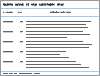
Tab.1
Domestic and international airborne hyperspectral imaging technologies and their applications
| 国家 | 高光谱成像传感器 | 应用 | |
|---|---|---|---|
| 国外 | 美国 | AIS | 获取美国一些地质目标上和各地的植被上的数据 |
| 美国 | AVIRIS | 在美国各地进行广泛的数据收集,以支持NASA的数据评估和技术评估计划 | |
| 加拿大 | CASI | 具有辐射精度较高的初始校准程序 | |
| 澳大利亚 | HyMap | 用于商业探测 | |
| 德国 | HySpex | 适合用于基准参考测量和对地观测应用的可行性研究 | |
| 国内 | MAIS | 地质和环境调查 | |
| OMIS | 安装了高质量的差分GPS,定位精度优于10 m | ||
| PHI | 植被生长状态、湿地生态环境调查,地物精细光谱分析,环境监测和城市规划 | ||
Tab.2
Domestic and international satellite-based hyperspectral imaging technologies and their applications
| 国家 | 高光谱成像传感器 | 应用 |
|---|---|---|
| 美国 | MightSat-II.1/FTHSI | 用于地形分类 |
| 美国 | EO-1/Hyperion | 可以实现精确的农作物估产、地质填图、精确制图,应用于采矿、地质、森林、农业以及环境保护领域 |
| 欧洲 | PROBA/CHRIS | 研究植被BRDF现象 |
| 欧洲 | Envisat-1/ MERIS | 主要对水色进行观测,促进了海洋生物学和海洋水色的遥感观测 |
| 美国 | MRO/CRISM | 研究地表矿物成分、绘制关键区域的矿物以及测量大气的空间和季节性变化等 |
| 美国 | HICO | 研究沿海海洋和河口、河流或其他浅水区域 |
| 印度 | Cartosat 2E/HRMX | 用于自然资源普查、灾害管理、地面形态以及农作物、植被等探测 |
| 德国 | EnMAP | 促进空间成像光谱产品的普及,并提供有关不同生态系统状况的信息 |
| 美国 | HyspIRI | 研究世界生态系统,并提供有关火山、野火和干旱等自然灾害的重要信息 |
| 俄罗斯 | Resurs-P1/P2/P3/P4/P5 | 应用于农业、渔业、气象、交通、紧急情况、自然资源和国防等方面 |
| 中国 | 神舟三号/CMODIS | 研究海洋、陆地和大气,它对地球进行了连续的遥感观测 |
| 嫦娥一号 | 分析月球表面矿物的化学成分 | |
| FY-3A/B/C卫星/MERSI-I | 实现植被,生态,土地覆盖分类和积雪覆盖的全球地表特征 | |
| FY-3D/MERSI-II | 结合了MERSI-I和VIRR的功能 | |
| FY-3E/MERSI-LL | 首次具备了夜间可见光波段观测的能力 | |
| FY-3F/MERSI-III | 提高了定标精度、观测灵敏度和使用寿命 | |
| FY-3G/MERSI-RM | 精确的云和降水观测 | |
| HJ-1A | 动态监测生态环境变化,有利于开展大气成分监测、水环境监测和植被生长监测等定量研究 | |
| 天宫一号 | 用于森林防火、石油和天然气勘探、水文生态监测和地质调查 | |
| SPARK | 应用于农业预测、病虫害监测、环境保护和灾害监测 | |
| 高分五号 | 能够实现对陆地和大气的全面观测 | |
| 珠海一号 | 应用于农业、林业、生态环境、自然资源等领域 | |
| 资源一号02 D卫星 | 应用于自然资源调查和监测 | |
| 天问一号 | 对火星的表面形貌、土壤特性、物质成分、水冰、大气、电离层、磁场等的科学探测 | |
| 高分五号01A | 主要应用于环境污染监测、环境质量监管、大气成分监测、自然资源调查、气候变化研究等 |
Tab.3
Characterization of vegetation chlorophyll inversion methods
| 反演方法 | 模型名称 | 优点 | 缺点 | 参考文献 |
|---|---|---|---|---|
| 光谱植被指数构建法 | 计算比较简单,速度较快 | 对不同植被及其不同生育期内植被指数的适用性不同,进而影响反演精度 | [ | |
| 高光谱红边位置参数法 | 对叶绿素含量非常敏感,能够捕捉到植物叶片中叶绿素变化的微小差异 | 红边位置的提取相对复杂,对光谱数据的质量要求较高,通常需要更高光谱分辨率,不适用于低分辨率的遥感数据 | [ | |
| 偏最小二乘回归 | 计算量小,处理数据速度快 | 容易受到观测噪声的影响,且在时间和空间维度上受到限制,适用于对模型精度要求不高 | [ | |
| 支持向量机回归 | 适合解决小样本的问题;能将多目标问题转化为单目标问题 | 不适合处理大规模数据集,计算时间较长 | [ | |
| 机器学习算法 | 随机森林 | 对数据噪声和异常值有较好的稳定性;能够评估各特征对模型的重要性 | 由于模型的复杂性,解释性差 | [ |
| BP神经网络 | 有很强的非线性转化能力 | 当训练集和验证集和特征空间的差异较小时,容易出现拟合问题 | [ | |
| 梯度提升回归树 | 有较强的特征选择的能力,能够实现降维;泛化能力较强 | 对参数设置敏感,因此要选择合适的参数,否则影响模型精度 | [ |
Tab.4
Commonly used spectral vegetation indices
| 指数类型 | 光谱植被指数 | 计算公式 | 参考文献 | |
|---|---|---|---|---|
| 差值光谱指数 | 差值植被指数(Difference Vegetation Index,DVI) | R810-R680 | [ | |
| 反射率差(Reflectance Difference1,RD1) | R800-R680 | [ | ||
| 反射率差(Reflectance Difference2,RD2) | R705/R505 | [ | ||
| 比值光谱指数 | 比值植被指数(Ratio Vegetation Index,RVI) | R810/R680 | [ | |
| 色素比值指数(Pigment Specific Simple Ratio Index,PSSR) | PSSRa=R800/R675 | [ | ||
| PSSRb=R800/R650 | [ | |||
| 归一化光谱指数 | 归一化植被指数(Normalized Difference Vegetation Index,NDVI) | (R810-R680)/(R810+R680) | [ | |
| 光化学植被指数(Photochemical Reflectance Index,PRI) | (R531-R570)/(R531+R570) | [ | ||
| 绿色归一化光谱指数(Green Normalized Difference Vegetation Index,GNDVI) | (R750-R550)/(R750+R550) | [ | ||
| 优化土壤调节植被指数(Optimized Soil Adjusted Vegetation Index,OSAVI) | (RNIR-R)/(RNIR+R+0.16) | [ | ||
| 多波段光谱指数 | 草地叶绿素指数(Grassland Chlorophyll Index,GCI) | (R780-R735)/(R715-R670) | [ | |
| MERIS陆地叶绿素指数(MERIS Terrestrial Chlorophyll Index,MTCI) | (R753.75-R708.75)/(R708.75-R681.25) | [ | ||
| 修正叶绿素吸收反射率指数(Modified Chlorophyll Absorption Ratio Index,MCARI) | [(R700-R670)-0.2(R700-R550)]× (R700/R670) | [ | ||
Tab.5
Red edge position extraction method
| 红边位置提取方法 | 算法 | 参考文献 |
|---|---|---|
| 拉格朗日插值 | A= C= REP= | [ |
| 线性插值 | (1)Rre=(R670+R780)/2 (2)λre=700+40[(Rre-R700)/(R740)-R700)] | [ |
| 最大一阶导数 | Dλ(i)=(Rλ(j+1)-Rλ(j))/△λ | [ |
| 倒高斯模型 | Rλ=(Rs-R0)exp- | [ |
| 线性外推法 | REP=-(c1-c2)/(m1-m2) | [ |
| 多项式拟合法 | ρ=a0+ | [ |
| [1] | 冯伟, 朱艳, 田永超, 等. 基于高光谱遥感的小麦冠层叶片色素密度监测[J]. 生态学报, 2008(10):4902-4911. |
| [2] | 章曼, 常庆瑞, 张晓华, 等. 不同施肥条件下水稻冠层光谱特征与叶绿素含量的相关性[J]. 西北农业学报, 2015, 24(11):49-56. |
| [3] | 李云梅, 倪绍祥, 王秀珍. 线性回归模型估算水稻叶片叶绿素含量的适宜性分析[J]. 遥感学报, 2003(5):364-371. |
| [4] | OSCO L P, RAMOS A P M, MORIYAÉ A S, et al. Modeling hyperspectral response of water-stress induced lettuce plants using artificial neural networks[J]. Remote Sensing, 2019, 11(23):2797. |
| [5] | 刘银年. 高光谱成像遥感载荷技术的现状与发展[J]. 遥感学报, 2021, 25(1):439-459. |
| [6] | 赵恒谦, 李美钰, 吴艳花, 等. 基于PROSAIL模型和Sentinel-2数据的陕北煤炭矿区植被叶绿素含量监测[J]. 地理与地理信息科学, 2024, 40(2):29-36. |
| [7] |
LU Bing, HE Yuhong, DAO Phuong D. Comparing the performance of multispectral and hyperspectral images for estimating vegetation properties[J]. IEEE Journal of Selected Topics in Applied Earth Observations and Remote Sensing, 2019, 12(6):1784-1797.
doi: 10.1109/JSTARS.2019.2910558 |
| [8] | BAATH G S, FLYNN K C, GOWDA P H, et al. Detecting biophysical characteristics and nitrogen status of finger millet at hyperspectral and multispectral resolutions[J]. Frontiers in Agronomy, 2021,2:604598. |
| [9] | VANE G, GOETZ A F H, WELLMAN J B. Airborne imaging spectrometer:A new tool for remote sensing[J]. IEEE Transactions on Geoscience and Remote Sensing, 1984,(6):546-549. |
| [10] | VANE G. First results from the airborne visible/infrared imaging spectrometer(AVIRIS)[C]// Imaging spectroscopy II.SPIE, 1987,834:166-175. |
| [11] | VANE G, GREEN R O, CHRIEN T G, et al. The airborne visible/infrared imaging spectrometer(AVIRIS)[J]. Remote Sensing of Environment, 1993, 44(2):127-143. |
| [12] | 束炯, 王强, 孙娟. 高光谱遥感的应用研究[J]. 华东师范大学学报(自然科学版), 2006(4):1-10. |
| [13] | BABEY S K, SOFFER R J. Radiometric calibration of the compact airborne spectrographic imager(CASI)[J]. Canadian Journal of Remote Sensing, 2014, 18(4):233-242. |
| [14] | KRUSE F A, BOARDMAN J W, LEFKOFF A B, et al. 1999 AIG/HyVista HyMap group shoot:Commercial hyperspectral sensing is here[C]// Algorithms for Multispectral,Hyperspectral,and Ultraspectral Imagery VI.SPIE, 2000,4049:210-217. |
| [15] | TONG Qingxi, XUE Yongqi, ZHANG Lifu. Progress in hyperspectral remote sensing science and technology in China over the past three decades[J]. IEEE Journal of Selected Topics in Applied Earth Observations and Remote Sensing, 2013, 7(1):70-90. |
| [16] | YARBROUGH S, CAUDILL T R, KOUBA E T, et al. MightySat II.hyperspectral imager:Summary of on-orbit performance[C]// Imaging Spectrometry VII.SPIE, 2002,4480:186-197. |
| [17] | PEARLMAN J S, BARRY P S, SEGAL C C, et al. Hyperion,a space-based imaging spectrometer[J]. IEEE Transactions on Geoscience and Remote Sensing, 2003, 41(6):1160-1173. |
| [18] | FLETCHER P F. Image acquisition planning for the CHRIS sensor onboard PROBA[C]// Imaging spectrometry X.SPIE, 2004,5546:141-148. |
| [19] | RAST M, BEZY J L, BRUZZI S. The ESA medium resolution imaging spectrometer MERIS a review of the instrument and its mission[J]. International Journal of Remote Sensing, 1999, 20(9):1681-1702. |
| [20] | MURCHIE S, ARVIDSON R, BEDINI P, et al. Compact reconnaissance imaging spectrometer for Mars(CRISM)on Mars reconnaissance orbiter(MRO)[J]. Journal of Geophysical Research:Planets, 2007, 112(E5):1-57. |
| [21] | LUCKE R L, CORSON M, MCGLOTHLIN N R, et al. Hyperspectral Imager for the Coastal Ocean:Instrument description and first images[J]. Applied Optics, 2011, 50(11):1501-1516. |
| [22] | CHO H J, OGASHAWARA I, MISHRA D, et al. Evaluating Hyperspectral Imager for the Coastal Ocean(HICO)data for seagrass mapping in Indian River Lagoon,FL[J]. GIScience& Remote Sensing, 2014, 51(2):120-138. |
| [23] | KREBS, GUNTER D. Resurs-P 1,2,3(47KS)[EB/OL].(2024-04-10)[2024-08-22]. https://space.skyrocket.de/doc_sdat/resurs-p.htm |
| [24] | THE CEOS DATABASE. CEOS EO:Handbook-Instrument Index[EB/OL].(2023-10-01)[2024-06-07]. http://database.eohandbook.com/database/instrumentindex.aspx#H |
| [25] | STORCH T, HONOLD H P, CHABRILLAT S, et al. The EnMAP imaging spectroscopy mission towards operations[J]. Remote Sensing of Environment, 2023,294:113632. |
| [26] | CHIEN S, SILVERMAN D, DAVIES A G, et al. Onboard science processing concepts for the HyspIRI mission[J]. IEEE Intelligent Systems, 2009, 24(6):12-19. |
| [27] | NASA Airborne Science Program. Hyperspectral infrared imager(HyspIRI) airborne campaign[EB/OL].(2020-01-21)[2024-06-07]. https://airbornescience.nasa.gov/content/Hyperspectral_Infrared_Imager_HyspIRI_Airborne_Campaign |
| [28] | KREBS, GUNTER D. Resurs-P 4,5(47KS)[EB/OL].(2024-04-10)[2024-08-22]. https://space.skyrocket.de/doc_sdat/resurs-p4.htm |
| [29] | CHEN Jinsong, SHAO Yun, GUO Hundong, et al. Destriping CMODIS data by power filtering[J]. IEEE Transactions on Geoscience and Remote Sensing, 2003, 41(9):2119-2124. |
| [30] | 赵葆常, 杨建峰, 常凌颖, 等. “嫦娥一号”卫星成像光谱仪光学系统设计与在轨评估[J]. 光子学报, 2009, 38(3):479-483. |
| [31] | National Satellite Meteorological Center. Feng Yun series satellites[EB/OL].(2013-01-18)[2024-06-20]. https://www.nsmc.org.cn/nsmc/en/satelli-te/index.html |
| [32] | WANG Qiao, WU Chuanqing, LI Qing, et al. Chinese HJ-1A/B satellites and data characteristics[J]. Science China Earth Sciences, 2010,53:51-57. |
| [33] | LIAO Chunhua, ZHANG Xianfeng, BAO Huiyi. Estimation of fractional vegetation cover by unmixing HJ-1 satellite hyperspectral data[C]// 2012 Second International Workshop on Earth Observation and Remote Sensing Applications.IEEE, 2012,278-281. |
| [34] | 覃帮勇, 刘志文, 李盛阳. 天宫一号高光谱数据的陆地应用[J]. 载人航天, 2018, 24(4):546-552. |
| [35] |
ZHONG Yanfei, WANG Xinyu, WANG Shaoyue, et al. Advances in spaceborne hyperspectral remote sensing in China[J]. Geo-spatial Information Science, 2021, 24(1):95-120.
doi: 10.1080/10095020.2020.1860653 |
| [36] | 杜润凤, 王霄鹏, 张佳华, 等. 高分五号卫星高光谱遥感分类方法研究综述[J]. 青岛大学学报(工程技术版), 2023, 38(4):83-93. |
| [37] | 张立福, 王飒, 颜军, 等. 珠海一号高光谱数据辐射质量评价[J]. 遥感学报, 2023, 27(8):1925-1935. |
| [38] | 李先怡, 颜军, 颜志宇, 等. 珠海一号卫星及其综合应用[J]. 卫星应用, 2022(7):25-30. |
| [39] | 生态环境部卫星环境应用中心. 高光谱综合观测卫星(GF5-01A)在轨投入使用[EB/OL].(2024-01-25)[2024-08-23]. http://www.se-cmep.cn/gzdt/kjgz/202401/t20240125_1064661.shtml |
| [40] |
阿热孜古力·肉孜, 买买提·沙吾提, 何旭刚, 等. 基于多植被指数组合的棉花叶片叶绿素含量估算[J]. 干旱区研究, 2023, 40(11):1865-1874.
doi: 10.13866/j.azr.2023.11.16 |
| [41] | 唐彧哲, 晋永芬, 吴凌波, 等. 红边位置估测玉米叶片叶绿素含量算法的比较[J]. 玉米科学, 2024, 32(4):46-54. |
| [42] |
依尔夏提·阿不来提, 买买提·沙吾提, 白灯莎·买买提艾力, 等. 基于随机森林法的棉花叶片叶绿素含量估算[J]. 作物学报, 2019, 45(1):81-90.
doi: 10.3724/SP.J.1006.2019.84058 |
| [43] | REN Kehui, DONG Yingying, HUANG Wenjing, et al. Monitoring of winter wheat stripe rust by collaborating canopy SIF with wavelet energy coefficients[J]. Computers and electronics in agriculture, 2023,215:108366. |
| [44] | ZHANG Teng, HUANG Mutao, WANG Zhongjing. Estimation of chlorophyll-a concentration of lakes based on SVM algorithm and Landsat 8 OLI images[J]. Environmental Science and Pollution Research, 2020,27:14977-14990. |
| [45] | 王震, 李映雪, 吴芳, 等. 冠层光谱红边参数结合随机森林机器学习估算冬小麦叶绿素含量[J]. 农业工程学报, 2024, 40(4):166-176. |
| [46] |
郭云开, 许敏, 张晓炯, 等. 结合PRO-4SAIL和BP神经网络的叶绿素含量高光谱反演[J]. 测绘通报, 2020(3):21-24.
doi: 10.13474/j.cnki.11-2246.2020.0071 |
| [47] | 王天丽. 基于高光谱和机器学习的作物叶片氮素与叶绿素含量反演研究[D]. 长春: 吉林大学, 2023. |
| [48] | JORDAN C F. Derivation of leaf-area index from quality of light on the forest floor[J]. Ecology, 1969, 50(4):663-666. |
| [49] | YU Kang, LENZ-WIEDEMANN V, CHEN Xinping, et al. Estimating leaf chlorophyll of barley at different growth stages using spectral indices to reduce soil background and canopy structure effects[J]. ISPRS Journal of Photogrammetry and Remote Sensing, 2014,97:58-77. |
| [50] | PERSON R L, MILLER L D. Remote mapping of standing crop biomass for estimation of the productivity of the short grass prairie[J]. Remote Sensing of Environment, 1972,1357-1381. |
| [51] | BLACKBURN G A. Quantifying chlorophylls and caroteniods at leaf and canopy scales:An evaluation of some hyperspectral approaches[J]. Remote Sensing of Environment, 1998, 66(3):273-285. |
| [52] | ROUSE Jr J W, HAAS R H, DEERING D W, et al. Monitoring the vernal advancement and retrogradation green wave effect of natural vegetation[R]. Greenbelt: Goddard Space Flight Center,1973:1-69. |
| [53] | 王家强, 伍维模, 李志军, 等. 基于高光谱指数的天然胡杨叶绿素遥感建模研究[J]. 干旱区资源与环境, 2014, 28(10):95-99. |
| [54] | GITELSON A A, KAUFMAN Y J, MERZLVAK M N. Use of a green channel in remote sensing of global vegetation from EOS-MODIS[J]. Remote Sensing of Environment, 1996, 58(3):289-298. |
| [55] | RONDEAUX G, STEVEN M, BARET F. Optimization of soil-adjusted vegetation indices[J]. Remote Sensing of Environment, 1996, 55(2):95-107. |
| [56] | 肖汉, 陈秀万, 杨振宇, 等. 基于光谱分析的草地叶绿素含量估测植被指数[J]. 光谱学与光谱分析, 2014, 34(11):3075-3078. |
| [57] | DASH J, CURRAN P. Evaluation of the MERIS terrestrial chlorophyll index(MTCI)[J]. Advances in Space Research, 2006, 39(1):100-104. |
| [58] | DAUGHTRY C S, WALTHALL C L, KIM M S, et al. Estimating corn leaf chlorophyll concentration from leaf and canopy reflectance[J]. Remote Sensing of Environment, 2000, 74(2):229-239. |
| [59] | 姚付启, 张振华, 杨润亚, 等. 基于主成分分析和BP神经网络的法国梧桐叶绿素含量高光谱反演研究[J]. 测绘科学, 2010, 35(1):109-112. |
| [60] | 张东彦, 刘镕源, 宋晓宇, 等. 应用近地成像高光谱估算玉米叶绿素含量[J]. 光谱学与光谱分析, 2011, 31(3):771-775. |
| [61] | QI Haixia, ZHU Bingyu, KONG Lingxi, et al. Hyperspectral inversion model of chlorophyll content in peanut leaves[J]. Applied sciences, 2020, 10(7):2259. |
| [62] | 张思楠, 王权, 靳佳, 等. 应用光谱指数法估算多枝柽柳同化枝叶绿素含量[J]. 干旱区研究, 2016, 33(5):1088-1097. |
| [63] | 曹晓明, 冯益明, 史建康, 等. 运用实测高光谱数据对梭梭同化枝叶绿素的估算[J]. 东北林业大学学报, 2020, 48(1):56-61. |
| [64] | 王敬湧, 张明珍, 凌华荣, 等. 干旱胁迫下玉米叶片叶绿素含量与含水量高光谱成像反演方法[J]. 智慧农业(中英文), 2023, 5(3):142-153. |
| [65] | 茹克亚·萨吾提, 阿不都艾尼·阿不里, 尼加提·卡斯木, 等. 基于分数阶微分的春小麦叶绿素含量高光谱估算[J]. 麦类作物学报, 2019, 39(6):738-746. |
| [66] | 姚付启, 张振华, 杨润亚, 等. 基于高光谱曲线峰度、偏度的植被叶绿素含量反演模型研究[J]. 测绘科学, 2009, 34(5):32-35. |
| [67] | 高兴, 李斐, 杨海波, 等. 基于红边位置的马铃薯植株氮浓度估测方法研究[J]. 植物营养与肥料学报, 2019, 25(2):296-310. |
| [68] | 曹英丽, 江凯伦, 刘亚帝, 等. 基于高光谱红边位置提取的水稻叶绿素反演研究[J]. 沈阳农业大学学报, 2021, 52(6):718-728. |
| [69] | 张佳伟, 王仲林, 谭先明, 等. 利用不同红边位置算法估测玉米叶绿素含量[J]. 浙江大学学报(农业与生命科学版), 2021, 47(4):464-472. |
| [70] | DAWSON T P, CURRAN P J. Technical note A new technique for interpolating the reflectance red edge position[J]. International Journal of Remote Sensing, 1998, 19(11):2133-2139. |
| [71] | CLEVERS W P G J, JONG D M S, EPEMA F G, et al. Derivation of the red edge index using the MERIS standard band setting[J]. International Journal of Remote Sensing, 2002, 23(16):3169-3184. |
| [72] | HORLER D N H, DOCKRAY M, BARBER J. The red edge of plant leaf reflectance[J]. International Journal of Remote Sensing, 1983, 4(2):273-288. |
| [73] | BONHAM-CARTER G F. Numerical procedures and computer program for fitting an inverted Gaussian model to vegetation reflectance data[J]. Computers and Geosciences, 1988, 14(3):339-356. |
| [74] | CHO A M, SKIDMORE K A. A new technique for extracting the red edge position from hyperspectral data:The linear extrapolation method[J]. Remote Sensing of Environment, 2006, 101(2):181-193. |
| [75] | PU R, GONG P, BIGING S G, et al. Extraction of red edge optical parameters from Hyperion data for estimation of forest leaf area index[J]. IEEE Transactions on Geoscience and Remote Sensing, 2003, 41(4):916-921. |
| [76] | 李向阳, 刘国顺, 史舟, 等. 利用室内光谱红边参数估测烤烟叶片成熟度[J]. 遥感学报, 2007(2):269-275. |
| [77] | CLEVERS J G P W, KOOISTRA L. Using hyperspectral remote sensing data for retrieving canopy chlorophyll and nitrogen content[J]. IEEE Journal of Selected Topics in Applied Earth Observations and Remote Sensing, 2011, 5(2):574-583. |
| [78] | ZHANG Aiwu, YIN Shengnan, WANG Juan, et al. Grassland chlorophyll content estimation from drone hyperspectral images combined with fractional-order derivative[J]. Remote Sensing, 2023, 15(23):5623. |
| [79] | 杨峰, 张勇, 谌俊旭, 等. 高光谱数据预处理对大豆叶绿素密度反演的作用[J]. 遥感信息, 2017, 32(4):64-69. |
| [80] | SHEN Lanzhi, GAO Maofang, YAN Jingwen, et al. Winter wheat SPAD value inversion based on multiple pretreatment methods[J]. Remote Sensing, 2022, 14(18):4660. |
| [81] | 尼加提·卡斯木, 师庆东, 王敬哲, 等. 基于高光谱特征和偏最小二乘法的春小麦叶绿素含量估算[J]. 农业工程学报, 2017, 33(22):208-216. |
| [82] | 李莉婕, 岳延滨, 王延仓, 等. 高光谱定量反演火龙果茎枝叶绿素含量的研究[J]. 光谱学与光谱分析, 2021, 41(11):3538-3544. |
| [83] | 张卓然, 常庆瑞, 张廷龙, 等. 基于支持向量机的棉花冠层叶片叶绿素含量高光谱遥感估算[J]. 西北农林科技大学学报(自然科学版), 2018, 46(11):39-45. |
| [84] | 谭林, 何秉宇, 刘卫国, 等. 基于优化SVR高光谱指数的独尾草叶绿素含量估算[J]. 生态学杂志, 2017, 36(2):555-562. |
| [85] | BHADRA S, SAGAN V, MAIMAITIJIANG M, et al. Quantifying leaf chlorophyll concentration of sorghum from hyperspectral data using derivative calculus and machine learning[J]. Remote Sensing, 2020, 12(13):2082. |
| [86] | 王丽爱, 马昌, 周旭东, 等. 基于随机森林回归算法的小麦叶片SPAD值遥感估算[J]. 农业机械学报, 2015, 46(1):259-265. |
| [87] | XU Miaomiao, DAI Jianguo, ZHANG Guoshun, et al. Inversion of glycyrrhiza chlorophyll content based on hyperspectral imagery[J]. Agronomy, 2024, 14(6):1163. |
| [88] | LIU Nan, LI Fei, YANG Haibo, et al. Machine learning models fed with optimized spectral indices to improve inversion accuracy of potato chlorophyll content[J]. Journal of Plant Nutrition and Fertilizers, 2023, 29(8):1531-1542. |
| [89] | 余蛟洋, 常庆瑞, 由明明, 等. 基于高光谱和BP神经网络模型苹果叶片SPAD值遥感估算[J]. 西北林学院学报, 2018, 33(2):156-165. |
| [90] | LIU Meiling, LIU Xiangnan, LI Mi, et al. Neural-network model for estimating leaf chlorophyll concentration in rice under stress from heavy metals using four spectral indices[J]. Biosystems Engineering, 2010, 106(3):223-233. |
| [91] | WANG Tianli, GAO Maofang, CAO Chunling, et al. Winter wheat chlorophyll content retrieval based on machine learning using in situ hyperspectral data[J]. Computers and Electronics in Agriculture, 2022,193:106728. |
| [92] | AN Gangqiang, XING Minfeng, HE Binbin, et al. Using machine learning for estimating rice chlorophyll content from in situ hyperspectral data[J]. Remote Sensing, 2020, 12(18):3104. |
| [93] | LIAN Suyun, GUAN Lixin, PENG Zhongzhen, et al. Retrieval of leaf chlorophyll content in Gannan navel orange based on fusing hyperspectral vegetation indices using machine learning algorithms[J]. Ciência Rural, 2022, 53(3):e20210630. |
| [94] | SHI Hongzhao, GUO Jinjin, AN Jiaqi, et al. Estimation of chlorophyll content in soybean crop at different growth stages based on optimal spectral index[J]. Agronomy, 2023, 13(3):663. |
| [95] | 姚阔, 郭旭东, 南颖, 等. 植被生物量高光谱遥感监测研究进展[J]. 测绘科学, 2016, 41(8):48-53. |
| [96] | ARAÚJO M C U, SALDANHA T C B, GALVAO R K H, et al. The successive projections algorithm for variable selection in spectroscopic multicomponent analysis[J]. Chemometrics and intelligent laboratory systems, 2001, 57(2):65-73. |
| [97] | GAO Dehua, LI Minzan, ZHANG Junyi, et al. Improvement of chlorophyll content estimation on maize leaf by vein removal in hyperspectral image[J]. Computers and electronics in agriculture, 2021,184:106077. |
| [1] | LIU Gao, XIE Zeqi, ZHOU Jianhao, LIAO Lipeng. Forest above ground biomass inversion using machine learning and sentinel data [J]. Forest and Grassland Resources Research, 2025, 0(4): 101-111. |
| [2] | REN Xiaoqi, HOU Peng, CHEN Yan. Advances in Remote Sensing Retrieval of Forest Aboveground Biomass [J]. Forest and Grassland Resources Research, 2023, 0(6): 146-158. |
| [3] | JU Wenzhen, WEI Longbin, PENG Bolin, LI Changcheng, PAN Ting. Study on Driving Factors and Prediction Model of Forest Fire in Guangxi [J]. Forest and Grassland Resources Research, 2023, 0(5): 56-62. |
| [4] | LONG Fei, YUE Cairong, JIN Jing, LI Chungan, LUO Hongbin, XU Wanting. Study on the Inversion of Basal Area from Airborne LiDAR Data [J]. FOREST RESOURCES WANAGEMENT, 2021, 0(5): 62-69. |
| [5] | HAN Rui, WU Dasheng, FANG Luming, HUANG Yuling. Estimation of Forest Reserves Based on Boruta and Extra-trees Methods [J]. FOREST RESOURCES WANAGEMENT, 2020, 0(4): 127-133. |
| Viewed | ||||||
|
Full text |
|
|||||
|
Abstract |
|
|||||
